




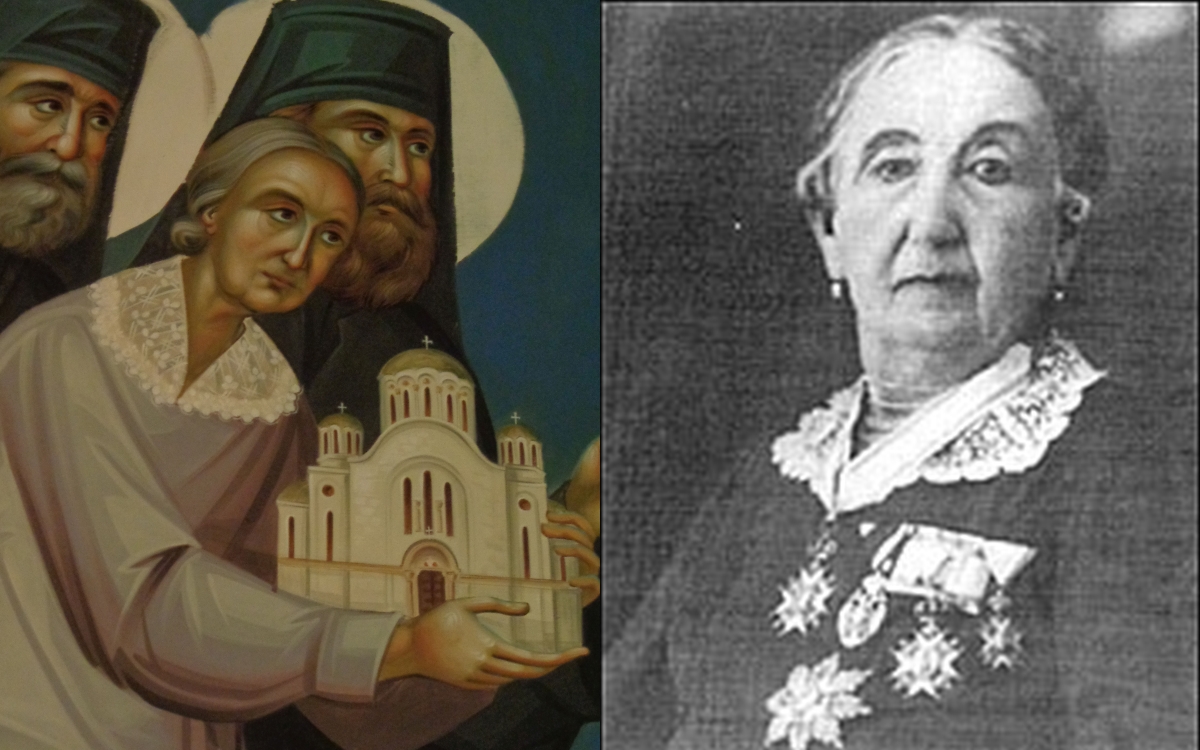
Many have contributed to Belgrade’s history, often giving everything they had to the city and its people. However, no one in the history of the Serbian capital has been so unjustly overlooked as Persida Milenković.
Persida was born on March 3, 1857, in Šabac, into the civil servant family of Nikodije Ćirić. Although not a native of Belgrade, she arrived in the capital when her father secured a position at the Ministry of Construction.
Little is known about Persida’s youth. It is certain that she married very young, as by the age of 25, she was already a widow. From her first marriage, she had a son, Vojislav, but unfortunately, he passed away shortly after, leaving Persida alone.

She remarried in 1883 to Belgrade merchant, landlord, and philanthropist Rista Milenković. At 26 years old, she was ready to seek happiness once again.
Rista was a very wealthy man. He owned numerous houses and commercial properties across the capital, which he rented out. The couple had a harmonious marriage, and alongside him, Persida began engaging in charitable work.
She helped impoverished students, donated to schools, and visited orphanages. Together with her husband, she funded the construction of an elementary school building on Kraljice Natalije Street, which today houses the Mathematical Gymnasium, as well as a building at 5 Zmaj Jovina Street for the University of Belgrade.
Belgraders remembered her as a tall, upright, and dignified lady who, even in her old age, was always impeccably dressed.
After becoming a widow for the second time, childless and alone once again, Persida fully devoted herself to helping others.

Although little is known about the details of her private life, what is well documented are her charitable acts. She was responsible for the construction of the Vavedenje Monastery in 1935, located in Senjak. The featured image on the left shows the fresco of her as the monastery’s benefactor.
According to legend, Persida repeatedly had the same dream in which a voice told her to build a church at the place “where Senjak descends into Topčider Park.” Besides this, she also built a church in Torlak.
Persida made significant contributions to women’s education and emancipation. She established a Women’s Teachers’ School, as well as an elementary school and training facility.
In Tabanovačka Street, in the Autokomanda district, she built a shelter for the poor in 1939. It was said to be a building with 16 hygienic apartments available to the city’s poorest residents. In addition, she provided funds to build an orphanage for abandoned children in the same area.
Already in her later years, in May 1937, Persida drafted a will ensuring that her vast fortune would remain with those who needed it most.
She founded the endowment “Fond Perse R. Milenković”, donating most of her properties to humanitarian organizations and educational institutions, including the Red Cross, the Circle of Serbian Sisters, and the University of Belgrade.
She also secured funding for the Vavedenje Monastery, leaving a savings account with 100,000 dinars, with a strict condition that only the interest could be used and solely for the maintenance of the church.
Beyond that, even household items from her residence were designated for the poor. Unfortunately, most of these were destroyed during the bombings of World War II.
Madam Persida lived at 8 Knez Mihailova Street. Tragically, her home was completely leveled during the bombing of April 6, 1941.
FIND OUT MORE IN ENGLISH:
Persa Milenković passed away in the midst of World War II, on February 8, 1943, in her villa on Topčider Hill, where she had moved after losing her home in the city center. She was 85 years old.
Her last wish—to be buried in her endowment, in the Vavedenje Monastery Church—was fulfilled. Known as a great benefactor even during her lifetime, she was laid to rest in the presence of high-ranking clergy as well as the leading officials of the occupied country—Minister of Education Velibor Jonić and Prime Minister General Milan Nedić.
Not far from the monastery she built, a street today bears the name Persida Milenković. However, aside from this, few other tributes exist in the capital to honor this remarkable Belgrader and great Serbian philanthropist.
MORE TOPICS:
TRANSFERRED BY THE SERBIAN ARMY: Twelve injured in the Kočani fire arrive in Belgrade for treatment!
LEST WE FORGET: The March pogrom in Kosovo was deadly for many Serbs, while thousands got expelled!
DUE TO THE UNPRECEDENTED TRAGEDY IN KOČANI: North Macedonia declares seven days of mourning!
Source: Istorijski Zabavnik, Foto: Wikimedia Creative Commons