



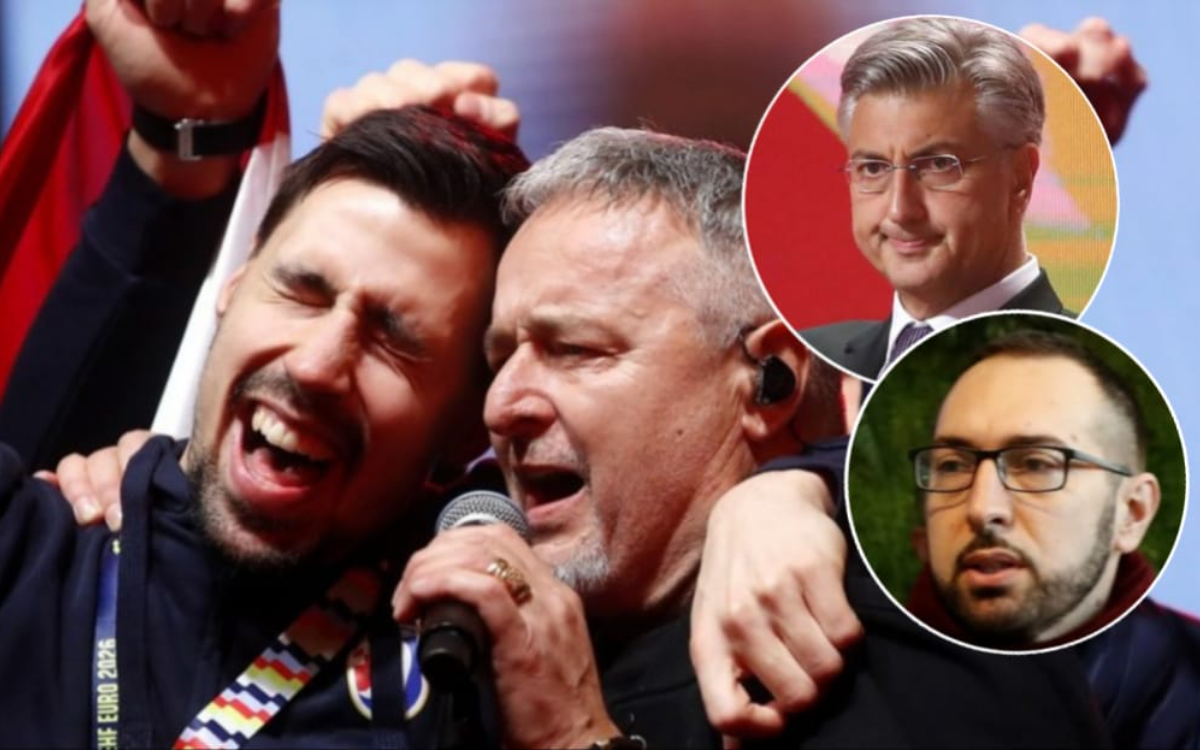
The welcome ceremony for the national handball team in Zagreb on the occasion of winning the bronze medal at the European Championship has escalated into a political conflict in Croatia. What should have been a celebration of sporting success turned into an open confrontation between the Government of Croatia and the city authorities in Zagreb, as well as a broader debate on the relationship toward the Ustasha legacy, the limits of state power, and respect for the Constitution.
The dispute broke out after the mayor of Zagreb, Tomislav Tomašević, refused to allow the performance of Marko Perković Thompson at Ban Jelačić Square, citing earlier decisions of the City Assembly and a ban on performers who have repeatedly used the Ustasha greeting “Za dom spremni” (For homeland ready).
The Croatian Handball Federation subsequently canceled the welcome ceremony organized by the City, explaining that the handball players insisted on Thompson’s performance. The Government soon intervened, deciding at a telephone session to take over the organization of the event and invite Thompson to perform.
State against the city
The Government’s decision to take over the organization of a mass public gathering without the consent of the City of Zagreb caused stormy reactions. Tomašević called the Government’s move a “state strike against the City of Zagreb” and a “violation of the Constitution,” claiming it was an unprecedented case of institutional violence against local self-government.
“If the Government consciously breaks the law, what message is it sending to citizens? That they don’t have to respect the rules either?” the mayor of Zagreb stated, warning that a dangerous precedent had been set. He announced legal steps, an appeal to the Constitutional Court, and even a referendum if the court does not react.
His claims were supported by the President of Croatia, Zoran Milanović, who assessed the Government’s decision as “unconstitutional, illegal, and piratical,” accusing Prime Minister Andrej Plenković of “conscious destruction of the constitutional order” and causing deep social divisions.
Ideological conflict and symbols
At the center of the dispute was Marko Perković Thompson, a singer who has been causing divisions in Croatian society for years. For some, a symbol of devotion to the homeland and patriotism; for others, an open promoter of Ustasha ideology, Thompson has become a political symbol of the conflict between the right wing gathered around the HDZ and the left-green city government led by the Možemo party.
At the welcome ceremony itself, Thompson performed several songs, but not “Čavoglave,” whose first verse begins with the Ustasha shout. Nevertheless, flags with the first white field flew across the Square, scarves with the inscription “Za dom spremni” were worn, while at the same time, a banner reading “United against fascism” was displayed on one building. The image of the divided Square became a symbol of a divided Croatia.
Former Prime Minister Jadranka Kosor assessed that such a political conflict is unprecedented in modern Croatian history, while the opposition accused the HDZ of using Thompson as a political tool ahead of local elections, especially in Zagreb, where that party has been unable to take power for years.
Plenković’s defense and political calculation
Prime Minister Andrej Plenković rejected the accusations of violating the Constitution, stating that the Government acted “in accordance with the law and common sense.” He accused the Zagreb authorities of ideological exclusivity and said that the Government did not want to allow an “abyss between the Croatian people, athletes, and patriotic singers.”
“If the City was not able to organize the welcome ceremony, the Government was obliged to do so,” Plenković said, clearly indicating that the state considers it has the right to intervene when it judges that “national interest” is at stake.
Such a stance, however, further deepened the concern of a part of the public and legal experts, who warn that this blurs the boundaries between state and local authorities.
The welcome ceremony for the handball players and the events surrounding it echoed outside of Croatia. The Ministry of Foreign Affairs of Serbia expressed concern over the display of symbols and messages associated with the ideology that led to mass crimes against Serbs, Jews, and Roma during World War II, calling for restraint and responsibility in public space.
In Croatia itself, the dispute opened a series of questions: can the Government bypass local self-government, where are the limits of state power, and is sport being consciously used as a means of political mobilization and ideological alignment.
MORE TOPICS:
HILARIOUS LESSON FROM PROFESSOR NIKOLA: See how Jović taught his Miami teammates Serbian! (VIDEO)
Source: Nova.rs, Photo: EPA / ANTONIO BAT