




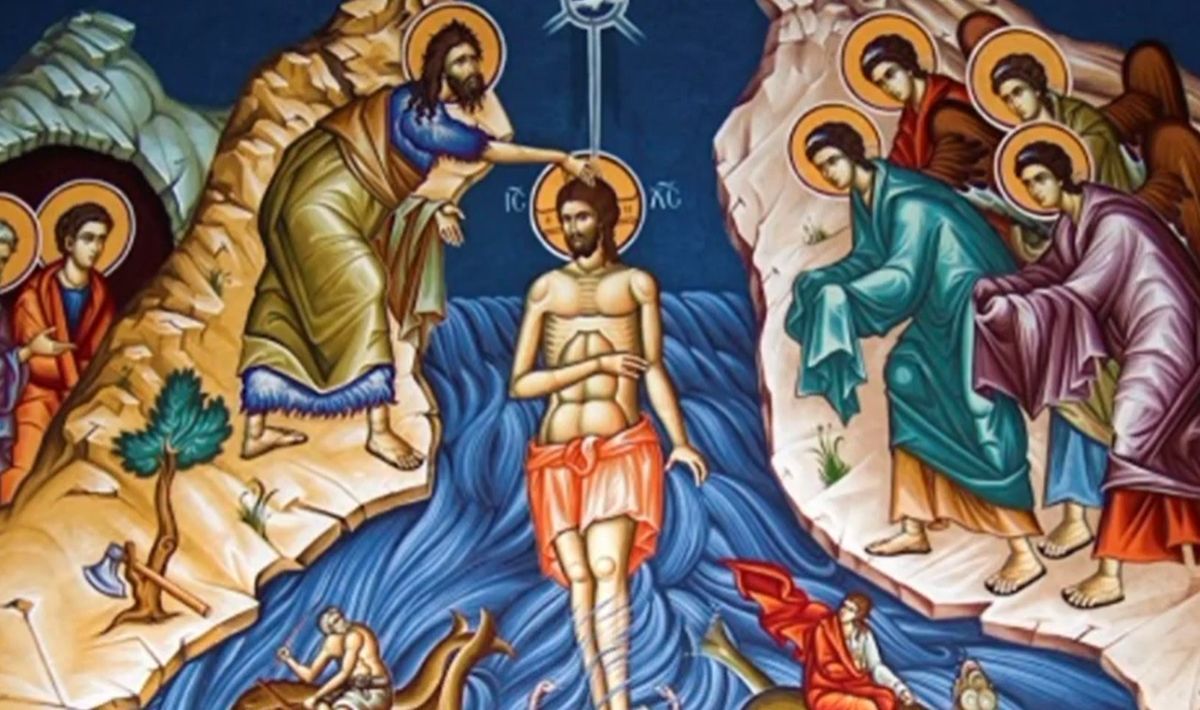
The Serbian Orthodox Church and the faithful today mark Krstovdan, a day of strict fasting celebrated on the eve of Epiphany. Many Orthodox Serbs also celebrate Krstovdan as their family patron saint day.
According to tradition, the first to accept the Christian faith and the first teachings of the new faith are mentioned as catechumens, or the announced, while in the Serbian Church and among the people the day of the baptism of the first Christians is known as Winter Krstovdan.
The holiday is linked to the celebration of Epiphany, the feast of the Baptism of Jesus Christ, as well as to the day dedicated to Saint John the Baptist, who baptized Him in the River Jordan. In fact, two events related to the Holy Cross are celebrated: the finding of the Holy Cross on Golgotha and its return from Persia to Jerusalem.
Winter Krstovdan precedes the next great feast, Epiphany, as well as the day after tomorrow’s Saint John – Jovanjdan, which are marked with red letters in the church calendar.
Folk customs
According to folk customs in some parts of Serbia, on Krstovdan one should wash all laundry and clean the house. Strict fasting is observed, the first time after Christmas, because until this day there was a dispensation due to the great feast. That is why the saying has remained among the Serbian people: “He who makes the sign of the cross fasts on Krstovdan.”
According to folk weather forecasting, whichever wind blows on Krstovdan will most often blow throughout the year. In Srem it was said that on this day the winds cross themselves (that is, they intersect, blow toward one another), and whichever prevails.
In the twelve days, beginning with Christmas and ending with Krstovdan, the twelve months of the coming year are reflected, so whatever the weather is like on a given day, it will be the same in the month that corresponds to that day in sequence.
On Krstovdan, according to chroniclers, leftovers of Christmas Eve beans were eaten and aspic was prepared. But since Krstovdan is a fasting day, these were eaten the next day, on Epiphany.
According to tradition, on the night of Epiphany the heavens open, and it is believed that every wish can be fulfilled. Exactly at midnight one should look at the sky and make a wish.
Winter Krstovdan is always celebrated on the eve of Epiphany and belongs to the fixed feasts. In the calendar of the Serbian Orthodox Church it is not marked with red letters, unlike Krstovdan celebrated on September 27, as a remembrance of the finding of the Holy Cross on which Christ was crucified on Golgotha. Krstovdan is marked as a remembrance of the first Christians – catechumens or the announced – who accepted the faith at the beginning of the spread of Christianity. As the first Christians were a sign of the global spread of the religion, so too Krstovdan, according to folk beliefs among Serbs, can give indications of what the year will be like.
In some regions there is a custom that on the eve of the feast a cross is placed in water and brought into the church. If the cross freezes, it is believed that the year will be fertile and healthy, and if it does not freeze it will be scarce and sickly. In Orthodox churches on Krstovdan the Liturgy of Saint John Chrysostom is served, along with the ritual of the great blessing of water, which accompanies the festive service. When Krstovdan falls on a weekday, royal hours are served in churches in the morning, and the liturgy in the afternoon. After the liturgy, the great blessing of water is performed in the church itself, while the next day, on the feast, the water is blessed outside the church, on rivers or other open places.
Krstovdan holy water
Krstovdan holy water is distributed to the faithful after the blessing of water and, according to custom, kept in homes for health. During the blessing of water, prayers are said that the water be for deliverance from sins, for healing and purification of soul and body, for the sanctification of heart and mind and for every excellent benefit, that it be a guide to eternal life and drive away every assault of visible and invisible enemies.
For the purpose for which it is blessed, it is sufficient to take it in a small bottle and keep it throughout the year, using it only on exceptional occasions. The faithful of the Serbian Orthodox Church celebrate Epiphany the next day, the feast of the baptism of Jesus Christ by which His mission and the preaching of the Christian faith began.
MORE TOPICS:
HILANDAR TURNED WHITE: Snow delighted Serbian monks after almost a decade! (PHOTO)
Source:Kurir
Foto: Printscreen / Youtube