





That Belgrade grew from a “Turkish township” into a European city in a short time and was considered one of the more beautiful capitals in this part of the world between the two world wars is largely thanks to this man. Although much of his work has been demolished, forgotten, and lost, what remains is still enough.
There are people who have indebted the entire Serbian people with the beauty of their artistic works. One such person was Aleksandar Bugarski, the most important architect of his time in Serbia and the man who designed some of the most beautiful buildings in Belgrade.
Bugarski was born in 1835 in Austria-Hungary (today’s Slovakia) into an engineering family. His father Jovan brought the family to Serbia in 1840, but after a change of dynasty had to move to Novi Sad, where Aleksandar most likely completed elementary school and high school.
He studied in Budapest, but returned to Serbia in 1867 where, as one of the first formally educated architects, he worked at the Ministry of Construction in Belgrade, the city in which he built the largest number of his structures.
It is also known that he was married, had a family, and died in 1891 in Belgrade. He was buried at the New Cemetery.
And that is all that is known about the life of Aleksandar Bugarski. Not a single photograph of him has been preserved to this day. It is not known what happened to his descendants. Even his grave no longer exists, as it was exhumed in 1920.
Still, if a man’s life is best spoken of by his works, then Bugarski has much to boast about.
The man who created refined Belgrade
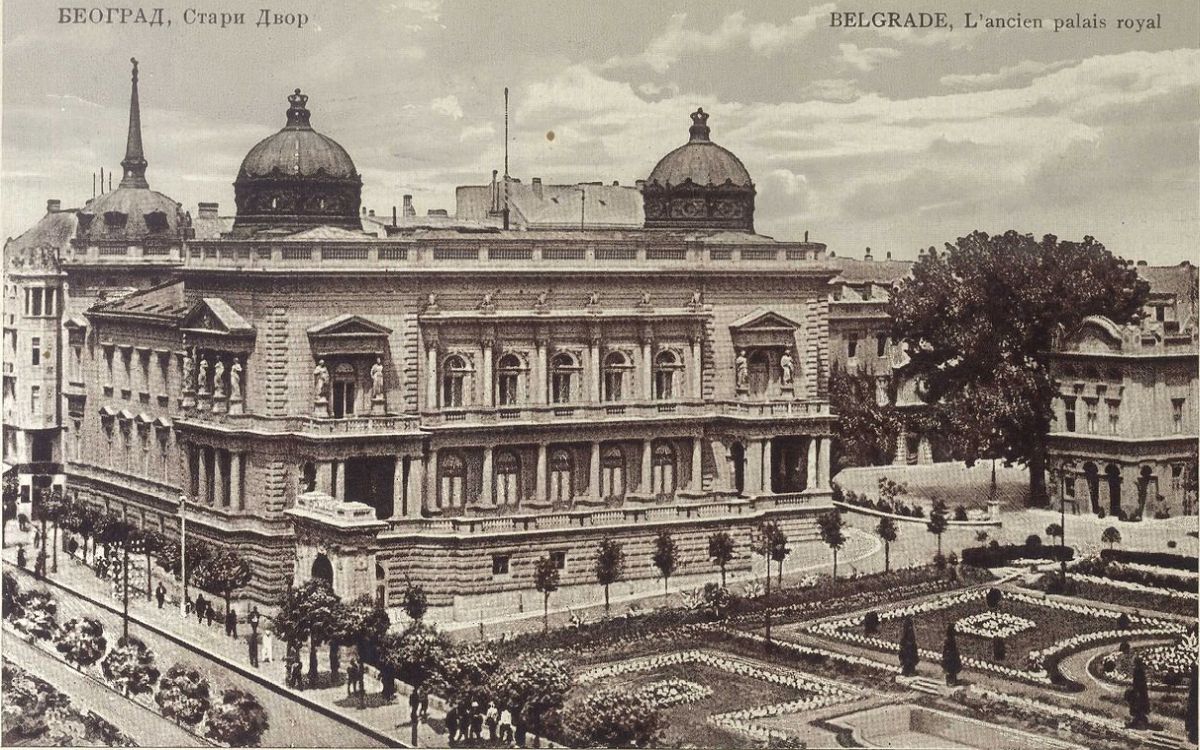
It can be said that Mr. Bugarski is the main “culprit” behind some of the most beautiful buildings of the Serbian capital. Among his works are the building of the National Theatre in Belgrade, the Old Palace (Belgrade City Assembly), the Red Cross Society building, the former Ministry of Education building (today better known as the Vuk Endowment House)…
The Old Palace, a building in the spirit of academism with decoration of ancient, Renaissance, and Baroque origin, Aleksandar Bugarski designed based on the ideas and instructions of King Milan Obrenović. The building was originally adorned with two large domes with gilded crowns on top, but it was heavily damaged in both world wars, so the present appearance of the Palace only partially resembles what Bugarski envisioned, although the original layout and form have essentially been preserved.
The National Theatre was originally supposed to be located at Zeleni Venac, but after that project failed, today’s Republic Square was chosen as the location. Bugarski conceived and designed the building as a representative structure whose overall appearance would resemble the famous Milan theatre La Scala. He devoted particular attention to shaping the façade facing the square.
The building was completed in 1869, and on October 30 of the same year the first performance, “The Memorial Service of Prince Mihailo,” was staged. To this day it has undergone several reconstructions and expansions, but it remains one of the most beautiful buildings in Belgrade.
Today’s Vuk Endowment House was built by judge Dimitrije Mita Golubović and initially served as the seat of the Russian Imperial Consulate, then as the Institute for Serbian War Orphans, and from 1879 it housed the Ministry of Education. The building at 2 Kralja Milana Street has been reconstructed several times, but it is still one of the oldest in that part of Belgrade. In 1988 it was granted to the Vuk Endowment for permanent use and management.
In addition to these most significant works, the rich oeuvre of Aleksandar Bugarski includes another 126 public and private buildings. Some are still known today, some no longer exist, and some have been altered beyond recognition.
In Knez Mihailova Street alone, he designed about ten houses for the most prominent Serbs of his time. Today fewer than half remain, but buildings at 14 Zeleni Venac, 24 Brankova Street, and others are still there. Aleksandar Bugarski also adorned Belgrade’s Cathedral Church.
It should also be noted that Aleksandar Bugarski built outside Belgrade as well. He designed churches in Loznica and Ritopek, the “Svetozar Marković” school in Novi Sad, the District Prefecture in Smederevo, as well as the Werthheim workers’ houses in Vienna.
MORE TOPICS:
HILANDAR TURNED WHITE: Snow delighted Serbian monks after almost a decade! (PHOTO)
Source:Istorijski Zabavnik Foto: Wikimedia Creative Commons