




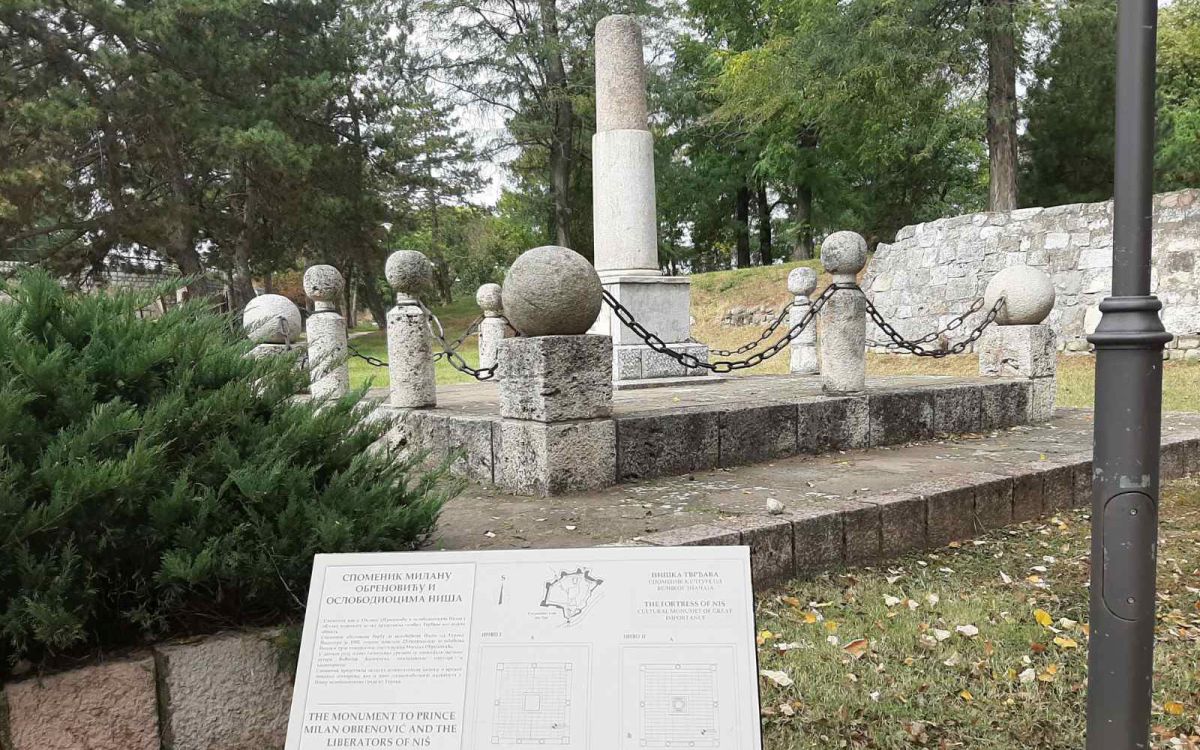
Every city, as a human settlement, has its stages of development. It usually begins as a place for establishing habitation, after which economic, transport, administrative, and other structures are formed around and within it.
These raise it on the ladder of civilizational development and enable its inhabitants to live better, more comfortably, and in harmony with civilizational achievements.
We will not list all the phases that Niš went through to reach the form, outlines, and status of a city in accordance with the norms and requirements that accompany them. We will focus on one stage that made it what it is, whose achievements have remained to this day. Only certain facts will be presented, as such a topic would require much more space, but even in this form it will provide a vivid picture of Niš during the reign of Milan Obrenović.

Most historians will probably agree that the “turning point” in its development was crucial after liberation from Turkish occupation in 1878. Likewise, a good number agree that Niš underwent its transformation and rapprochement with European cities at that time during the rule of the Obrenović dynasty, primarily under Prince and later King Milan Obrenović. In Niš, King Milan saw capacity and a visionary idea of a modern city in southern Serbia. Its geostrategic position, above all, motivated him to see it as a second Serbian capital, which Niš would indeed become in various periods in the future, not only under the Obrenović throne.
Rapid development became visible almost immediately after liberation. As early as 1878, machinery produced by about fifty tanneries and leather-processing workshops was exported from Niš to Pest. King Milan invested in Niš’s economy in 1880 by building a brandy factory, which was also intended for export. Particular progress was achieved with the construction of the railway line that connected it with Belgrade and from Niš continued toward Vranje. This undertaking of King Milan’s government was by no means simple. The construction of the railway was to be financed through the so-called railway loan, whose financier was to be the French General Union, with which a contract was signed in 1881. The problem met with condemnation because the selection of the General Union was carried out without a process that we today know as a tender.
A sharp debate took place in the National Assembly, which at that time held its sessions precisely in Niš. The objections proved justified, as the “General Union” from France soon went bankrupt. The problem was resolved by concluding a new contract in 1882 with the French bank Comptoir National d’Escompte, and work on railway construction continued. The development of Niš followed an upward trajectory; in 1881 it also received its first banking institution – the “State District Savings Bank,” followed by the development of the first printing house. Niš also became the seat of various diplomatic representations – France, England, Italy, Turkey, and Austria.
The first train arrived in Niš in 1884, opening new perspectives and the emergence of new economic and financial factors. A railway hub was formed in Niš, modeled on major urban centers; it became an important travel and transport point from east to west and from north to south. The French financier Comptoir National d’Escompte received a concession to exploit the railway for twenty-five years, which, along with other state concessions, was not particularly favorable.
However, with the construction of this transport route, Niš drew closer to the Western world, its economy, and financial flows. The construction of production capacities gained unstoppable momentum.
The Austrian Jovan Apel, who as early as 1864 had a manual brewery in Aleksinac, bought about six hectares of land from the Turks in Niš (the part of the city today known as Apelovac, author’s note), built a modern steam brewery, and in 1884 transferred all equipment there. His beer production on a daily level rose to an incredible twenty hectoliters. That same year, 1884, the first domestic financial institution was founded in the city with an initial capital of 250,000 dinars – the Niš Joint-Stock Savings Bank. Monetary circulation, loans, and the handling of monetary deposits would approach those established in Western Europe.

The Niš Joint-Stock Savings Bank would later, in 1902, build for its own needs one of the most beautiful and recognizable buildings testifying to the rise of Niš, on General Milojko Lešjanin Street, which today houses the “Symphony Orchestra” ensemble.
Many production and economic facilities were also built, providing employment for the population of the city and its surroundings. One of the oldest was certainly the “Railway Workshop,” which served for the repair of locomotives and passenger and freight wagons, founded in 1885. Initially, about 100 workers were employed there, headed by a French manager named Felix, while most of the craftsmen were also of French origin. Later, the number of workers increased, and many residents of Niš found employment there. The Railway Workshop would become the embryo of what Niš would later be recognized for – the Mechanical Industry of Niš.
Roads in the vicinity of the city were not neglected either, so in 1885 the Niš–Gornja Toponica and Niš–Gramada roads were built. In 1886, a brick factory with a modern kiln called the “Jovanović, Živković and Popović Brickworks” was built in the area near the Jewish cemetery.
In the following years, 1887 and 1888, railway lines toward Bela Palanka and Ristovac were built, expanding Niš’s transport capacity. At the same time, guild craftsmanship production in Niš grew, as did agricultural production from surrounding villages, on which the city’s economy relied heavily.
The Tutunović Cellar (whose remains are shamefully deteriorating and testify to neglect of heritage, author’s note), which besides this one in Niš also had a branch in Thessaloniki, poured mash in 1890 amounting to 150,000 oka (one oka equals 1.28 kg). Businesspeople and trade agents from France, Austria-Hungary, and Germany came to the city, interested in wine from this region. Wine produced in Niš contained 22 to 30 percent must and was highly sought after abroad. The appearance of phylloxera in 1889 somewhat reduced production capacities, but in 1889 a winegrowers’ assembly was held in Niš, which brought guidelines for preventing further destruction of vineyards and their renewal. The consequences of phylloxera were less severe than in some other European countries. For example, the price of Sićevo wine reached as much as 30 dinars for 100 oka.
In 1890, with the growth of the economy, the population increased to 19,877, of whom 12,348 were born there. There were fewer and fewer Turks who remained after liberation, but the influx of Greeks and Cincars increased. From the census of foreigners in 1879, when there were 2,100 of them, the number in the city rose to over 2,950. Investment of foreign capital, not counting loans and concessions, proceeded at a somewhat slower pace. Insecurity reflected in the interests of foreign powers in this area of the Balkans and constant geostrategic frictions diverted attempts to accumulate foreign capital.
King Milan Obrenović often stayed in Niš, undoubtedly considering it his “second home.” He frequently went hunting in the surrounding area, received foreign delegations, and conducted various state affairs. The residence by the Nišava River was a second court, and alongside strengthening the city’s economic, military, and other power, he worked on shaping it. Turkish alleyways were straightened, squares were built, the area along the river was arranged, and parks sprang up.
The city was connected by roads to its surroundings and represented a kind of administrative, cultural, and economic center of the region. Has Niš forgotten Milan Obrenović, the visionary king and liberator in the true sense of the word? Unfortunately, it has. Why this is so is for us ourselves to reflect upon.
MORE TOPICS:
DODIK’S PARTY DECLARED VICTORY: Siniša Karan is the new president of Republika Srpska!
Source: Telegraf, Foto: Niške vesti