


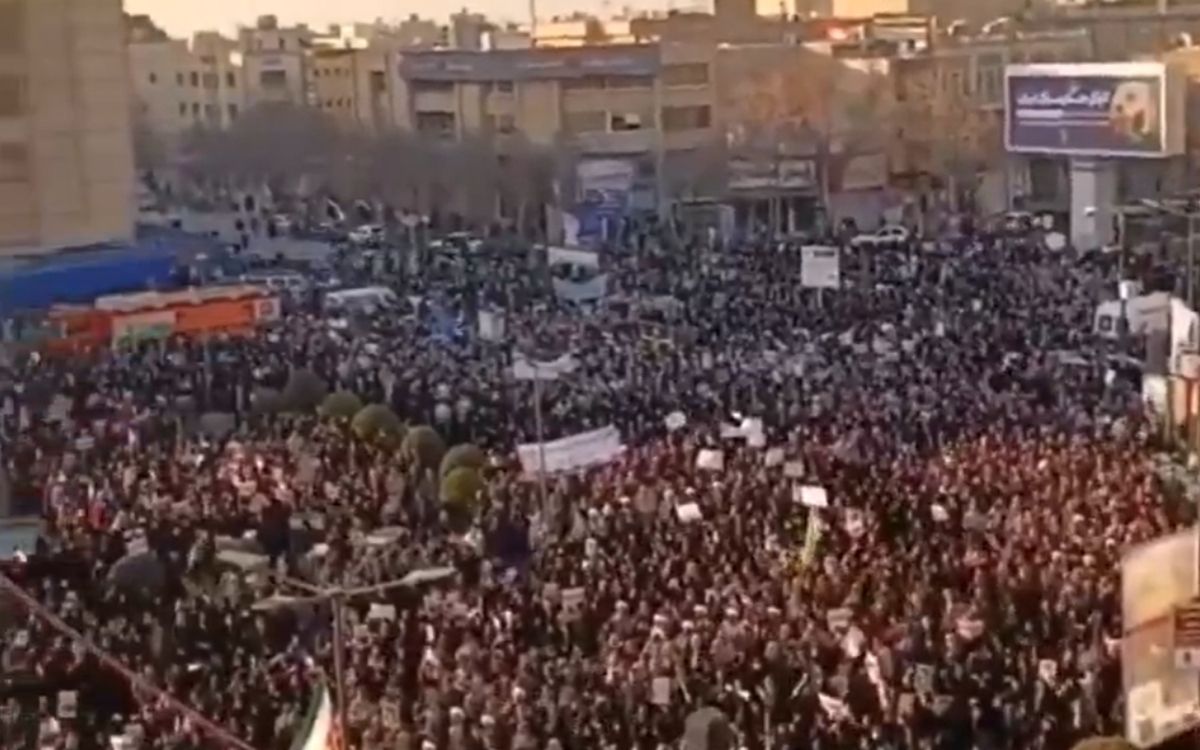
Iran has been shaken for over a week by massive protests that erupted in late December due to a severe economic crisis, the dramatic devaluation of the national currency, high inflation, and widespread poverty. Demonstrations have rapidly spread to dozens of cities across the country, including Tehran, Isfahan, and Kurdish regions in western Iran.
According to i24news, two cities in the Kurdish province—Abdanan and Malekshahi—have effectively fallen under the control of protesters after security forces withdrew. International agencies report that at least 36 people have been killed so far, while hundreds of demonstrators have been arrested. Authorities accuse the protesters of acting with support from “foreign enemies,” primarily the U.S. and Israel.
Although the government attempted to calm the situation by announcing limited economic measures, such as subsidies for basic food items, protesters say these are far from sufficient. Kurdish organizations have meanwhile called for a general strike across the country.
Day 12 of protests in Iran begins.
— Eli Afriat 🇮🇱🎗 (@EliAfriatISR) January 8, 2026
People are starting to take to the streets.
This is shaping up to be the MOST important day.
DON'T FORGET, at the prince's request, everyone in Iran is going outside today at 8 pm.
PASS IT ON. pic.twitter.com/AdwwP1da3W
Bloody Saturday in Malekshahi
The most dramatic and violent events occurred on Saturday in Malekshahi, a small city in western Iran with a majority Kurdish population. Protesters gathered in front of the Revolutionary Guard base, banging on gates and throwing stones at walls to express their anger over the economic catastrophe. Security forces responded with live ammunition.
While some of the crowd tried to flee, others were shot on the spot, and bystanders desperately tried to pull out the wounded.
The next day, protests continued in front of Malekshahi’s main regional hospital, where families of the killed and injured demanded an end to the regime. Security forces reportedly arrived on foot and motorcycles, attempting to enter the hospital. Despite efforts by medical staff and civilians to stop them, authorities forcibly broke through the main entrance.
According to Amnesty International, security personnel repeatedly entered the hospital, arresting injured protesters and members of their families, and removing the bodies of the deceased to prevent public gatherings and expressions of mourning.
🚨 The towns of Abdanan and Malekshahi in western Iran have been LIBERATED
— M. Hanif Jazayeri (@HanifJazayeri) January 6, 2026
Khamenei's forces fled as protesters chanted "Death to Khamenei" on Day 10 of #IranProtests
Opposition leader Maryam Rajavi saluted the Resistance Units, adding this is a fire that cannot be extinguished pic.twitter.com/EAQ3IZJhHR
Economy on the Brink
The mass protests began on December 28 and have now engulfed nearly all parts of Iran. The first wave of unrest erupted in Tehran, where merchants from the famous Grand Bazaar took to the streets because, due to the currency collapse, they could no longer buy or sell goods.
When the nuclear deal was signed in 2015, one U.S. dollar was worth around 32,000 rials. This week, the exchange rate reached a staggering 1.46 million rials per dollar—the lowest level in history. Inflation is estimated at around 40% annually, while the prices of basic foods such as oil, meat, rice, and cheese have become unaffordable for most of the population.
The economic collapse has been worsened by U.S. sanctions, years of poor governance, and widespread corruption, with the situation further deteriorating after conflicts with Israel.
READ MORE:
Protests Demand Regime Change
Initially, demonstrations were triggered by what protesters describe as poor government management of a struggling economy weighed down by international sanctions. Officials have also been accused of widespread corruption.
In recent days, however, the protests have taken on an openly anti-regime character, with demonstrators in many locations chanting slogans against Supreme Leader Ayatollah Ali Khamenei and the clerical establishment that has ruled Iran since the 1979 Islamic Revolution. Verified footage also shows support for Reza Pahlavi, the son of the exiled Shah of Iran, and the Pahlavi dynasty that ruled prior to 1979.
At the University of Tehran, some protesters on December 30 shouted “death to the dictator”—a reference to Khamenei—while dozens forced their way through the university’s main gate.
⚡️ ⚡️ Protesters have already taken control of two cities in western Iran
— NEXTA (@nexta_tv) January 7, 2026
Residents of Abdanan and Malekshahi have pushed out security forces and are celebrating their victory. People are chanting “Death to Khamenei!” and renaming streets in the cities — some are being named… pic.twitter.com/9FmmTcukvm
Authorities No Longer Hide Violence
Iranian scientist and political analyst Yassamine Mather told Sky News that authorities have not even tried to fully conceal the protests this time, aware that videos are spreading rapidly on social media and international media.
“On one hand, they claim the protests are legitimate and attempt to talk to the people, and on the other, they crack down very harshly on those confronting the police. This cycle of violence is becoming inevitable,” Mather said.
Funerals for the dead were held in Malekshahi in the meantime. One survivor of “Bloody Saturday,” who wished to remain anonymous, told Sky News that the attack on the hospital and the way authorities treated residents, in light of established humanitarian principles, can be described as a “crime against humanity.”
MORE TOPICS:
Source: Nova.rs; Foto: Printscreen X