




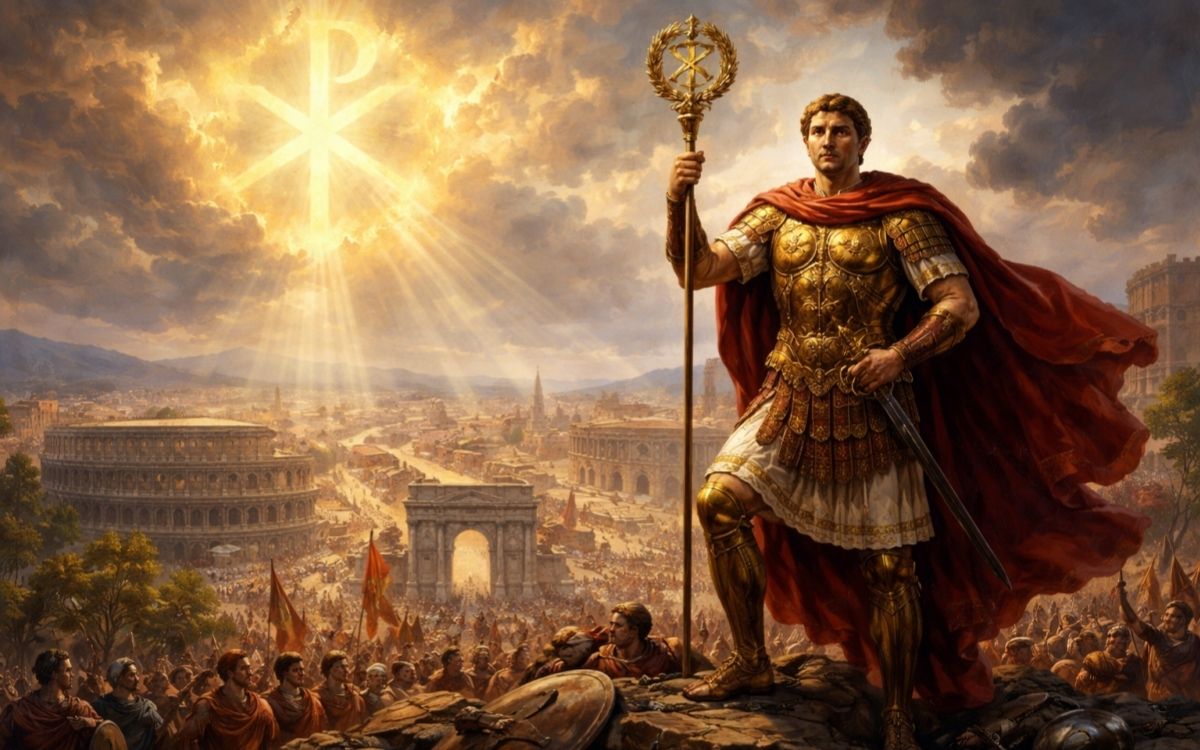
What did Constantine the Great achieve? Constantine I was not only the first Roman emperor to embrace Christianity, but also a ruler who unified and strengthened the Roman Empire. Few individuals have had such a dramatic and long-lasting impact on the fate of an entire continent.
Only one Roman emperor bears the epithet “the Great” – Constantine. Today he is most commonly associated with the Christianization of the Roman Empire, but even had he remained a pagan, he would have deserved that title. He came to power at a moment when Rome’s fate hung in the balance. His predecessors had managed to pull the Empire out of the severe crisis of the 3rd century, but danger still lingered. It fell to Constantine to stabilize the new order and secure the survival of the state.
Although his deeds are well documented, Constantine himself remains an enigmatic figure. Early Christian writers portrayed him as a wise and benevolent ruler. Later historians, particularly in the early modern era, depicted him as a ruthless political opportunist who mercilessly eliminated both allies and family members. Some even claimed that his embrace of Christianity was a cynical political move.
Who was Constantine the Great?
Constantine was born in 272 in Niš, in the Roman province of Upper Moesia, in what is now Serbia. His father, Constantius Chlorus, became caesar in Diocletian’s tetrarchy. Under that political system, he was forced to leave Constantine’s mother Helena and marry Theodora, the daughter of Emperor Maximian.
In 306, after his father’s death in Eboracum (modern-day York), the army proclaimed Constantine caesar. Although this violated the principles of the tetrarchy, Constantine consolidated his position by defeating the Franks in Gaul. Their kings were, in a brutal display of power, thrown to wild beasts in the arena.
Conflicts with Maxentius and Licinius led to civil wars. The decisive battle took place in 312 at the Milvian Bridge. It was then that Constantine’s army first carried the labarum bearing the Christian symbol chi-rho (XP). According to later sources, Constantine had a vision in a dream that he would conquer under that sign. The victory was swift and decisive.
FIND OUT MORE:
Constantine and Christianity
In 313, Constantine and Licinius reached an agreement known as the Edict of Milan, granting Christians freedom of worship. This was not a declaration of Christianity as the state religion, but a guarantee of religious tolerance.
Later, Constantine convened the First Ecumenical Council in Nicaea in 325, where the Nicene Creed, the foundation of Christian doctrine, was formulated.
Although he supported Christianity, Constantine simultaneously remained the formal head of pagan cults. He declared temples state property, and the gold and silver from their treasuries were minted into a stable currency – the gold solidus. In doing so, he stabilized the economy and curbed inflation.
Reforms and the military
Aware that many emperors had fallen to military revolts, Constantine reorganized the army. He disbanded the Praetorian Guard and divided the troops into border units (limitanei) and mobile forces (comitatenses). He increased the use of cavalry and recruited barbarian units.
In the East, he led successful campaigns against the Goths and Sarmatians. Although he did not fully recover Dacia, he strengthened Roman influence in the region.
Family tragedies
His private life was marked by drama. His mother, Saint Helena, became renowned for her pilgrimage to the Holy Land and the discovery of the True Cross. However, in 326, Constantine had his son Crispus executed, followed by his wife Fausta. The reasons were never fully clarified.
The founding of Constantinople
In 324, Constantine decided to establish a new capital – New Rome, on the site of Byzantium. The city, later named Constantinople, became the center of the Eastern Roman (Byzantine) Empire for the next thousand years.
Death and legacy
Constantine fell ill in 337. He was baptized shortly before his death by a bishop inclined toward Arian teachings. He died at the age of 65.
His influence was immense. Without Constantinople, Europe might not have survived the barbarian and later Muslim conquests. Without his support, Christianity might not have become the foundation of European identity. Constantine did not merely change the course of history – he shaped the very idea of Europe.
MORE TOPICS:
ANGER GROWS AT THE BLOCKADES: Police summoned more than 10 farmers for informative talks!
HORROR IN NORTH MACEDONIA: Serial killer arrested, suspected of murdering as many as five women!
Source: Serbian Times; Foto: Chat GPT prompt by Serbian Times