




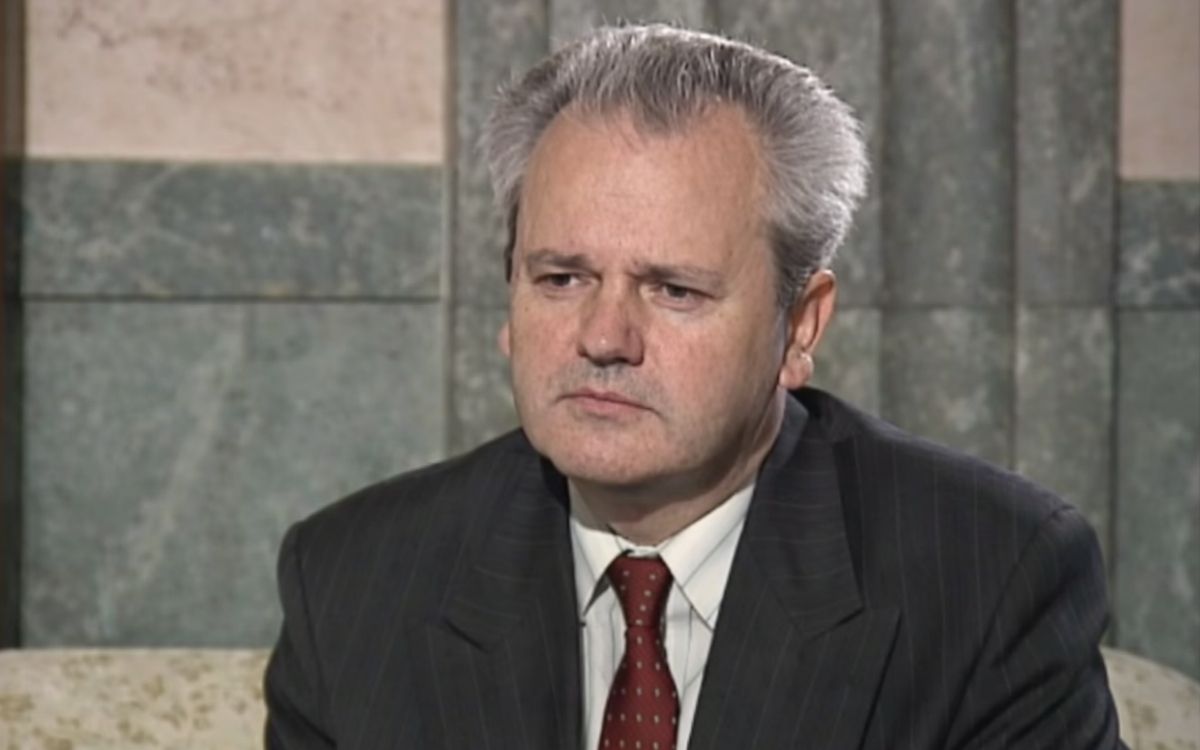
Slobodan Milosevic, the former president of the Federal Republic of Yugoslavia, the Republic of Serbia, and the leader of the SPS, died on this day 20 years ago in the detention unit of the Tribunal for the former Yugoslavia in Scheveningen, in The Hague.
Slobodan Milosevic passed away on March 11, 2006, from a heart attack, and according to the family’s wishes, after the request for him to be buried in Belgrade with state honors was rejected, he was buried in the yard of the family house in Pozarevac.
Milosevic was one of the key figures during the wars in the former Yugoslavia and in Kosovo and Metohija, and the International Criminal Tribunal for the former Yugoslavia in The Hague brought an indictment against him for crimes against humanity.
He was extradited to the Hague Tribunal on June 28, 2001, where he was tried for war crimes in Kosovo and Metohija, Croatia, and Bosnia and Herzegovina.
The process, which began on February 12, 2002, during which he defended himself, was interrupted more than 15 times due to his health condition, and it was suspended a few days after his death.
Milosevic’s rule lasted slightly longer than ten years, and it began with a speech at Gazimestan on Vidovdan – June 28, 1989, on the occasion of marking 600 years of the Battle of Kosovo, which was attended by, as it was stated at the time, a million people.
In the first multi-party presidential elections in Serbia, in December 1990, as the SPS candidate, he received 65.34 percent of the votes and became the first president of the Republic of Serbia. In the Federal Assembly on July 25, 1997, he was elected president of FR Yugoslavia.
His rule ended in 2000 at the elections in which he was defeated in the race for the presidency of FR Yugoslavia by the candidate of the Democratic Opposition of Serbia, Vojislav Kostunica. At that time, he did not want to admit defeat, which led to mass protests across Serbia, ending on October 5 with a large gathering in front of the Assembly of the FRY.
Milosevic was arrested on April 1, 2001, and was extradited to The Hague on Vidovdan by the government of Zoran Djindjic, the prime minister who was assassinated in 2003. He was the initiator of the change in the constitutional position of autonomous provinces within Serbia and one of the signatories of the Dayton Agreement, which officially ended the war in the territory of the former Yugoslavia after five years.
He was associated with the murder of the former president of the Presidency of Serbia, Ivan Stambolic, and the quadruple murder on the Ibar Highway, but also with direct or indirect influence on events on all battlefields in the former Yugoslavia, especially with the events in Srebrenica and Vukovar.
Former Hague prosecution spokesperson Florence Hartmann claimed a decade later that the former president of the FRY and Serbia, Slobodan Milosevic, poisoned himself with the drug “rifampicin” with the aim of worsening his condition so that he would be released to defend himself from freedom, and then, as speculated, he would flee to Russia, where members of his immediate family were also located.
Slobodan Milosevic is the author of the book The Years of Resolution, translated into several foreign languages.
MORE TOPICS:
Source: RTS; Photo: Printscreen YouTube