




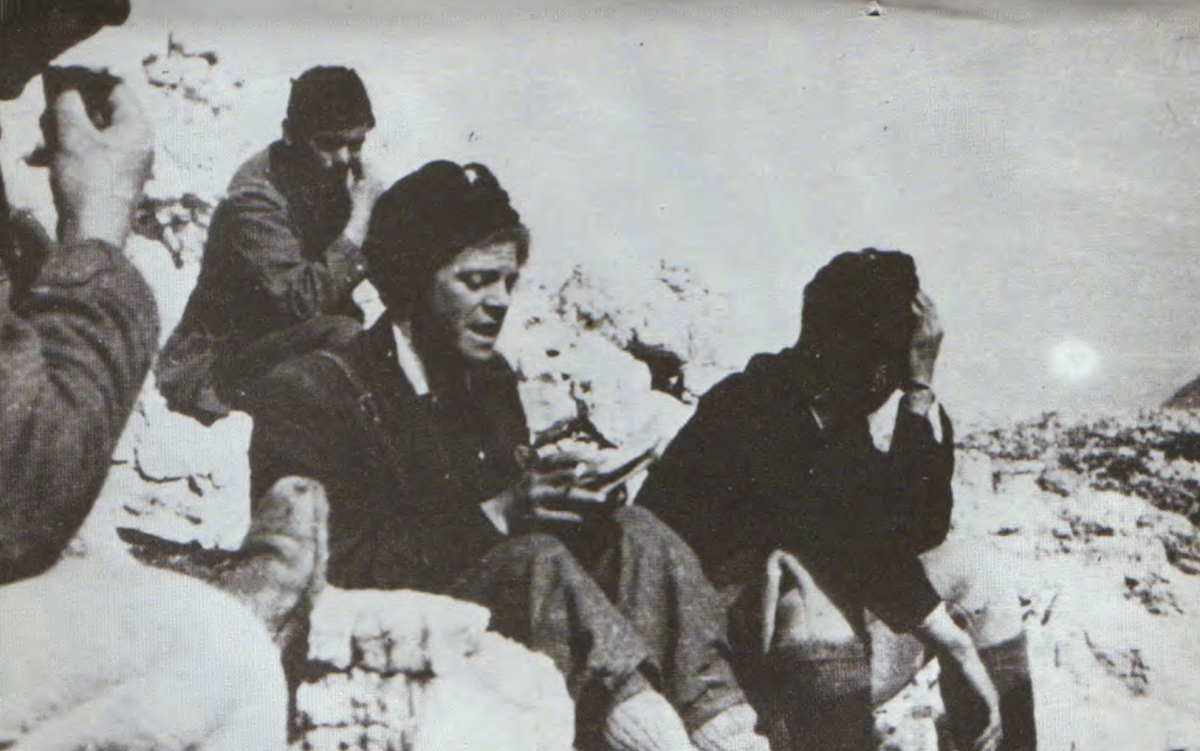
The poet who sang of his tragic fate in the poem “Moj grob” and wrote the famous poem “Jama”, as a protest against the Ustaše massacres of Serbs during World War II, lost his life at the hands of the Chetniks in 1943.
Ivan Goran Kovačić was a Yugoslav poet, writer, essayist, critic, translator, journalist, and participant in the National Liberation Struggle.
He was born in 1913 in Lukovdol to his mother Ruža, who was of Jewish origin, and his father Ivan, who was Croatian.

He completed elementary school in his hometown and later continued his education in Karlovac and Zagreb.
Already as a high school student, he began publishing literary works in magazines and newspapers.
He started his studies at the Faculty of Philosophy in Zagreb and, along with two friends, published his first collection “Lirika” in 1932, but soon after, he left the faculty.
As a philosophy student at the University of Zagreb, he collaborated with magazines that had a clear leftist orientation.
In addition to poetry, Kovačić also engaged in prose, essays, and criticism. He translated from several languages and had an admirable literary and linguistic culture.
In 1936, he published a book of short stories titled “Dani gnjeva”.
Progressively inclined, Goran joined the Partisans in 1942 together with the well-known Croatian poet Vladimir Nazor.

He wrote the famous poem “Jama” while in the Partisans, inspired by the Ustaše crimes in the vicinity of Livno, where a large number of Serbs were thrown into karst pits around the Livno field.
*”The last light before the dreadful night
Was the flash of a lightning-quick knife,
And a scream, still white now in blindness,
And white, white was the executioner’s skin;
For they were stripped to the waist,
And thus their nakedness burned our eyes.”*
It was first read to the wounded of the First Proletarian Division by actor Vjekoslav Afrić.

By mid-July 1943, Ivan Goran Kovačić was killed by the Chetniks in the village of Vrbnica, near Foča. His words from the poem “Moj grob” were tragically fulfilled.
*”Let my grave be on a dark mountain,
Above it, the howl of a wolf, the rustling of black branches.
In summer, an eternal storm, in winter, deep snow,
The silence of my tomb, an inaccessible hill.”*
In Kovačić’s honor, since 1964, the poetry festival “Goranovo proljeće” has been held annually in his hometown of Lukovdol, in Gorski Kotar.
During the festival, the “Goranov vijenac” award (since 1971) and the “Goran for Young Poets” award (since 1977) are presented.
MORE TOPICS:
TRANSFERRED BY THE SERBIAN ARMY: Twelve injured in the Kočani fire arrive in Belgrade for treatment!
LEST WE FORGET: The March pogrom in Kosovo was deadly for many Serbs, while thousands got expelled!
DUE TO THE UNPRECEDENTED TRAGEDY IN KOČANI: North Macedonia declares seven days of mourning!
Source: Danas, Foto: Wikimedia Creative Commons