




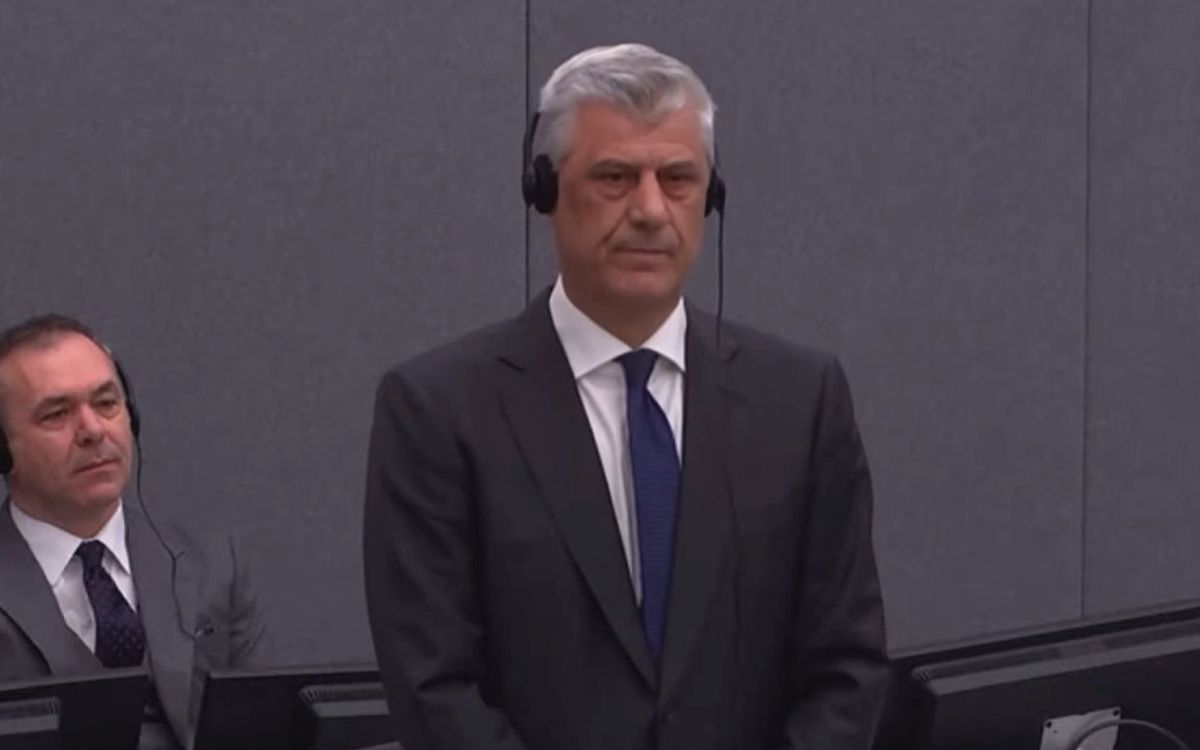
The Hague prosecution requested today a sentence of 45 years in prison for the former leaders of the KLA, Hashim Thaçi, Kadri Veseli, Rexhep Selimi, and Jakup Krasniqi, accused of war crimes in Kosovo and Albania, 1998-99.
At the beginning of the closing arguments, Chief Prosecutor Kimberly West assessed that the evidence presented during the trial showed that the crimes in the indictment were committed and that “the accused bear criminal responsibility.”
“The evidence justifies long prison sentences for all the accused,” said the Chief Prosecutor.
Thaçi, Veseli, Selimi, and Krasniqi are accused of crimes against Serbs, Roma, and Albanians declared “collaborators,” in about 40 KLA detention centers in Kosovo, as well as in Kukës and Cahan in northern Albania, from March 1998 to November 1999.
The Chief Prosecutor specified that the accused are responsible for the deaths of at least 100 victims and for the abuse of hundreds of persons.
West identified as proven the allegation that the four KLA leaders were “protagonists of a joint criminal enterprise,” with the goal of taking control over the whole of Kosovo.
Targeted by them, according to West, were all those perceived as “opponents” of the KLA – Serbs, Roma, Albanians whom they declared collaborators of the Serbian authorities, and members of Ibrahim Rugova’s Democratic League of Kosovo.
Prosecutor West, referring to the evidence, assessed that the accused were “key members of the KLA General Staff” and that “KLA operational zone commanders received orders from them, and not the other way around,” as claimed by the defense.
West called those defense claims a “cynical distortion of the truth.”
The prosecutor marked as unreliable the testimonies of seven international officials, including General Wesley Clark and Ambassador Christopher Hill, in defense of the first-accused Thaçi.
Those testimonies were based, according to West, on the “limited knowledge” of witnesses who were “parachutists” in the complex situation in Kosovo and had no knowledge of the internal organization of the KLA and its activities on the ground.
The Chief Prosecutor expressed special gratitude to the victims and witnesses who gave testimony despite the “persistent climate of intimidation in Kosovo,” namely the “threats, fear, and stigma” to which they were exposed.
Before the trial chamber of Presiding Judge Charles Smith from the USA, prosecutors and defense attorneys will present closing arguments until February 18.
According to the rules of the court, the verdict for the four former KLA leaders will, thereafter, be pronounced within 90 days.
If the judges need more time to decide, the deadline for pronouncing the verdict can be extended by another 60 days.
According to the indictment, Thaçi, Veseli, Selimi, and Krasniqi are individually criminally responsible for the atrocities of KLA members committed during a non-international armed conflict as part of “widespread and systematic attacks against persons suspected of opposing the KLA.”
The ten-count indictment charges Thaçi, Veseli, Selimi, and Krasniqi with: persecution on political and ethnic grounds, imprisonment, illegal arrest and detention, other inhumane acts, cruel treatment, enforced disappearance, torture (two counts), and murder (two counts).
KLA members committed crimes against approximately 407 detainees, of whom at least 102 were killed, from March 1998 to September 1999, the indictment states.
The indictment identifies 75 victims – 51 Serbian, 23 Albanian, and one Roma.
Six counts of the indictment charge Thaçi (56), Veseli (57), Selimi (53), and Krasniqi (74) with crimes against humanity, and four counts with war crimes.
According to the indictment, Thaçi, Veseli, Selimi, and Krasniqi were participants in a joint criminal enterprise.
The goal of that criminal enterprise was to take control over the whole of Kosovo through violence against everyone the KLA considered “opponents.”
As accomplices in the criminal association, the indictment also lists KLA officers: Azem Syla, Lahi Brahimaj, Fatmir Limaj, Sylejman Selimi, Rrustem Mustafa, Shukri Buja, Lutfi Haziri, and Sabit Geci.
All the accused stated that they are not guilty.
They have been in detention in The Hague since their arrest in Kosovo, carried out on November 4 and 5, 2020.
The trial of Thaçi and the co-accused began before the court in The Hague on April 3, 2023, and the prosecutors ended their evidentiary proceedings on April 15 of last year.
125 prosecution witnesses testified in the Hague courtroom, and the statements of dozens of other witnesses were introduced as evidence in written form by the prosecutors.
The prosecution’s evidence also consists of 3,000 documents in Albanian, Serbian, and English.
In defense of Thaçi, seven witnesses testified, former British and American officials who met with him and held talks in 1998-99.
Those witnesses gave almost identical testimonies that Thaçi was not a military commander, but a political representative of the KLA and that he could not have been the perpetrator of the crimes in the indictment.
According to defense witnesses, the KLA was not even an organized army with a central command and chain of command.
To the prosecutors’ questions, Clark, Hill, and other witnesses for Thaçi’s defense confirmed, however, that at that time they did not have detailed information about the internal organization and activities of the KLA on the ground, nor about the abduction and detention of civilians.
Defense evidence in written form was also submitted by the representatives of the fourth-accused Krasniqi.
Considering that the prosecutors did not prove their guilt, the second-accused Veseli and the third-accused Selimi did not present defense witnesses before the court.
More than 150 victims of the crimes in the indictment are also participating in the trial of Thaçi and the co-accused.
During the process, the court heard reports from two experts on the material, physical, and mental damage suffered by the victims.
If Thaçi, Veseli, Selimi, and Krasniqi are found guilty, all victims participating in the trial will have the right to compensation.
The Kosovo Specialist Chambers, as the court is officially called, was established in 2015 by the Assembly of Kosovo under international pressure caused by the report of Council of Europe rapporteur Dick Marty on KLA crimes in Kosovo and Albania, published in 2011.
The court is formally part of the judicial system of Kosovo, but operates in The Hague. In verdicts and other documents, the court has established that a persistent climate of intimidation and harassment of witnesses against accused members of the former KLA prevails in Kosovo.
MORE TOPICS:
DODIK’S PARTY DECLARED VICTORY: Siniša Karan is the new president of Republika Srpska!
Source: N1; Photo: Printscreen YouTube / Reuters