




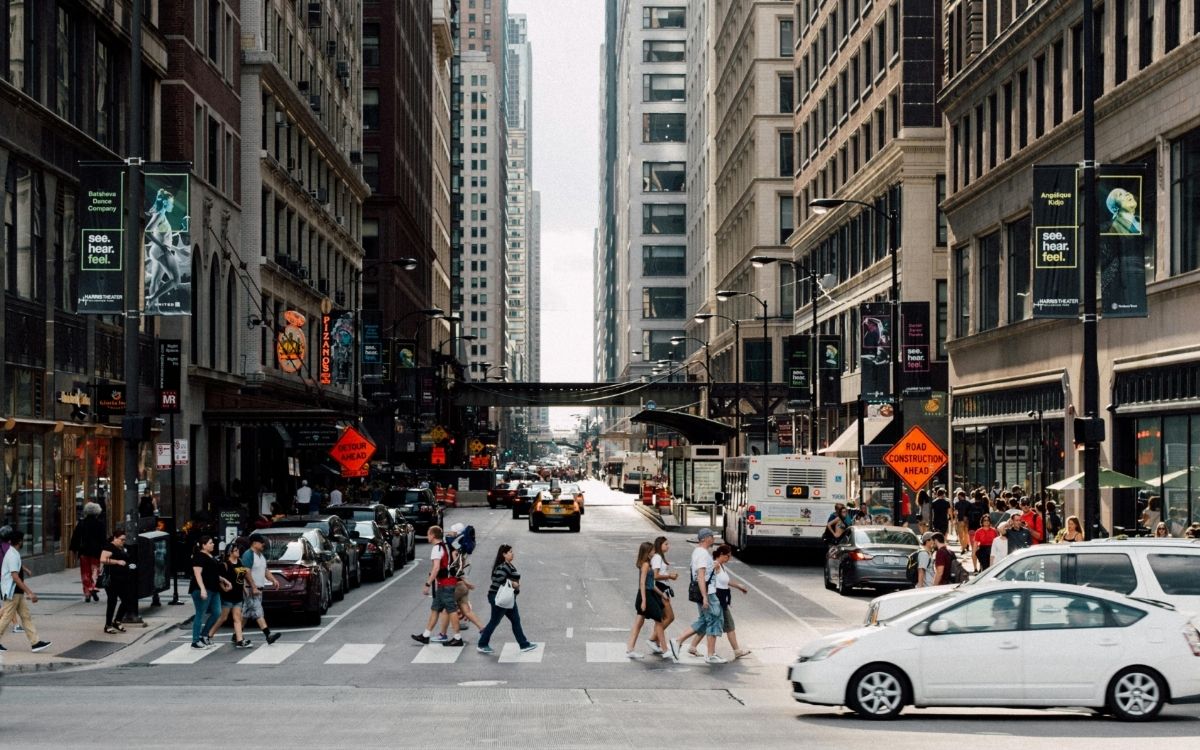
A large number of people from this region sought refuge abroad due to the economic situation, wars, and living conditions that arose as a result of the events of the nineties of the last century. While some settled there, found happiness, and have no plans to return, there are also those who dreamed of returning to their homeland.
Among them is Dragan Perić (47), who went to Chicago to live with relatives in 1999 and stayed there until 2019 when he returned to Serbia with his wife.
For the Sremska Mitrovica portal, he revealed his life story, how Serbs live in this overseas country, how much money they earn, whether they socialize with each other, what they think of those who stayed in Serbia, and why he eventually returned to his homeland.
According to him, life in Chicago initially seemed like “life on another planet.”
He went to stay with relatives and planned to remain in America for only a few years until he earned enough money and returned to Serbia.
“As soon as I arrived, I got a job in a factory where I did physical labor, while my colleagues were mostly immigrants from various countries. Since the salary was low and the expenses were high, I schemed a bit, delivered stolen goods from the factory to our people who sold them and earned a little more. I’m not proud of that period, I managed as I knew how. After that, I got a job at a car repair shop in the suburbs, as I had experience in that line of work. That’s when real life in America began,” says Dragan, who later got the nickname Peter.
As he explains, the people who hired him were Serbs originally from Šumadija. When he gained stability in his job, he married his long-time girlfriend who came from Serbia.
“After a few years, we bought a real family house of 100 square meters with a yard, which we almost paid off. That’s the part of Chicago where a large number of Serbs live, like our neighborhood. In that part of the city, there are several shops where our people work, selling our food and popular products, from sweets and biscuits to clotted cream and cured meats. In almost all houses, Serbian television channels are watched, gibanica is baked, barbecues are made in the yard, rakija is drunk… That’s why it was easier for us to live there, but on the other hand, we never fully adapted to life in America,” Dragan says.
His wife worked as a dental technician, while Perić, after 10 years, opened his own auto repair shop.
FIND OUT MORE IN ENGLISH:
“You earn better there, you can save money and send it to your family in Serbia. However, you work twice as much, and the expenses are enormous. Everyone there mostly works two jobs, doesn’t spend money on cafes and going out, since there’s practically none of that there. You go to a restaurant once a week, and that’s it. We always had enough money for travel, vacations to distant destinations, a car, and a good life. However, most of the money was spent on our two daughters, who were educated there. We also invested in a house in Serbia, where we always planned to return,” he says.
Due to work, the family mainly sees each other in the evenings, especially because Chicago is not considered a safe city at night, says Perić.
“Chicago is a beautiful city, but my wife and I never fully got used to it because American culture is completely different from ours. Americans are generally uninterested in meeting and socializing, but on the other hand, there is a lot of racism in this country, and a distinction is made between blacks, Latinos, Asians… So that we wouldn’t feel rejected and lonely, we mostly socialized with Serbs. However, the mentality of our people there is also different than in Serbia. Young people start working early, travel the world more than is possible in Serbia. They listen to our music and visit Serbian places, but they mostly speak English. At home, I speak half in English and half in Serbian with my daughters. That’s hard for me, but I’m aware that they grew up there and had to adapt,” says this Serb.
What he didn’t like among Serbs in Chicago is that the material aspect is much more important in socializing than in Serbia, and that newcomers often try to take advantage of Serbian women, entering into relationships and marriage just to get American papers, he claims.
“On the other hand, there are also good sides to life there, and it seems to me that people in the family are much more connected than in Serbia, where you are not so reliant only on each other. We missed our friends and parents, even though we had a new environment there. When some of them came to visit us, which wasn’t often, it was like a holiday. We came to Serbia once or twice a year, and sometimes it seems to me that my whole life passed in the question of when we would go to Serbia and when we would go back to America. We always wanted to return and stay in Serbia, but it was postponed. By the time we saved money for a house, by the time our daughters finished school, more than 20 years had passed,” he says.
As he says, he was bothered by the prejudices and comments when he came to his homeland, but over time he got used to it and understood everything as part of our mentality.
“When we were in Serbia, many looked at us as foreigners who have money, for whom everything falls from the sky, and who live like kings. If you say that it’s not all that ideal, some don’t believe you, others ask why you don’t return, and still others pity you. If I say something bad that I noticed in Serbia, it’s considered an insult, they say I have no right to comment because I don’t live here. If I’m positive, say something nice about Serbia and want to see and socialize with everyone, then people comment that I’m longing for that, that I have no one to spend time with in America, that I went bankrupt. However, I accepted all that as part of our mentality, with all its virtues and flaws,” says this Serb from the diaspora.
After more than 20 years, his wife and he decided to finally return, and for now, he believes he made the right decision.
“I spent half my life there, half in Serbia. Now I am finally here, and we plan to stay for the rest of our lives. We left the house to one daughter, the other is currently studying in Vienna, and I hope that one day we will all gather in Serbia. No matter how many flaws life here has, I believe that I am now in my own place,” concludes Dragan.
MORE TOPICS:
TRUMP’S BIGGEST RAID SO FAR: Over 100 illegal immigrants arrested in Colorado Springs underground nightclub!
COLUMN, KOVAČEVIĆ: Not My Patriarch! Because my Patriarch would never slander his people in Moscow…
MILAN CELEBRATED SERBIAN FOLKLORE IN AMERICA: Came to Chicago for love, became a cultural ambassador
Source: Telegraf, Foto: Pexels