



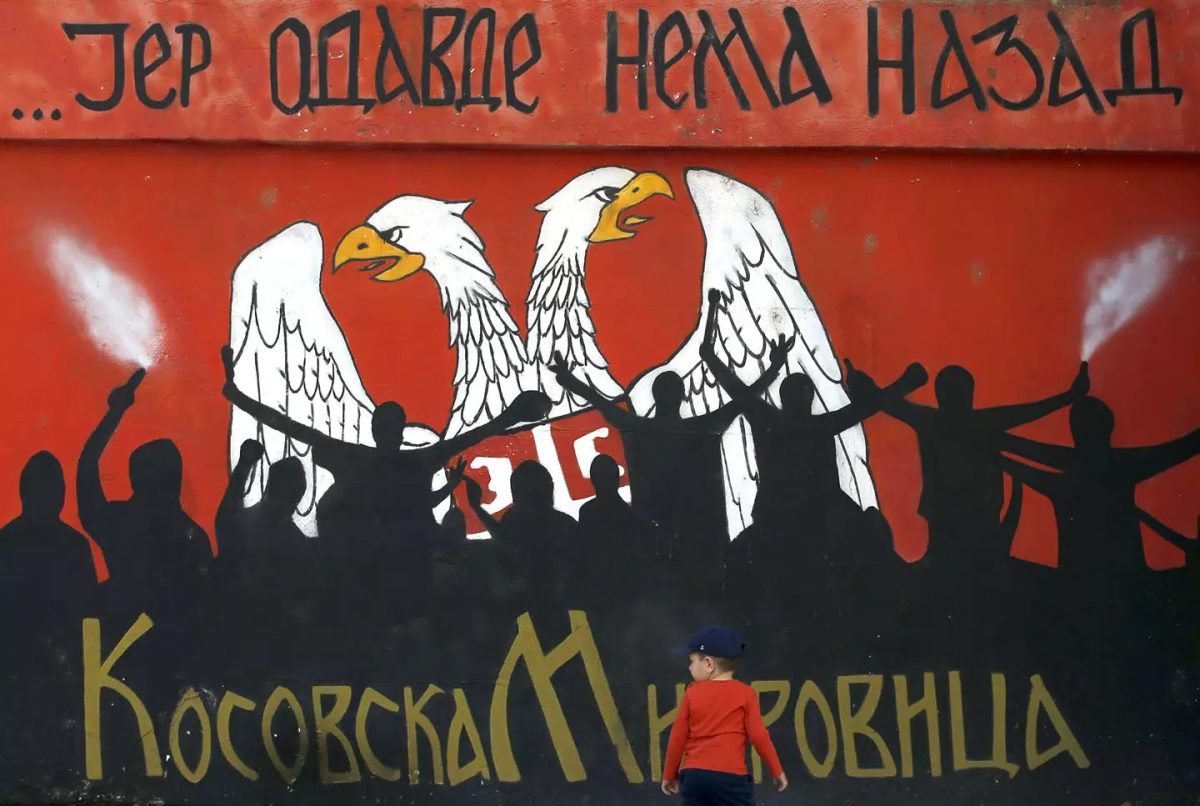
With the raid by the Kosovo police on the Pension, Disability and Health Insurance Fund facilities in North Mitrovica, Serbia has practically lost its last trace of statehood on the territory of Kosovo and Metohija.
In that sense, the statement of the American embassy in Pristina that it is freezing the dialogue with Kurti’s government is poor comfort, because the fact is that neither the Americans nor Eulex lifted a finger to prevent the Albanians when they previously occupied hospitals, post offices, sports halls, and even earlier public enterprises, telecommunications, the area code, water supply (Lake Gazivode), the electric power system, infrastructure, railways, judiciary, land registers, the tax and monetary system, courts, police, customs, border crossings, license plates, passports, personal IDs, documents…
And the question arises as to why the Americans and Europeans would even prevent them from doing that when almost all of these elements of Kosovo’s independence were blessed with the signature of Serbian president Aleksandar Vučić, and the seal was stamped with the participation of the Serbian List in Kosovo’s ruling coalitions in previous years.
The Brussels Agreement as a distant dream
Looking from this perspective, the Brussels Agreement, which was extremely unfavorable for Serbia and Serbs, today seems like a godsend in comparison to what has been signed or accepted in the meantime, including the German-French plan, which was not actually signed, but which Vučić accepted on behalf of Serbia and guaranteed for.
On the other hand, the Community of Serbian Municipalities, the only positive paragraph of the Brussels Agreement, which the Serbian authorities triumphantly brandished in 2013, has not been formed to this day, and probably never will be.
In that sense, although he became famous for statements like “5:0 for us” and similar, Vučić is either the greatest manipulator or the worst negotiator in the history of international relations, because every time he gives something to the Albanians, and in return he constantly asks for what he should have received on paper long ago.
However, one should be realistic and admit that Vučić, by a twist of fate, found himself in a position to be the one to drive the last nails into the coffin of Serbian statehood in Kosovo, but that the ground for the loss of a territory that has not only a physical but also a historical and spiritual significance for the Serbian people, was previously prepared and paved by all Serbian rulers since 1945 onwards.
The less Kosovo in Serbia, the more votes in the ballot box
Perhaps their greatest crime lies in the fact that they turned Kosovo and Metohija, the most valuable Serbian word, into the cheapest political platitude, mercilessly using it in the daily political marketplace, for one more point and vote, while the situation in practice and on the ground was developing in the opposite direction.
The more Kosovo was on their tongues, the less it was within Serbian borders.
The consequence of this long-term brainwashing is the momentum that actually hurts the most – to the average Serb in 2025, Kosovo and Metohija does not mean much and he boasts about it more in a pub and on social media than where he should.
He is not ready to die for it, God forbid, or even to vote, which is best illustrated by the fact that Vučić and the SNS, who have practically handed over Kosovo to the Albanians in the last 13 years, have since convincingly won the elections, mostly thanks to the votes of the so-called nationally-oriented voters, who once swore by the Kosovo covenant.
And the fewer Serbian institutions there were in Kosovo, the more dominantly Vučić won at the polls.
This shows that Kosovo is absolutely no longer a topic (if it ever was) around which spears are broken and voters are determined in elections. And not only that…
Heart of Serbia or sneakers, that is the question?
As someone who has spent the last 30 years in the Serbian media, I can testify that Kosovo and Metohija are at the bottom of the list of topics that interest the Serbian media consumer, whether a reader of print, or a follower of electronic media, TV and internet portals.
Namely, while leading and editing several Belgrade daily newspapers, I regularly received sales reports from distributors every week.
Whenever the front page dealt with the Kosovo issue, the circulations plummeted, no matter how tragic and dramatic those events were, from the March Pogrom to the declaration of independence, the Ahtisaari plan, ending with the Brussels Agreement.
That interest, or rather its lack, is perhaps best described by the case of the declaration of Kosovo’s independence and Koštunica’s rally, when the media and the public in the following days were more concerned with blonde teenage girls stealing sneakers than with the loss of 13% of Serbian territory.
Who is to blame?
Of course, the blame for this state of affairs is by no means the fault of the people who did not just forget the importance of Kosovo as the Serbian Jerusalem overnight, but their faith in the survival of Kosovo as part of Serbia, especially from 1999 onwards, was systematically destroyed by those who led them, i.e., politicians, the ruling caste, starting from Slobodan Milošević and so on (not to go further back in history).
Of course, all the Dedinje and Terazije bigwigs used Kosovo to perfidiously build up their political rating.
Milošević thus, on the wave of Gazimestan, cemented himself in the position of the undisputed ruler of Serbia, and all subsequent ones used it as much as they needed at a given moment, wholeheartedly pushing it towards the edge of the abyss all the way to the current phase, in which Kosovo is Serbian only in the preamble of the Constitution.
Although they differed ideologically and methodologically, what they all had in common was the lack of a rational, mature, visionary policy, which they then justified with the will of world powers and potentates and the influence of the Albanian lobby, interpreting the term “lobbying” to the uninformed people as something horrible and immoral, thus missing the train to do the same, to invest money and influence in order to “convince” world centers of power of the need to maintain the existing state of affairs, or rather the survival of Kosovo and Metohija as an integral part of Serbia.
Which was certainly an easier task than the one that the Albanian lobbyists had before them, who fought and finally won for the change of borders in the middle of Europe, which rarely happened, or rather not at all since the Second World War onwards.
Serbia, however, is neither the first nor the last country in Europe (not to mention the world) that has had a situation with minority separatist movements, they still have them today in Spain (Basque Country, Catalonia), Great Britain (Northern Ireland, Scotland), Italy (South Tyrol), Belgium (Flanders), France (Corsica) Moldova (Transnistria), etc… but it is the only one that managed to lose a territory where, to make the tragedy even greater, its oldest churches and monasteries are located.
Abuse of the “populace”
A special story is the abuse of the tragedy of the “Serbian populace” (the most disgusting expression that anyone has ever used to describe their own people in the media) in Kosovo for cheap political points and theatrics.
There are countless examples and there is practically no misfortune or crime against the Serbs there that the heads of the Belgrade caliphate have not abused for their vile goals, while at the same time not once did they make an effort to ensure that the perpetrators of these crimes were caught and punished…
From that tormented Martinović from Gnjilane, raped in a field, through the victims of the terrorist KLA and NATO bombing, the murdered children in Goraždevac, the reapers in Staro Gracko, all the way to the present day, when Serbs are tried and convicted for war crimes with the statements of witnesses who heard about the events from Facebook.
The last such case is Miloš Plesković, a Serb from Prizren, who was sentenced to 15 years in prison for the alleged murder of three Albanian civilians, although there is no person who saw him at the scene of the crime, and the only and therefore key witness was not even present when the murder happened.
Did anyone from Terazije react, ask the international community for a retrial, arbitration, an independent expert opinion? Of course not.
Inheritance for sale
A special problem in this sad Kosovo story is that today Serbs, besides not being physically present (it is estimated that only about 55,000, i.e., 2.5% of the population, are left to live in the province), are not even in the land registers and cadastres, i.e., as landowners.
The lack of political vision of those whom the Serbs have chosen to lead them in the last 80 years has spread like a plague to the common people, and has led to local Serbs selling their houses and yards since the 1970s and moving to central Serbia or abroad.
In the first phase, the sums they received from the Albanians for the land and real estate were fabulous, which enabled them to become wealthy hosts in Serbia.
But the fewer Serbs there were in Kosovo, the more the price fell, all according to the unwritten laws of that bizarre market of ethnically clean real estate, until finally, after the Kumanovo Agreement and the withdrawal of the Serbian army, those who most believed in the survival of Serbia in Kosovo fared the worst, some of whom lost literally everything they had and ended up in the barracks of refugee centers.
They became victims of a short-sighted policy that for years turned its back and a “blind eye” to the fact that a well-organized Albanian emigration, with money that largely came from drug trafficking, was buying up Serbian homes and properties, thus creating an ethnically clean “lebensraum”.
Albanian besa and Serbian purse
For Albanians and their elite, the issue of Kosovo’s independence has been a crucial issue of national dignity and survival since the 1950s, while for the authorities in Belgrade, communist, socialist, democratic and today’s cacist ones, the preservation of Kosovo was a secondary, daily political topic that they would remember usually before elections.
The only “wise” thing that the Serbian establishment came up with in the last half century to preserve and motivate Serbs to stay in the province is the so-called “Kosovo allowance”, according to which the salaries of employees in Serbian institutions were increased by 50%, and which many received for jobs they did not even perform, in companies they never set foot in, and some continued to collect them long after they moved to central Serbia.
Which, all together, caused the anger of both the citizens of inner Serbia and those Serbs from Kosovo who did not have the same privileges as some others.
The final result of this sloppy policy of “from today to tomorrow” was, of course, devastating, because without a serious and long-term platform, everything came down to squandering taxpayers’ money, without being able to convince anyone who enjoyed those privileges that the life and survival of Serbs in Kosovo had any perspective.
It is true that they managed to make some of them rich, and some of them party soldiers, and today those same people are repaying the debt by moving kidneys of students and citizens on Serbian streets and squares. Dressed in uniforms or black T-shirts and hoods, it does not matter.
From Oliver to yard dogs
The selection of those who represented Kosovo Serbs in the political arena fit perfectly into this hopelessness, and the portfolio of those representatives in the last few decades also reveals how serious the intentions of the authorities in Belgrade were to preserve the “heart of Serbia” and the “holy Serbian land”, as they called it in their bombastic, slogan-like performances.
From university professors and people of political integrity, reputation and trust of the citizens, to obedient servants, firefighters and drivers with fake diplomas – that would be, in short, the proportion of Serbian politics and its Kosovo champions in the last twenty years.
The last hope that someone serious would remain “down there” who could represent the Serbs in political life was extinguished by the still unsolved murder of Oliver Ivanović, after a heinous campaign was waged against him by the media from the Capital under the control of the current regime.
From then until today, the Serbian List has had an undisputed power, whose exposed pawns have absolutely no autonomy in thinking and decision-making but receive directives via SMS and emails from Belgrade.
It is justifiably assumed that according to those directives in previous years they entered the government of a state that their orderers still call “so-called” in their public appearances and signed parliamentary oaths in which they swear that they will “defend the sovereignty and territorial integrity of the Republic of Kosovo.”
However, a small dilemma remains in the air: Did the frontmen of the Serbian List, Zlatan Elek and Slavko Simić, when they last signed the said oaths in May of this year, hide in the corridors and toilets of the Kosovo assembly running away from the cameras on orders from Belgrade or because of a personal feeling of shame?
It must be the former, otherwise they would not have signed them.
Where tomorrow?
After all that I have written here, what we know and what we suspect and are not able to fully explain, which is above all that astonishing coordination of Kurti’s and Vučić’s moves, which in football terms could be described as “setting up a penalty” and which very often looks as if it is remote-controlled from one center, the question arises: What is the future of Serbs and Serbia in Kosovo?
The current government in the last 13 years, apart from the violent, manipulative and corrupt methods with which it controls the few remaining Serbs through loyalists, has shown neither the will nor the power to fight for what was signed in the Brussels Agreement, let alone anything more than that.
On the other hand, the civil opposition in its political programs, nor in the public discourse, has shown much idea or initiative to, when and if it takes power, dedicate itself to solving the Kosovo problem, in favor of Serbia, of course.
The only ones who at this moment show the awareness and willingness to face and fight for Kosovo and Metohija in Serbia and with Serbs as its citizens, are students and the little that is left of the patriotic opposition, which has been devastated and compromised for years by both the BIA and foreign agencies.
The one who takes power after Vučić’s inevitable fall will, it is already certain, face great problems how to get any support from those who were the sponsors of Kosovo’s independence in international waters, primarily the USA and the most powerful EU countries, before he promises that he will finish what Vučić started in Kosovo, let alone fight for something that has already been handed over/sold, or at least to get what was signed but forgotten and put ad acta, such as the Community of Serbian Municipalities, for a start.
Turning the wheel of history back is a Sisyphean task, but a future in which the foundations of the state will be built on stable foundations and long-term plans, instead of on empty promises, lies and self-deceptions, is not an impossible mission.
As is, after all, the slogan “Next year in Prizren.”
MORE TOPICS:
NATO IS CONSIDERING CLOSING THE SKY OVER UKRAINE: Russia responded fiercely, “that would mean war”!
Source: Antonije Kovačević Photo: Darko Vojinović /AP