




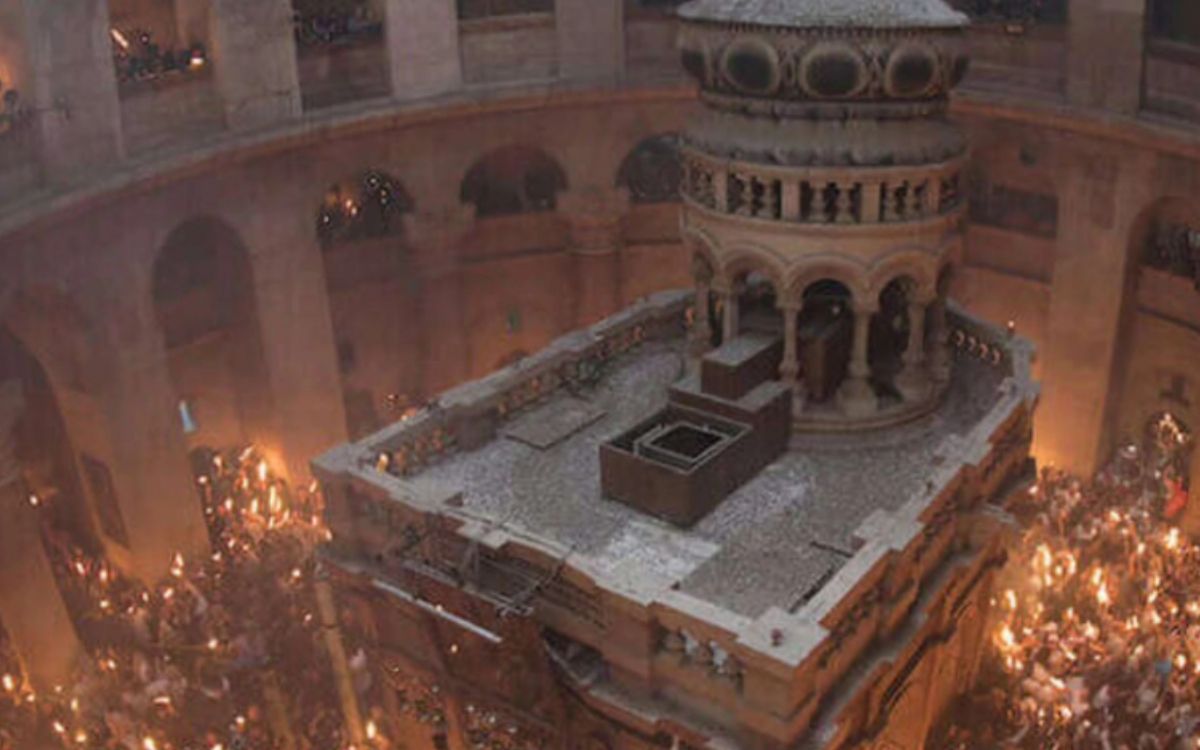
With the escalation of the war in the Middle East, the Church of the Resurrection of Christ in Jerusalem has been closed for weeks, halting services during the Lenten period. For Christians, this church represents the center of the key story of their faith. According to tradition, within its walls are both Golgotha, where Jesus was crucified, and the tomb from which believers say he rose. That is why its prolonged closure during the current conflict in the Middle East is echoing across the Christian world.
Authorities closed the church’s doors on February 28 due to the deteriorating security situation as the war in the region intensified. Since then, access to the main holy sites in the Old City has been severely restricted.
For the first time in modern memory, services in the basilica have been suspended for weeks. Normally, prayers continuously rotate in this sanctuary, led by the three communities that share custody of the church — the Greek Orthodox, Armenian Apostolic, and Roman Catholic churches.
On Monday afternoon local time, Israeli police said that parts of projectiles fell on locations in Jerusalem’s Old City, including the area near the Church of the Holy Sepulchre. According to The New York Times, the Latin Patriarchate of Jerusalem stated that one fragment fell just a few hundred meters from the church, injuring at least one person.
The Way of the Cross
The closure comes at a particularly sensitive moment in the Christian calendar. Lent, the period of preparation for Easter, traditionally draws pilgrims from around the world to Jerusalem. Many walk the Via Dolorosa — the path marking Christ’s journey to crucifixion — before gathering for prayer at the Church of the Holy Sepulchre. These centuries-old practices have now been abruptly interrupted.
Church leaders in the Holy Land say the situation is unprecedented in its duration. Even during previous wars and periods of tension, services at this site were held in some form. Restrictions during the pandemic reduced the number of pilgrimages, but clergy were still able to conduct liturgies inside the church. The current uncertainty is raising concern about the upcoming observance of Holy Week and Easter, the most important days in the Christian year.
Fragments of intercepted Iranian missiles have recently fallen in parts of Jerusalem during the escalation of the conflict, according to police and emergency services. Reports indicate that debris landed near the Old City, including areas around the Church of the Holy Sepulchre.
These incidents have further heightened fears for the safety of the historic sanctuary.
Christian leaders are working with Israeli authorities in hopes of obtaining permission to hold Easter liturgies inside the church, even if access remains limited. The basilica is often referred to as the “mother of churches” in Christianity due to its direct connection to the events of Christ’s suffering and resurrection.
The Vatican seeks special status for the Holy City
As part of the Vatican’s call for a two-state solution to stop the conflict in the Middle East, it also supports a special status for the city of Jerusalem.
For example, at the United Nations in 2025, Archbishop Kača (now the Pope’s representative in the United States) stated:
Jerusalem is a city of universal religious and cultural significance. It is sacred to Christians, Jews, and Muslims. Therefore, it requires a status that transcends political divisions and ensures the preservation of its unique identity. To this end, the Holy See reiterates its long-standing call for an internationally guaranteed special statute that can ensure the dignity and rights of all its residents and believers of the three monotheistic religions, equality before the law of their institutions and communities, as well as the protection of the sacred character of the city and its exceptional religious and cultural heritage.
Furthermore, it is necessary to ensure the protection of holy sites, guarantee unhindered access and the right to worship. The “status quo” must also be preserved where applicable. In Jerusalem, no one should be subjected to harassment. Therefore, it is regrettable that Christians increasingly feel threatened in the Old City of Jerusalem.
MORE TOPICS:
LEST WE FORGET: The March pogrom in Kosovo was deadly for many Serbs, while thousands got expelled!
Source: Aleteia, Foto: Printscreen Facebook / Greek City Times