




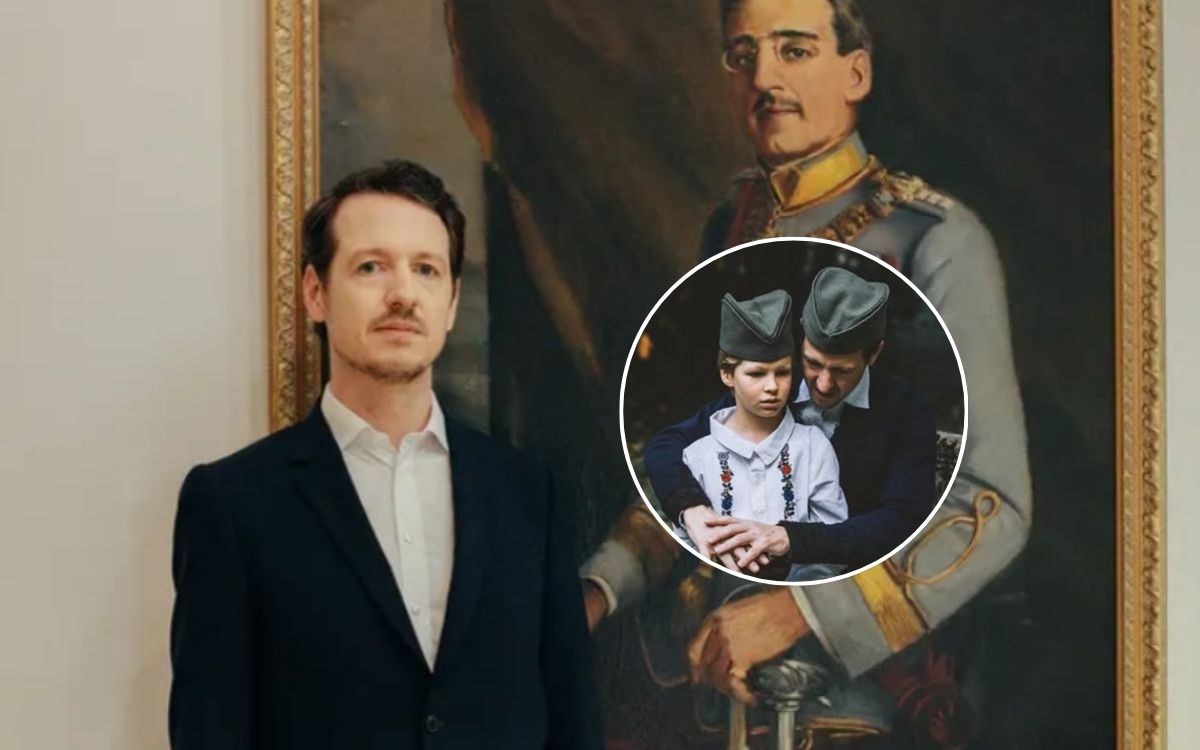
For Prince Filip Karađorđević, heir to the Serbian royal crown, the previous year was full of trials, but also joy.
In the five years that have passed since he decided to move from London to Belgrade with his wife, Princess Danica, and son Stefan, Prince Filip has built an image and authority in public as a man who clearly and unequivocally expresses his views on the most important political and social topics and dilemmas that worry, and often divide, Serbia.
Unlike his father, Prince Alexander, who mostly went along with the authorities, Filip quite loudly supported the students, risking the regime denying him the maintenance of the Karađorđević court complex, which in the end partially happened.
The people recognized that sincerity and concern for national interests, as did our editorial staff, and thus Prince Filip Karađorđević is the person of the year in Serbia as chosen by Serbian Times.
We began the interview on this occasion with what we, and the prince, considered most important…
You publicly took the side of the students who are seeking justice for the victims in Novi Sad and asked the state not to carry out violence against them…
-As the prince-heir, I am very aware of my role, which does not belong to daily politics and party divisions. But as a man, a parent, and a citizen of Serbia, it was important for me to express my view that Serbia does not need additional divisions.
The demand for truth, justice, and dignity must not be the property of any political side. These are the foundations of every state that wants to last, to develop, and to build trust among its citizens.
The role of institutions, but also of all of us who have public responsibility, is to contribute to calming, dialogue, and the restoration of trust in moments of tension. Only a society that knows how to listen to its youth can have a secure future.
You recently celebrated the Karađorđević royal Slava, and the liturgy was served by the Serbian Patriarch Porfirije…
-I perceive our church as one of the pillars of spiritual and historical identity that for centuries preserved the continuity of the people and the state, often in the most difficult times.
The role of the Patriarch carries great responsibility, especially in a society undergoing deep changes and challenges. I believe that the Church should remain a space of conciliarity, dialogue, and spiritual comfort, above daily-political debates.
In times of division, our common obligation is to preserve unity, mutual respect, and understanding. Without that, there is neither a stable state nor a healthy future.
You refused to lay wreaths with the state delegation during the commemoration of the anniversary of the death of your great-great-grandfather, King Peter. How did you experience the fact that as a Karađorđević and heir to the throne, they placed you only 5th in the protocol sequence of those who were supposed to lay wreaths? What do you think of that move by the authorities, what does it show?
-The state’s relationship toward the Karađorđevićs in the last 25 years has often depended on political circumstances and the current relationships of political actors. However, I believe that a mature and self-confident state has the strength to build a stable and dignified relationship toward its own history, regardless of political cycles. This was best understood by Prime Minister Zoran Đinđić, who had exceptional relations with my father, a visionary stance toward the Karađorđević dynasty and the role it has in modern society.
What is significant is the long-term regulation of relations between the state and its historical dynasty, for the benefit of institutions, society, and citizens as a whole. The Karađorđević dynasty does not see itself as a rival to the state, but as a part of it – as a resource of experience, continuity, and international reputation that can be to its benefit.
Our wish is to contribute to Serbia through work, knowledge, connections, and symbolic stability, always in the service of the state and its citizens.
On that occasion, you linked the legacy of King Peter with the student protests. Do you think your ancestors would be with the people or with the authorities today?
-My ancestors always strived to put the interests of the state and the people ahead of personal or political ones, even in moments when they themselves were the authority.
In modern democracies, protests and differing opinions are not a threat to stability, but a part of social life. The real challenge arises when the ability to hear the other side is lost.
The struggle for a state of law, responsible institutions, and mutual trust should be a common goal, above divisions. That is the space in which society can unite around the future, rather than divide over the past.
You have addressed the public several times regarding “Ćacilend,” specifically the tent settlement in Pionirski Park, where the New Palace is located, where your ancestors once stayed… Have you ever received any response from the authorities?
-My addressing of the public related exclusively to the protection of cultural-historical heritage and natural assets, which belong to all citizens of Serbia, regardless of political beliefs. Our historical heritage is not a matter of the moment, but a responsibility toward future generations. I am glad that the authorities recognized the importance of preserving that space and made decisions in accordance with the interest of the state and that it was dismantled.
You sent congratulations to the new Pope Leo XIV upon taking office, wishing that he does not recognize the independence of Kosovo and does not allow the canonization of Stepinac.
-These are messages we haven’t heard for a long time from those who ought to be sending them, the politicians who lead Serbia…
How important is it that such messages are emitted at every opportunity?
-In international relations, consistency, symbols, and continuity have exceptional weight. The issue of Kosovo and Metohija for Serbia is not a daily-political topic, but a matter of international law, historical heritage, and basic justice.
That is why it is important to speak about these issues calmly, with arguments, and always in the interest of the state, regardless of political changes.
The head of the Roman Catholic Church has a strong symbolic influence in the world and precisely because of that, it is important that messages concerning international law and respect for the sovereignty of states be clear and principled.
With Princess Danica, you were at the memorial service for the murdered Obrenović dynasty this year. What led you there and what message did you want to send?
-Our wish was to pay respect to the Obrenović dynasty, as well as to all Serbian dynasties that wove themselves into the creation and preservation of the state.
Serbian history is not a series of opposing families, but a continuity of statehood, sacrifice, and service to the people. Every dynasty, from the Vlastimirovićs and Nemanjićs, through the Lazarevićs and Brankovićs, to the Obrenovićs and my ancestors the Karađorđevićs, made its contribution to the freedom, sovereignty, and identity of Serbia.
It is time to view history as a space of gathering, not separation, to learn from it and draw strength for the future.
Apart from what they see in public, people in Serbia actually do not know what you do and what you live on?
-Apart from what they see in public, people in Serbia often do not know what I do professionally.
For years I worked in an international environment as a portfolio and stock market analyst in a quantitative equity team, which brought me practical experience in financial analysis, understanding markets, and long-term thinking.
Today I am professionally engaged in the international company JAN3, a Bitcoin technology company that develops infrastructure and collaborates with individuals, companies, and states on strategy, education, and the implementation of solutions based on Bitcoin.
I believe that this combination of experience from traditional finance and work on Bitcoin technology can be useful to Serbia through practical education, a better understanding of sound economic principles, and making more thoughtful decisions and policies guided by long-term interest rather than short-term gain.
Where do you currently live and do you plan to move into the Old Palace, where your father and stepmother live?
-In 2024, my family and I moved into the house – an annex located within the Palace Complex known as the Straw House. It was the first building constructed on the site of today’s Palace Complex when the land was bought by my great-grandfather King Alexander I and great-grandmother Queen Maria. They bought the Palace Complex in Dedinje with the wish to build a private home for their family there. It was precisely from the Straw House that King Alexander oversaw the construction work on today’s Royal Palace. Upon completion of the construction of the Royal Palace, the Straw House was used as a school – classroom for Princes Peter, Tomislav, and Andrej, and later as an art studio for Queen Maria. Today, Danica and I live in that house with our children Stefan and Marija. For us, it is primarily a family home, a space where we want to raise our children with an awareness of continuity, responsibility, and service to the community. As for moving into the Old Palace, that is not a priority for us right now.
As the heir to the throne, do you receive any income from the state of Serbia and how much is it?
-Neither my father nor I receive personal funds from the state of Serbia. The state allocates funds for the maintenance of the Palace Complex as a cultural monument, which belongs to all citizens and is owned by the state. The palaces were built with the personal funds of my great-grandfather King Alexander I and were confiscated by the new communist authorities in 1947.
Danica and I finance our family and private obligations with our own work, like most people in Serbia. I believe it is important that the relationship toward the state be based on responsibility, not privileges.
How are you doing with the Serbian language? Our sources say you are on a good path to mastering it completely?
-Learning the Serbian language is going well for me, but Serbian is not an easy language at all. Our children growing up in the diaspora, with whom I have much in common, will understand me. It is challenging to teach children both the language and identity of their country while living abroad, but it is not impossible. That is why Danica and I are very happy that our children are growing up in their fatherland and that Serbian is their mother tongue. My mother tongue is Spanish; I spoke first in Spanish and I think that greatly facilitates my learning of the Serbian language, compared to people whose first and mother tongue is English. I learn the most precisely through daily life, but also with my children and wife.
And your children, what language do they speak in daily life? What schools do they go to?
-Serbian is the mother tongue of our children. Stefan is bilingual and speaks English, and is currently also learning French. Marija is still small and for now uses exclusively Serbian words.
Besides the fact that Danica is Serbian and Serbian is the mother tongue, it is important to us that the children grow up rooted in Serbian culture and language, but also open to the world in which they will live.
Princess Marija is still small, but is our future king Stefan interested in Serbian history and current events? What interests him most, what are his favorite topics…?
-Stefan shows great interest in history, both family and national. He is very curious and asks many questions, which I consider a great value.
He is particularly interested in the history of our Church and spiritual heritage. Visits to Hilandar and Visoki Dečani left a strong impression on him and contributed to his understanding of identity and responsibility.
This year you were in the Hilandar monastery for the first time with your son Stefan. What did you bring home as the dearest memories and mementos from that trip? What will you remember for the rest of your life?
-Mount Athos and the Hilandar monastery have a special significance for me. There is the root of our faith and the foundation of Orthodoxy. The most precious memory from that trip is Stefan’s sincere joy and curiosity. His attention, questions, and respect for the holy site were a moment of great pride for me.
The moment when he recited the “Our Father” during the liturgy represents a joy that I will carry within me forever. Those are the moments that remind one of the meaning of continuity and the responsibility we carry as parents.
How do you spend your free time in Belgrade, in Serbia? What are your favorite places for a walk, going out, where do you go on excursions?
-Unfortunately, I don’t have much free time. What I enjoy most is going to Liturgy at the Topčider church and meeting people after the service.
Those conversations, simple and sincere, help me stay connected with the real life of the people and their daily worries.
How much has your perception of the Serbian people changed since you returned and started life in Belgrade? Who has changed more since then, you or the Serbs?
-Living in Serbia for the last five years has given me the opportunity to get to know our people much more deeply, their strengths and challenges.
Traveling through the country and talking to people helped me develop a strong sense of belonging. Today I fully identify with Serbia and its citizens, which is an experience that cannot be gained from a distance.
You have never been to Chicago, visited our diaspora… do you plan on coming with your family anytime soon? (Btw, I would very gladly organize your visit here when you decide…)
-A visit to Chicago is not currently in our short-term plan, but the diaspora has special significance for us. The connection between the motherland and the dispersed population is one of the foundations of Serbia’s long-term strength.
When conditions are created for it, we will gladly visit our community and spend time with people who carry Serbia far beyond its borders.
Do you, honestly, in the depths of your soul, still hope that Serbia could one day become a kingdom again?
-Thinking about different forms of state organization, including a monarchy, is legitimate in any democratic society. Such questions can make sense only as an expression of the free and clearly stated will of the citizens.
In countries where it exists, a monarchy often has a stabilizing and symbolic role, above daily politics. If Serbia were to decide on that path one day, I believe it could contribute to institutional stability and the international reputation of the state.
Until then, my role is to serve Serbia within the existing order, with respect for the democratic will of the people.
Finally, I would ask you to send a New Year’s message to all Serbs in the motherland and the diaspora…
-On the threshold of the new year, I address you with deep respect and a sense of shared responsibility toward the land from which we originate.
Serbia is not just a space bounded by borders. It is a community of memory, language, work, and dignity that we carry within us, wherever we live.
The New Year is an opportunity to renew faith in honesty, work, and mutual understanding. The future of Serbia depends on all of us – both those who live in it and those who carry it in their hearts around the world.
May the new year bring more harmony, trust, and strength to build Serbia as a country that is believed in and returned to – through deeds, respect, and love.
MORE TOPICS:
Author: Antonije Kovačević; Photo: Handout