




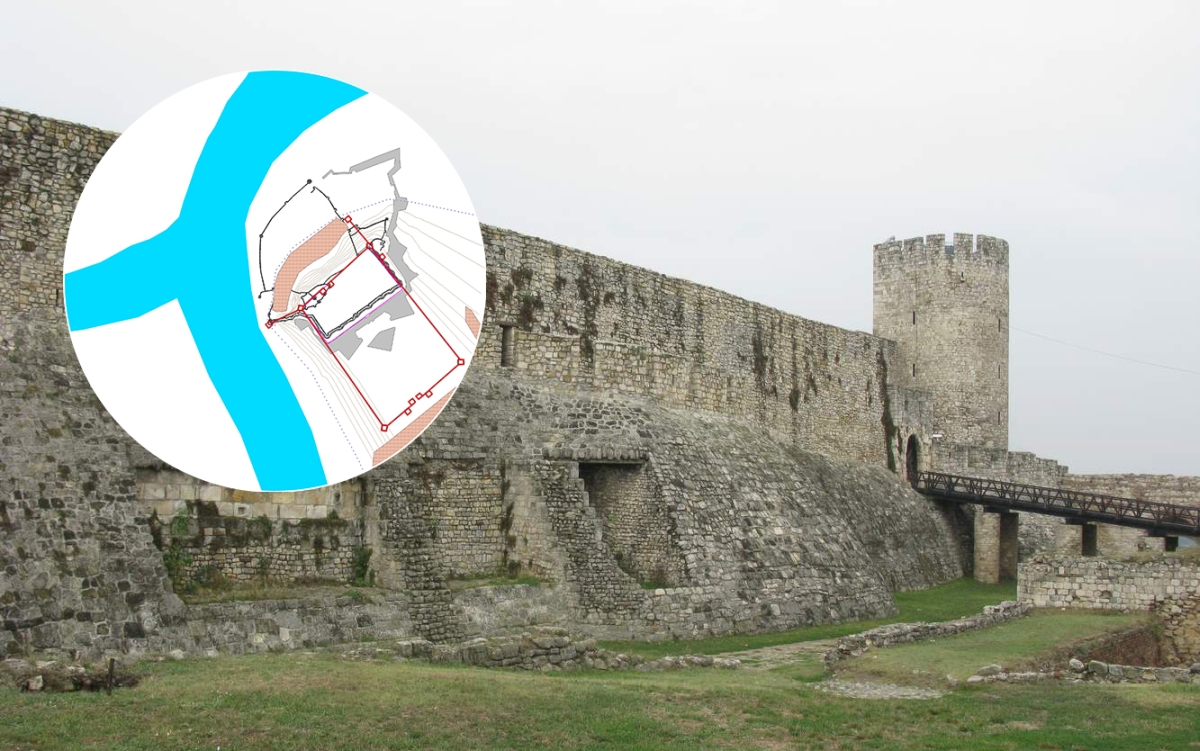
The confluence of the Sava into the Danube has attracted many peoples since prehistoric times due to its favorable geostrategic position. Due to the ability to monitor water and land routes from Europe to Asia Minor that intersected here, as well as control the left bank inhabited by barbarian peoples, this place was of great importance to the Roman Empire.
The Celtic Singidunum was conquered by the Romans at the beginning of the 1st century AD. When they established a border with barbarian lands (limes) along the Danube, a series of larger and smaller military fortifications were built on the northern border of the Roman province of Upper Moesia, including a legionary camp in Singidunum.
On the ridge above the confluence, at the beginning of the 2nd century, a large fortification (castrum) was built, in which the IV legia Flavia Felix was permanently stationed.
In nine decades of archaeological research of the Belgrade Fortress, the remains of the castrum were found in the area of the Upper Town and Kalemegdan Park on an area of 20 hectares.
Research has shown that the castrum was in the shape of an irregular trapezoid, with the main gate (porta praetoria) on the route of the northwest rampart near the present-day Defterdar gate and the remains of the northern corner tower visible below today’s Despot tower.
Parts of the northeast rampart were discovered near the Zindan gate and the Cvijeta Zuzorić Pavilion, and the one opposite it on the edge of the Sava promenade.
FIND OUT MORE IN SERBIAN:
In today’s Pariska Street, parts of the southeast rampart were found, of which the best preserved are the remains of the southeast gate (porta decumana), whose foundations are located below the building of the Belgrade City Library.
Artifacts found in Singidunum can also be seen as 3D models on the Singidunum 3D platform.
Jovian (pictured) was #Roman Emperor from June AD363 to February 364. He was born in Singidunum ( #Belgrade in #Serbia) in AD331, the son of the commander of Constantius II's imperial bodyguards. Jovian went on to join the imperial bodyguard himself. pic.twitter.com/EBTgeq35Yb
— Trimontium Trust (@TrimontiumTrust) March 27, 2020
Remains of the southeast gate
The complex of this monumental gate consisted of a portal with three passages – a larger central one for carts, and two strong side towers. In the Roman Hall of the BGB, its stone foundations can be seen today below the former northeast passage and tower, as well as a walled canal with a lead pipe for supplying the castrum with water. According to the dimensions and depth of the foundations, it is assumed that the gate was over 20 meters high.
Inside the fortification, the remains of the main street leading from this gate to the command headquarters, then the remains of soldiers’ barracks, hospital, baths, warehouses and other buildings were found. The strong ramparts and towers of the fortification were built of broken stone and lime mortar, with cladding of hewn stone blocks. Deep defensive ditches stretched in front of the walls.
Outside the fortification, the core of the city settlement developed with public and private buildings in the areas between today’s Kralja Petra Street, Kosančićev venac, Republic Square and Gospodar Jovanova Street.
In front of the Library building in Rajićeva Street, the remains of two streets were discovered that went from the southeast gate through the civilian part of the city and which partially coincide with today’s Vasina and Knez Mihailova streets.
Roman Gold 4th Legion Flavia Felix Ring. This legion was once stationed in Singidunum, modern #Belgrade, #Serbia. pic.twitter.com/Hk5koz518J
— Ivana Lepojev (@ivanalepojev) September 6, 2015
Economic and cultural prosperity of the city
With the arrival of the IV Flavia Legion, a time of economic and cultural prosperity of the city began. In addition to the local population and soldiers, merchants and craftsmen from all over the Empire lived in Singidunum.
The achievements of Roman civilization, as well as elements of various cultures, often from the most remote provinces, met here, giving life and a special spirit to the city which in the 2nd century received the status of a municipium, and in the 3rd century became a colony.
At the end of the 4th century, barbarian attacks became more frequent, but only in 441, in a fierce Hunnic attack, one of the strongest fortresses in this part of the Danube, the castrum in Singidunum, failed to resist.
Modern Belgrade lies on the material remains of its turbulent past. During construction works, especially in the city center, fragments of ancient monuments are often found today. Thus, during the reconstruction and adaptation of the Belgrade City Library building, in the mid-1980s, parts of Roman fortification were discovered below the basement premises. After that significant discovery, it was decided that part of the ancient building should be presented museologically by incorporating it into a modern interior intended for public gatherings. Thus, instead of the planned book depot, a unique Roman Hall of the BGB was formed.
MORE TOPICS:
Source: National Geographic, Photo: Wikimedia Creative Commons