




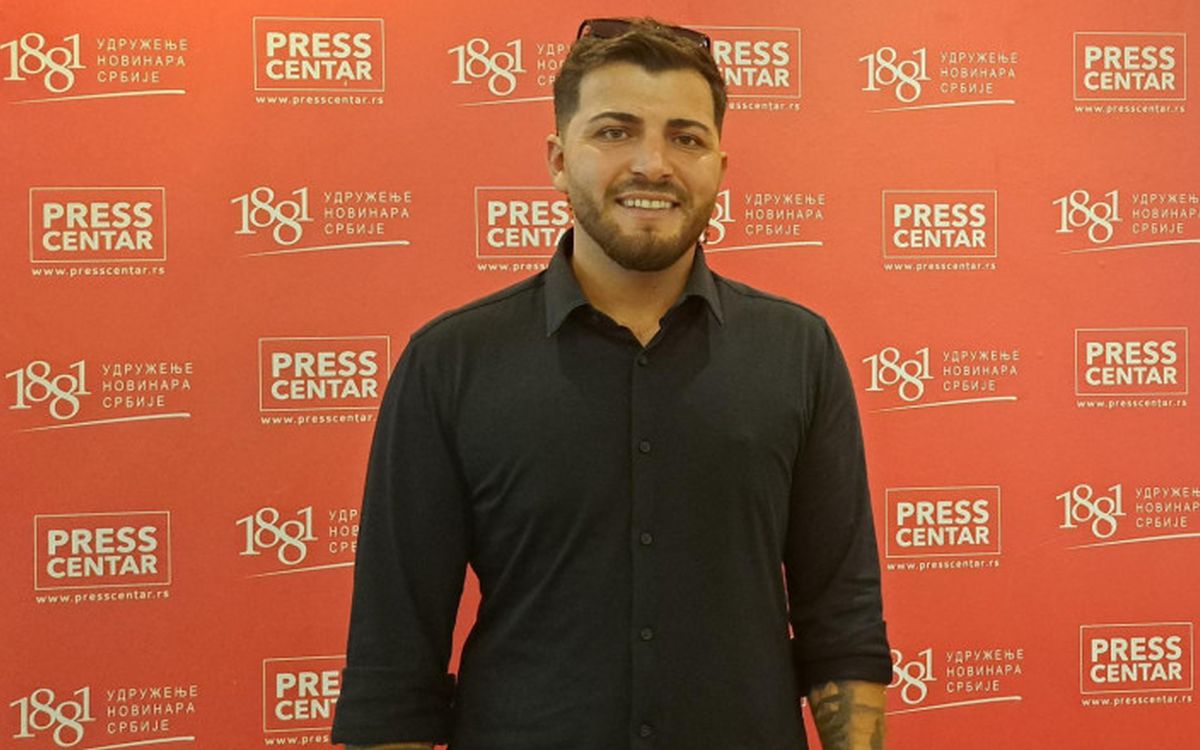
Karoh Pishtevan, a Kurd from Iraq, was forced to leave his homeland at the age of fifteen. He didn’t think about where he was going, he just knew he had to leave Iraq. He describes that long journey, which he says lasted almost a year, in one word – terrible. On that journey, he was beaten, spent seven months in Romania where his asylum request was rejected. After that, he went to Austria, from where he was deported to Hungary, and from Hungary to Serbia.
Today, Karoh works in Belgrade, happy to have stayed here and doesn’t intend to leave Serbia one day. Incidentally, Karoh Pištevan is the second refugee in Serbia who, after five and a half years spent here, received a travel document with which he can, as he told us six months ago when he received it, finally see the sea.
Six months later, he tells us what it was like to finally cross the Serbian border and return home – to his Belgrade. “I was in Bosnia and Herzegovina, and then I went to the sea in Montenegro. I spent the whole summer there. I had a wonderful time and was so happy that after so many years I could also travel and see the sea. In previous years, my friends invited me to go with them, but since I didn’t have a passport, I couldn’t travel anywhere. Finally, I could go somewhere. I made the most of it,” he told Euronews Serbia.
In an interview for our portal, he states that he decided to stay in Serbia because he likes it here and doesn’t see himself in any other country.
“I really like it here, it suits me, the people are wonderful. Everything suits me, really,” he says, and when asked what “bought” him so much to stay, he answers immediately: “People.”
“People, culture, and how we accept each other”, Pištevan adds with a smile that doesn’t leave his face when talking about the citizens of Serbia.
He says that people accepted him well, that he never experienced anything unpleasant because he was a refugee. He adds that people in this region have experienced a similar situation as he did, who had to leave their homeland, so they understand, he explains.
FOLLOW US ON FACEBOOK:
How he left Iraq Karoh Pištevan works as a translator in two companies in Belgrade, but that’s not all he does.
He talks with great enthusiasm about his volunteer work in the Cultural Center for almost seven years. In that cultural center, he also found support, and he says that the employees there helped him a lot to learn the Serbian language.
“I went there often and worked with people and they helped me learn the language”, said Karoh. When asked if our people have prejudices against refugees, he replies that he did not have such an experience, but he adds that his roommate with whom he lived once followed a page on Instagram – “Stop migrants” – and then they became best friends.
“We lived together for three years. Now he has finished university and is returning to Šabac. He is ours, so to speak, and my best friend”, Karoh joked and continued:
“I never experienced anything unpleasant, thank God. The people around me were phenomenal, so I never had any problems.”
Karoh, a Kurd, while recalling during our conversation what his departure from his native Iraq looked like, says that he embarked on a difficult, long and uncertain journey nine years ago. He set off at the age of fifteen, alone. The whole journey lasted about a year, and he says that he stayed in Romania for seven months, and that his asylum request was rejected there, he went to Austria from where, he recalls, he was deported to Hungary, and from Hungary to Serbia. The whole journey, he says, was terrible and a lot of bad things happened to him. He was also beaten in Bulgaria, but he claims that everything paid off. He had to embark on such a long journey, he replies.
“I was young, but I had no choice. My uncle was a general in the army. When my father died, when I was 13 years old, and in our country when the father dies, the uncle takes responsibility for the family, he wanted my brother and I to go to war. My brother then went to Iran, and I came here afterwards”, says Pištevan.
He also adds that he hopes to “use” the passport again soon and meet his mother in Iran in the spring, whom he hasn’t seen for almost a decade.
First passports Let us remind you that after 16 years of the asylum system functioning in Serbia, the first passports for refugees were issued at the end of March this year. The first one went to a Kazakhstani, and the second to Karoh’s.
“This passport means a lot to me, I’m overjoyed. It opened doors for me all over the world”, Pištevan told Euronews Serbia six months ago. Incidentally, foreigners who have been granted asylum, the right to residence and protection in Serbia, in accordance with the Law on Asylum and Temporary Protection and the Regulation on the Appearance and Content of the Travel Document for Refugees, from February 1, 2024, can submit a request for the issuance of a travel document for refugees.
In 2023, 1,654 persons expressed their intention to seek asylum in the Republic of Serbia. Most of them are citizens of Burundi, Russia and Cuba. Of that number, 196 of them decided to initiate formal asylum proceedings and submitted an asylum application to the Asylum Office. From 2008 to February 2024, 248 persons were granted international protection in the Republic of Serbia (114 persons were granted refugee status and 134 persons were granted subsidiary protection).
“The Law on Asylum and Temporary Protection prescribes the issuance of a travel document for refugees on a biometric form, which, in addition to protecting human rights, enables freedom of movement for this category of persons”, the Ministry of the Interior stated for Euronews Serbia at the time.
With the adoption of the Regulation on the Appearance and Content of the Travel Document for Refugees in November 2023, Serbia has defined the appearance of the travel document for persons who have been granted asylum in Serbia. The same regulation was adopted on November 24, 2023, and began to be applied from February 1, 2024.
Serbian passports for refugees are blue, and at first glance they do not differ from passports for Serbian citizens. However, the refugee passport, as a travel document, does not imply Serbian citizenship, but enables persons to whom Serbia has granted asylum, i.e. provided them with its protection and residence on its territory, to travel outside Serbia if there is a need for it.
READ MORE
ONLY THEY WORK MORE THAN US: Serbs second in the number of working hours in Europe!
Source: Euronews
Photo: Euronews/Branislava Gigović