




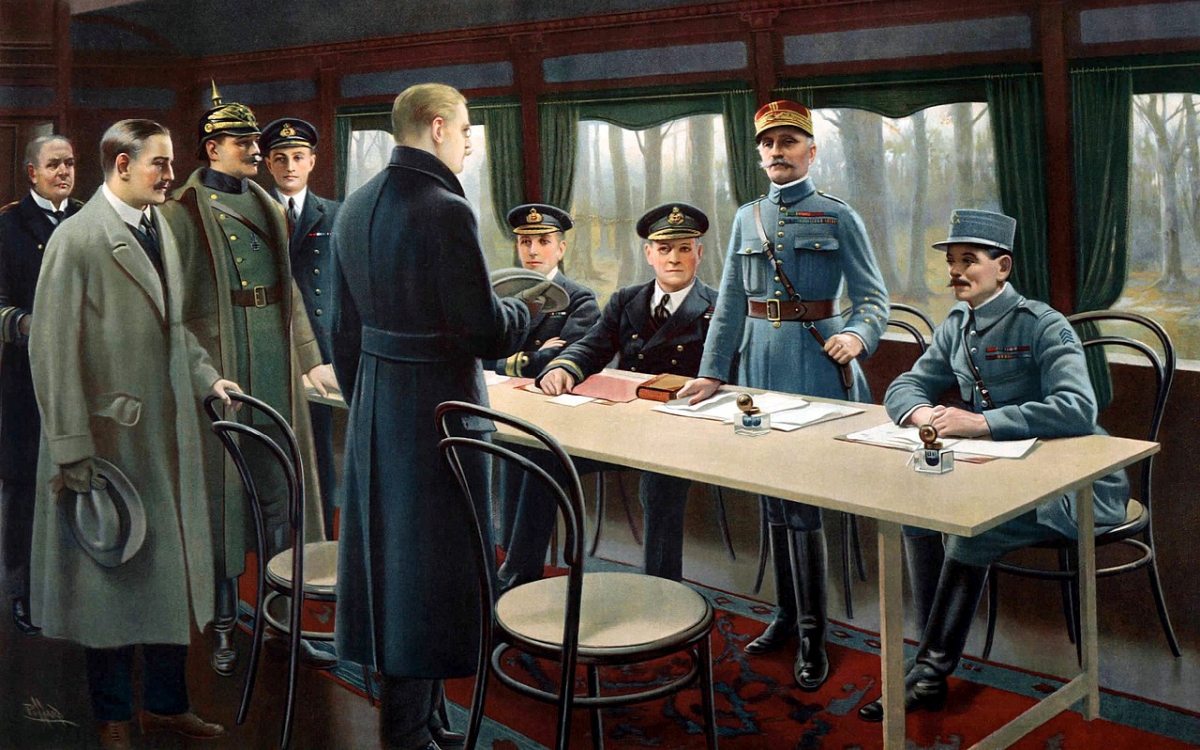
Serbia and the world today mark Armistice Day in World War I in memory of November 11, 1918, when the Allied Powers signed an armistice with Germany, thus ending the First World War.
Armistice Day in the First World War is marked in memory of November 11, 1918, when an armistice was signed in the French town of Compiègne, ending the First World War.
The armistice was signed in a special car by Marshal Ferdinand Foch. It came into place at 11 AM and was active until the conclusion of the final peace treaty in Versailles on June 28, 1919.
In Serbia, this day was first marked in 2012.
The main motif for the emblem of this holiday is the flower of Natalijina Ramonda, and the emblem also features the motif of the ribbon of the Albanian Commemorative Medal, which is located above the flower.

The symbolism of Natalijina Ramonda
Natalijina Ramonda has multiple symbols and speaks of our people and the trials they went through during and after that war.
It is an endangered species that grows in eastern Serbia and on Mount Nidže at the highest peak of Kajmakčalan, where the Serbian army, under the command of Vojvoda Živojin Mišić, fought fierce battles during the creation of the conditions for the breakthrough of the Salonika Front.
The flower was named after Queen Natalija Obrenović and is known as the “phoenix flower” because even when it completely dries out, if watered, it can revive.
That is precisely why Natalijina Ramonda was chosen as a symbol to mark this important date – to indicate the resurrection of the Serbian state from the ashes after the First World War.
In addition to the flower of Natalijina Ramonda, the emblem, which is worn on the lapel, also contains two green ribbons, which are associated with the ribbon of the famous Albanian commemorative medal.

The armistice in the First World War was signed on November 11, 1918, between the Allied Powers and Germany, thus ending that war.
In that war, the Serbs suffered a great sacrifice, as about 1.3 million citizens were killed, which at that time represented almost a third of the total Serbian population.
In addition to Serbia, Armistice Day in the First World War is given special attention in Great Britain and Commonwealth countries.
Other countries commemorate fallen soldiers and civilians in a similar way on this or another day.
FIND OUT MORE:
Thus, in Great Britain, in the period before Remembrance Day, as Armistice Day is also called, almost the entire population, and especially state officials, civil servants, media workers, and other categories of citizens, wear a stylized poppy flower on their lapels.
The red-black flower of the wild poppy, which, according to poetry and tradition, was the first to sprout after the war on the fields of Flanders where millions of soldiers died, is also distributed to foreign participants in commemorations at military cemeteries.
In Russia, Victory Day in the Second World War is commemorated in a similar way, when volunteers, usually young people, distribute orange-black ribbons on the streets of cities, the St. George’s ribbon (in the colors of the Order of St. George).
SIMILAR TOPICS:
Source: Nova.rs
Photo: Wikimedia Creative Commons