




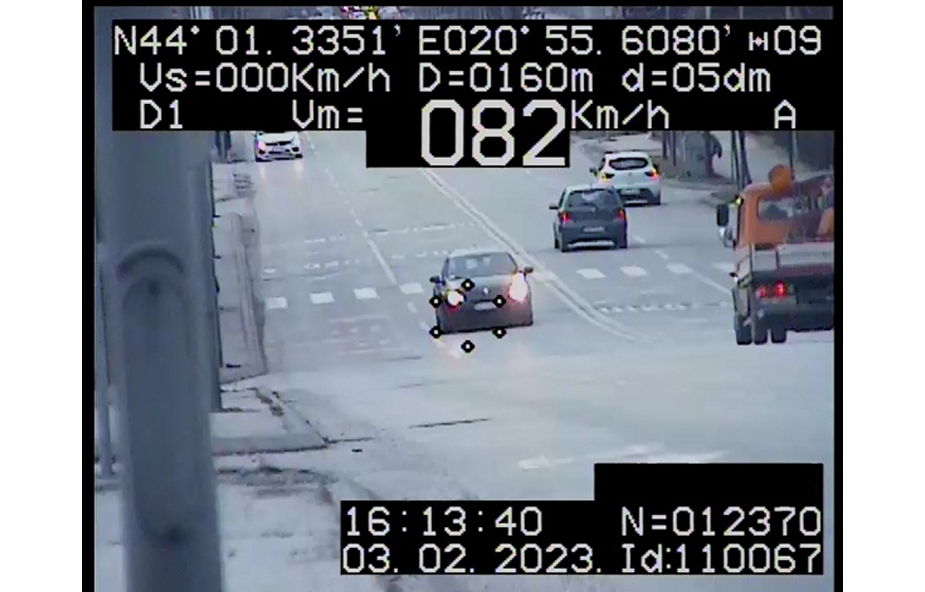
Classic radars, which are becoming increasingly rare on Serbia’s roads, will be replaced starting in January next year by new, “invisible” radars that, in addition to measuring a vehicle’s average speed, will also register other violations. How radars work in general, at what distance they record violations, and what types exist were topics we discussed with traffic attorney Vladimir Miljević.
When it comes to classic radars, he says they are appearing less and less on Serbian roads and points out the new types that are now in use.
Laser devices – lidars
“Laser devices, or so-called lidars, are now increasingly represented and operate on a different principle. These are a newer generation of laser devices for measuring speed. This applies to handheld or stationary speed-measuring devices used by police officers,” attorney Miljević says at the beginning of the conversation.
He adds that there are also console-mounted systems—speed-measurement systems that are practically operational throughout the entire day—as well as systems for measuring average speed on highways.
“These are not speed-measuring devices in the classic sense, because speed here is expressed using the standard formula v = s/t—speed (v) equals distance traveled (s) divided by time (t). I also have documentation from ‘Roads of Serbia’ confirming that they do not have devices for measuring speed in the classic sense, but rather calculate the distance traveled per unit of time from the entry point to the exit point, because speed is not measured only at the entrance and exit; there are also intermediate sections where average speed is measured,” says attorney Miljević.
“What we additionally have on the roads are so-called dual radars, which are last-generation devices and record speed in multiple traffic lanes simultaneously,” he adds.
They catch violations at 150 to 300 meters
As for how many meters away radars detect violations, our interlocutor says it depends on the specific radar.
“If we are talking about classic portable speed-measuring devices, handheld or mounted on a tripod, these are devices capable of measuring speed at distances greater than 500 meters. However, that is not the usual practice in speed enforcement; recording typically begins at distances of 150 to 300 meters—this is an average—because the aim is to make both the recorded speed and the license plate visible. The reason is that the only credible proof of an offense is a photograph showing all elements of the violation, namely the speed and the license plate,” Miljević explains.
Radar that records average speed
Asked what average speed is, the attorney explains that it is “a speed that is not determined instantaneously, but is calculated based on the distance traveled per unit of time between two control points, the beginning and the end.”
“If we know the exact length of the road and how long it took the vehicle to travel that distance, we can calculate the average speed, which in my opinion is quite controversial.
For example, someone may drive constantly at 140 km/h on the highway, which is 10 km/h above the limit, but that is far less dangerous than someone who drove over 200 km/h on certain sections but averaged maybe 120 km/h, so their overall average still comes out to around 135 or 140 km/h. So averages, like statistics, can say everything—and nothing.”
“Speed is measured on approach, but also on departure”
As a rule, a violation is recorded regardless of whether the vehicle is accelerating, maintaining the same speed, or decelerating.
“There is no sensor that can be considered a trigger. The devices are set to measure speed, so you can have a high speed during the deceleration phase and it will be recorded at some moment as the instantaneous speed. It should also be known that speed can be measured not only when the vehicle is approaching but also when it is moving away, in which case it is marked with a minus sign, as a negative value. This is practiced on sections where the terrain morphology makes it difficult, for certain reasons, to organize speed recording of oncoming vehicles, so speed is recorded as the vehicle departs. In such cases, the driver is not stopped but is usually later sent a request to state who was driving the vehicle,” Miljević explains.
What the new radars will detect
The head of the Traffic Police Directorate, Slaviša Lakićević, previously announced the installation of average-speed measurement systems, which were said to be rolled out across Serbia this month. On some sections they have indeed been installed, but for now there is no official information on whether the system is fully operational.
According to him, these devices will detect:
- speeding violations
- mobile phone use
- seat belt use
- parking violations
- everything else that leads to the most serious traffic accidents
Mobile radars always in a different location
What is new are mobile radars, and the trick with them is that they can always be placed in a different location, well concealed.
“When it comes to mobile radars, they can be moved around, and drivers will not know whether the radar is located in a van, a trailer, or some other device. You will never know its location, and no one will be able to warn you about a radar, and the punishment of all participants who do not respect traffic regulations will be extremely extensive,” Mirko Koković, deputy director of the Traffic Safety Agency, previously said.
As Professor Milan Vujanić from the Faculty of Transport and Traffic Engineering earlier told Blic, mobile radars are moved from place to place and, upon detecting one of three traffic violations, automatically send a report to the Ministry of the Interior (MUP).
The next step is for the MUP to send the report to the vehicle owner, regardless of whether they were driving the vehicle at the time.
The vehicle owner must respond, otherwise pays 25,000 dinars
“The owner of the vehicle with which the violation was committed will receive, in the envelope sent to their home address, a question they must first answer—whether they were driving the vehicle. If they do not provide information about who was driving, they will have to pay a fine of 25,000 dinars,” Professor Vujanić explains.
As he emphasizes, the goal of these radars is to help ensure greater compliance with regulations and indirectly improve traffic safety, because many consequences arise precisely from not wearing seat belts, using mobile phones, and exceeding the speed limit.
Are radar apps useful
As for radar apps, attorney Vladimir Miljević says the question is how much they can actually help drivers.
“They most often warn about locations where a stationary speed camera is known to be installed. These apps will sometimes also warn us about temporary controls carried out by police officers using portable speed-measuring devices. They can help only to the extent that the information is up to date at that moment. That depends on the content and quality of the app,” Miljević says.
MORE TOPICS:
MARK BRNOVIĆ BURIED IN PHOENIX: Family and Friends Pay Their Final Respects! (VIDEO)
Source: Nova Foto: MUP