





On July 19, 1956, the leaders of Yugoslavia, India, and Egypt – Josip Broz Tito, Jawaharlal Nehru, and Gamal Abdel Nasser – signed the Brioni Declaration on a Joint Anti-Bloc Policy.
This marked the beginning of the creation of the Non-Aligned Movement, which was officially established five years later in Belgrade.
The fact that the Non-Aligned Movement still exists today and includes 125 countries worldwide is a true marvel. No other informal Cold War-era framework managed to survive after the fall of the Berlin Wall and the collapse of the USSR.
Six decades after that first conference in Belgrade and three decades after the end of the Cold War, the movement’s development can be summarized in its two main phases: during the bipolar Cold War confrontation and the turbulent period in the world after the disappearance of the Eastern Bloc and the Soviet Union.
It is sufficiently impressive to simply observe that the Non-Aligned Movement managed to persist in two completely contradictory environments: one for which it was created, and another that is a formal negation of the first.
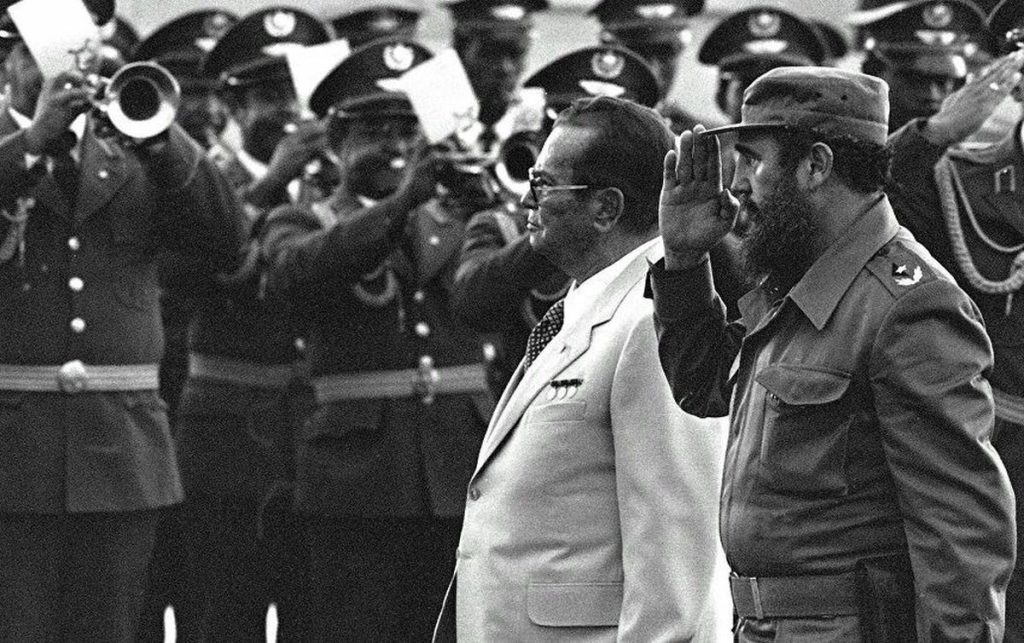
Like other multilateral treaties and organizations, the Non-Aligned Movement is going through uncertainties and a search for its new identity – just as it is happening with NATO, the EU (EEC), the Council of Europe, CSCE/OSCE. However, after the United Nations, it has remained the most numerous effective inter-state movement of countries with over 120 members.
The end of the Cold War in Europe, one could say, is partly due to the policy of the Non-Aligned Movement and then-Yugoslavia, as they jointly demanded an end to bloc divisions, a halt to the arms race, the dominance of large over small countries, peaceful resolution of problems, peaceful coexistence, and a more just economic system in the world.
Non-alignment is the greatest achievement of Yugoslav revolutionary diplomacy.
This experience of Yugoslavia is often trivialized and presented as an unprincipled policy by which Tito deceived the West a little, the East a little, or was sometimes with the West, sometimes with the East. Nothing could be further from the truth. Neither the West nor the East were foolish enough to be manipulated or deceived so easily.
Yugoslav non-alignment did not happen overnight but developed gradually.
The first step in that direction was the split between Yugoslavia and the Soviet Union in 1948, which turned into the first socialist decolonization. Imperialist decolonizations followed later, and the Yugoslav schism became the matrix for later ruptures between colonial centers and peripheral colonies, which gave it experience, secured its reputation, prestige, and advantages in relations with newly liberated states.
The United Nations was the natural center of Yugoslav activities, where it had held a place of honor since 1951 and maintained it for almost the next four decades.
In the same year, the policy of foreign policy balance was shaped. On one side, secret negotiations were held in Washington about American military aid, while on the other, a conflict with the USA and the West erupted over Trieste. Interestingly, the same person was on both sides of this pendulum – Dr. Vladimir Velebit, Tito’s most important wartime and post-war diplomat.
There is no doubt that the main and most important architect of the non-alignment policy was the Yugoslav president, Josip Broz Tito. But, in the beginning, Tito was not the main leader, nor the kind of leader he would become later.
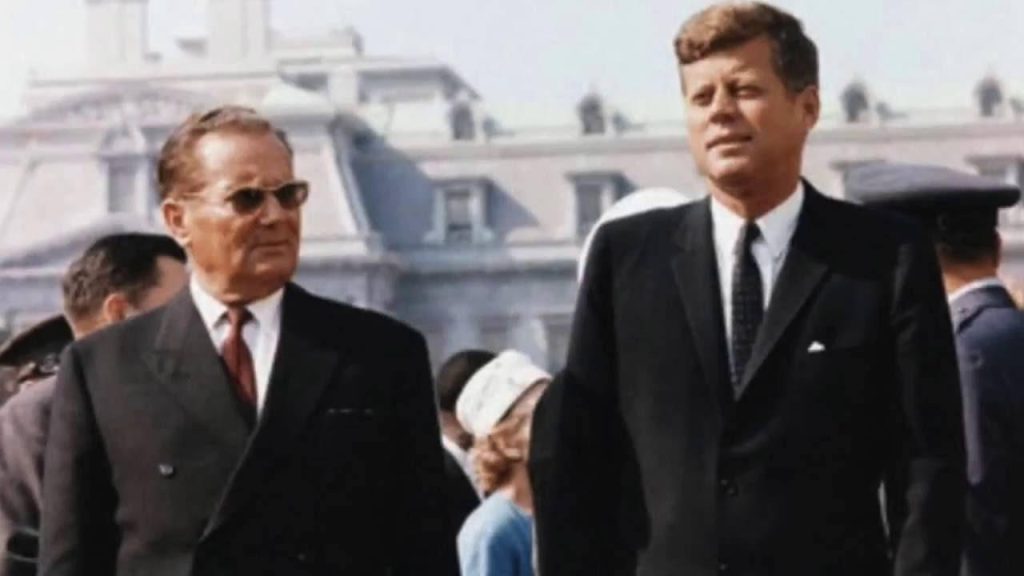
Tito was forged on the international scene by the rise of liberated African nations in the 1960s. While India, Indonesia, and other Asian states, supported by communist China, wanted a regional organization and denied the possibility of coexistence with blocs, Tito wanted a global movement based on the principles of “active peaceful coexistence.”
Active peaceful coexistence recognized the existence of blocs, sought to cooperate with them, acknowledged the existence of pluralistic forms of states in the world, and accepted that “a hundred flowers bloom.” Peaceful coexistence thus transformed into non-alignment and the first international globalization, and Yugoslavia became its leader.
Tito’s activism surpassed Nehru’s passivity, Sukarno’s excessive emotionality, and Nasser’s inexperience. He brought dynamism and devised the movement’s goals. What was then “active peaceful coexistence” is today called a “multipolar world.”
Serbian diplomacy still bears deep traces of this approach to international relations. The policy of four pillars, or the best relations with the USA, China, Russia, and the EU, despite their numerous internal conflicts, and then friendly relations with states considered Western pariahs – Iran, Venezuela, Belarus – are the clearest reflection of contemporary resentments towards earlier forms of active peaceful coexistence. This in no way conflicts with Serbia’s ambitions to become an EU member.
The European Union in Brussels and the Non-Aligned Movement in Belgrade originated from the same philosophical idea. The Non-Aligned Movement is a peace project in the same way as the EU. Serbia is, therefore, determined to contribute to building peace and its values in all organizations that strive for it, regardless of regional or global characteristics.
The idea for the First Non-Aligned Conference in Belgrade was actually born in the Bay of Pigs. When American troops landed in Cuba, Tito was with Nasser in Cairo. They immediately decided to issue a joint statement and propose holding the First Non-Aligned Summit in Belgrade.
When, 60 years ago, on September 3, 1961, in Belgrade, Tito uttered the sentence that he understood why the USSR conducted a nuclear test, but not why it did so during the Non-Aligned conference, he simultaneously laid the foundations of American misunderstanding and distrust towards the non-aligned. The American ambassador in Belgrade, George Kennan, experienced those words as a personal betrayal, as the Yugoslav president had previously promised him not to criticize the USA.
When the US Embassy in Belgrade analyzed the First Non-Aligned Conference held in Belgrade in 1961, it noted that “the presence of a large number of well-known personalities had a very exciting effect on the local population, who greeted delegates whenever they appeared on the streets, sometimes up to four times a day.” “This certainly flattered and pleased the participants and favorably influenced their opinion of Yugoslavia,” the analysis stated, further concluding that “the strong impression Yugoslavia left on all delegates was a reward for the efforts and financial costs invested in its organization. It presented itself as a country with an efficient and energetic government that met needs and enjoyed the support of its people, setting exceptionally high standards of political and economic development.”
No one was as sensitive to the criticism of the non-aligned as Henry Kissinger. And Tito did not spare him when he implicitly accused him of the coup in Chile in 1973 and the military coup in Cyprus in 1974. Kissinger did not want to meet with any Yugoslav official for almost two years and ordered a list of sanctions against Yugoslavia to be drawn up due to its stance in leading the non-aligned movement in relation to American policy.
Kissinger, however, at his last meeting with Tito, from October 12 to 15, 1979, in Belgrade, acknowledged the Yugoslav president for his role in the Non-Aligned Movement, which “America highly values.”
A turning point in the movement’s development occurred at the end of the Cold War. When the 9th Summit was held in Belgrade in 1989, it was clear that the bipolar world was coming to an end and that the foundations of the movement’s existence until then were crumbling. Perestroika in the Soviet Union was in full swing, and the Belgrade Summit was expected to modernize the paradigm of the movement’s activities. As the host of the gathering, Yugoslavia believed that a change in the movement’s policy at the global level was necessary for the movement to survive the challenges of a new era. Hence, Yugoslavia advocated for what was called the “modernization of the Non-Aligned Movement,” which in fact implied rejecting the former negative stance towards the two blocs of world power.
US President George Bush described a vision of the future of international relations in a speech before the US Congress on September 11, 1990, calling it a “new world order,” describing it as “a new era free from the threat of terror, stronger in the pursuit of justice, and more secure in the search for peace, an era in which the peoples of the world, East and West, North and South, can prosper and live in harmony…”
The non-aligned did not adopt the idea of a “new world order.” Before the Non-Aligned Ministerial Conference in Accra (Ghana) in September 1991, the global political situation further deteriorated, including, among other things, the disintegration of the Yugoslav federation. The Accra conference report concluded that no consensus had been reached in favor of the view that the Cold War had ended and that a “new world order” had emerged. The meeting did, however, reaffirm its earlier commitment to a policy of compromise and consultation.
Thus, before the 13th Summit, which Bangladesh was supposed to host in 2002, in the autumn after the 2001 elections, at the first session of the new government, Bangladesh canceled its hosting of the event. The new finance minister said that non-alignment was a “dead horse” and that Bangladesh should not spend money to “bury that horse.” Some major countries accused the Non-Aligned Movement of belonging to an “opportunistic bloc.”
The fact that the non-aligned countries survived the end of the Cold War still indicates that it is a significant political fact or opens up the dilemma that it might just be a case of inertia in international relations. Based on this, the question arises whether the Movement has remained effective and relevant in the current international context?
Contemporary sharp confrontations and conflicts on the world stage have once again raised the issue of unfulfilled high expectations that humanity had after the end of bloc divisions and the Cold War, but also the necessity of explaining why this is so and why relations in the world have taken the path of escalating conflicts and tensions, which sometimes feel stronger than during the Cold War. Some members state that the movement remained too tied to moral, rather than material, strength, although it is clear that developing countries do not have the conditions to emphasize their own economic power.
Speaking in Parliament in February 1953, Jawaharlal Nehru noted that “the strength that limits or conditions the foreign policy of a state can be military, financial, or, if I may use the word, moral. It is obvious that India has neither military nor financial strength. Furthermore, we have no desire and cannot impose our will on others.”
Therefore, only moral strength remained as the basis for action in international relations. And that moral strength was closely linked to the strict observance of international law, from which the founding non-aligned countries formulated their basic principles. The more disrespect for international law, i.e., disrespect for the rights of other states, the more attractive the position of non-alignment becomes for many states in the contemporary world.
Non-alignment took nothing from Yugoslavia and gave it much. It opened Yugoslavia to the world, changed its communism, and integrated its numerous enterprises into the world economy.
Source: Danas, Photo: Non-Aligned Movement Summit in Belgrade / Wikimedia Creative Commons
MORE TOPICS:
SERBIAN DIASPORA GATHERS: Crown Prince Alexander’s Birthday Celebrated in New York!
SECRET VIDEO SURFACES: Nole Wishes Teodosić Retirement with a Song, Sings a Legendary Hit! (VIDEO)
PRICES SOAR: Inflation in Serbia Exceeds Upper Limit, Authorities Blame Bad Weather!
ITALIAN MOVED TO SERBIA FOR LOVE OF DUŠICA: Changed Faith and Took the Name Stefan!
END OF AN ERA: After 25 Years, EXIT Moves from Petrovaradin to the Egyptian Pyramids!