




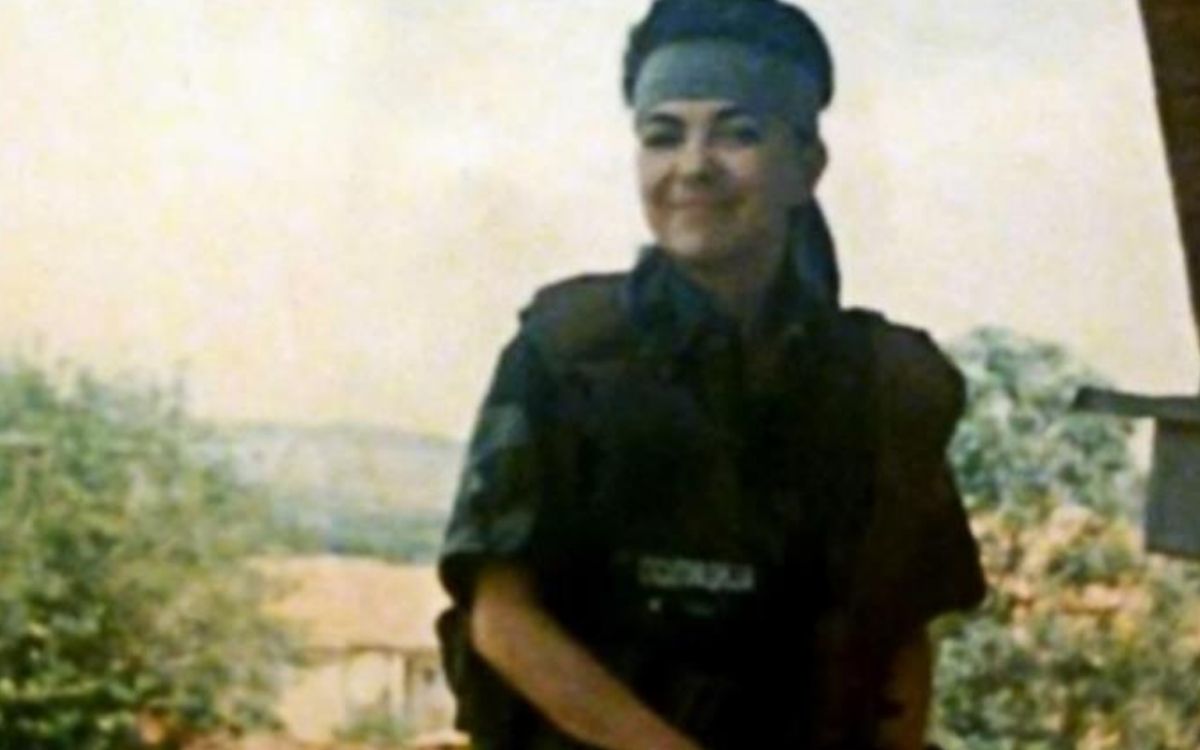
Slađana Stanković (1964–1999) had everything – a successful business, a family and friends who loved her, and a peaceful life in her hometown of Niš. However, while others were planning the future, she wrote a sentence in her diary that would determine her fate: “In case of an attack on Serbia, I will go to Kosovo.”
This is the story of a woman who kept the promise she made to herself, found the love of her life in the midst of the fiercest ბრძოლes, and ultimately laid down her life on the altar of the homeland, leaving behind a legend that will never fade.
Her story was published on the Facebook page “Bombardovanje Srbije 1999. – Da se nikad ne zaboravi”, and we bring it to you below:
“Slađana Stanković was born in Niš. She grew up in a family whose ancestors had always participated in wars in the past. Of course, they were all men.
Everyone loved Slađana. She had a cheerful spirit, a good friend. She was a trader. She had her own company engaged in export and import. She earned honestly, lived an ordinary and peaceful life, appropriate for a woman in her 30s.
Before the start of the NATO aggression, Slađana Stanković kept a diary. Deeply concerned about the situation in Kosovo and Metohija, one day she wrote: “In case of an attack on Serbia, I will go to Kosovo to defend my country. I don’t know if I will return”.
This was later read by her sister Olivera while reviewing the diary. Slađa had no reason to go to war. She was a woman, she was young, had a stable job, everything she needed not to endanger herself in any way.
However, with the beginning of the NATO aggression, this girl, on Wednesday evening, March 24, firmly decided to fulfill the promise she made to herself. She turned to her father and seriously told him: “Dad, I want to go to Kosovo, I want to go to war, this is too much!”.
Her father was stunned: “Slađana, what are you talking about, what war, are you even aware of what is happening, people are dying there, this is not a café”. To which she replied: “Dad, I have firmly made my decision and nothing will stop me”.
The very next day, March 25, Stanković left and voluntarily enlisted in the Niš Corps, with the explicit wish to participate as a fighter, with a weapon.
However, she was soon assigned to the 549th Motorized Brigade on the border, but as a medic, because the soldiers there needed help and reinforcement in terms of medical care. She was assigned to the Gorožup border post, Planeja near Prizren. Her main task was, as a member of the medical corps, to treat the wounds of the injured and provide them with first aid. She performed this flawlessly from the very first day.
After two months, at the end of May, she contacted her family for the first time and told them somewhat unbelievable news. At the border post, she met a Russian volunteer, Yuri Osipovsky. He was only a year older than her, a Russian officer originally from Minsk, Belarus.
Love ignited. In such a difficult and bleak environment, Slađana and Yuri simply found each other instantly. They bonded so strongly that they soon decided to get married. On May 22, both in uniform, they got married in Prizren, and their best man was none other than Božidar Delić, the brigade commander.
The Stanković family was overjoyed, first because they heard from her after so long, and then because of the surprising marriage. At the end of the conversation, she promised them that she would come to Niš with her husband on June 2 on leave for one day, so they could meet him. Unfortunately, that was the last time they heard from her.
Since nearly two-month attempts to break through Košare had failed, and the terrorists had suffered extremely heavy losses, as even the American New York Times wrote at the end of April describing the situation as: “The KLA breakthrough operation at the Yugoslav border has turned into a bloody mess”, a new plan had to be adopted.
At the end of May, more precisely on the 26th, Operation “Strela” began, with massive attacks by combined forces of Albanian terrorists, the regular Albanian army, foreign mercenaries and instructors, aiming to break through Mount Paštrik via the Gorožup border post and reach Prizren.
Their idea was that, since they had not succeeded at Košare, here they would open a route for inserting additional terrorist forces into the territory of Kosovo and Metohija, cut the Peć–Prizren communication line and create space for a possible deployment of NATO infantry, whose ground action had not yet been completely ruled out.
FIND OUT MORE:
The terrorist forces were quite exhausted and reduced, so it was clear, especially after the failure at Košare, that they would not be capable of doing so. Therefore, NATO decided to take the initiative and launch full-scale air attacks on Serbian positions on Paštrik.
On that day, the terrorists launched a general attack, attempting to capture the border post, but primarily to weaken Serbian forces, which NATO would then strike from the air as planned. In the first few hours, part of the aggressors managed to enter deep into our territory, but no more than 200 to 400 meters.
They were first resisted by the First Company of the First Motorized Brigade, with about 200 soldiers on the front line.
The border post itself was guarded by two platoons, that is, 63 fighters. The arrival of four officers from the brigade command after two hours particularly boosted the confidence of our soldiers and raised their morale.
Our side received information that around 1,000 terrorists were at the border itself, and about 5,000 were ready for action in total. The situation seemed extremely critical. Despite a strong initial attack supported by Albanian artillery, the positions were defended and the terrorists stopped.
Our forces did not wait, but after a short break, they were the first to act with 122 mm howitzers and 120 mm mortars, inflicting serious losses on the surprised aggressors. NATO joined in and with an Apache helicopter destroyed the border post building itself. Strong flanking fire then began on our positions, attempting once again by the end of the first day to break through the front line. Because of this, our fighters occupied a second line of defense and defended tactically excellently, once again repelling the attacks. Information then arrived about reinforcements. By nightfall, about 1,200 men were already at the positions, which was now quite sufficient for defense in that direction compared to the initial attacks.
In the following days, the fighting continued. On May 29 alone, NATO flew over Paštrik more than 150 times and observed our positions. The intention was completely clear. The next day, on the 30th, B-52 bombers launched horrific attacks around the village of Planeja. Hell ensued, difficult to describe.
They resorted to so-called “carpet bombing”, dropping 110 tons of bombs over an area between 200 and 800 meters in distance. The surface hit in this way was practically leveled to the ground. The goal of such action was completely clear. Total destruction of the Yugoslav Army forces and enabling the entry of the KLA, who after Košare once again showed they were nowhere near capable of that. They repeated everything the next day, with additionally intensified ground attacks by terrorists, strongly supported by NATO from the air, but again – failure. Our forces held positions with one killed and a large number of seriously and lightly wounded.
It became clear that the military outcome of the war was probably being decided precisely on Paštrik.
Slađana Stanković, who was supposed to go to Niš on leave on June 2, swapped with another soldier and remained at the positions. Unfortunately, this would cost her her life.
On June 5, new attacks from the air above all, both the sky and the الأرض were burning. The medical corps treated several Serbian wounded and received the task of evacuating them to positions where they would receive additional necessary help. Slađana had already that day gone eight times accompanying medical teams who transported a large number of wounded to hospitals. This was even the ninth time. Trucks clearly marked with the Red Cross had to cross a road that soldiers called the “Gates of Hell”. It was an open stretch where the aggressor had full visibility and the ability to act without any protection, and NATO had open space for targeting. Our forces set off in two trucks and assumed that the clearly marked medical vehicles were a sufficient reason for no one to attack them, as had been the case many times before when they crossed that section.
Unfortunately, they were mistaken. Just before entering the safe zone, when they had practically completed the risky route, a mortar rocket came from the direction of Albania and hit them directly near Šeh Mahala.
Soldier Slobodan Mladenović was thrown out of the vehicle by the explosion and waited a minute for the fire to stop. From the truck he heard loud screams of wounded comrades. Among them was a military policeman. The young man somehow got out of the truck and shouted: “Help me, help me”. Blood was everywhere.
A medic also came out. He managed to take a step and fell like a candle. He died on the spot. Then he saw Slađa, who was sitting on the bumper, and approached her. He asked her: “How are you?” and at that moment saw something horrific.
Half of Slađana Stanković’s skull had been torn off.
The scene was so gruesome that the brain could be seen pulsating. Soldier Mladenović did not know how to help her, in panic he went to warrant officer Sava Erdeljan to ask how he was.
He received the answer: “It seems I have three shrapnel pieces in my spine, but leave me, help them”.
Slobodan Mladenović was also wounded, but due to the scene and adrenaline he was not aware of it at all.
He called for help on the radio, and soon a new team arrived. Yuri also appeared, descending wounded from Paštrik, shocked by the scene, he took Slađa in his arms, carried her and placed her into the arriving vehicle, they put in the others and headed for Prizren.
On the way to the hospital, the severely wounded military policeman died. Slađa, with a horrific head injury, slowly lost consciousness. The road to Prizren was קשה. Gravel. The vehicle shook heavily, which further worsened her condition. She showed some signs of life upon arrival in Prizren, but the on-duty doctor, an Albanian, according to testimonies of our medics, refused to admit her.
He did not want to even try anything despite it being clear that she was counting her final moments. There she ultimately died. Practically in Yuri’s arms. The man began to scream and cry in grief and disbelief.
Warrant officer Erdeljan managed to endure until the operating table, but he also died immediately. From the directly hit truck, in the end only Slobodan Mladenović survived, who was lucky that shrapnel pierced only his legs.
In just one moment that day, as many as four heroes gave their lives for Serbia. Among them was also a woman. A woman who set an example for every man and every true patriot.
She was buried in her hometown of Niš. At the funeral, her husband Yuri brought the pink wedding dress she wanted but did not get to wear, because they married in uniform. Other Russian volunteers also attended the farewell.
They placed the wedding dress and a hair wreath into the coffin. They said a final goodbye to Slađana, who had saved other soldiers so many times by delivering food and medicine in time. Until the last moment, she did not retreat. Yuri regularly visited her grave and her family for some time, as he remained in Niš after the war.
Another famous Russian volunteer who lost an eye in Kosovo and Metohija, Albert Andiyev, was in contact with him and once stated that Yuri was never the same again, he suffered greatly.
After some time, he returned to his country, but nothing more was ever learned about him, not even by Albert who searched for him in Minsk years later.
After her death, her father soon died of grief.
In the Niš neighborhood of Brzi Brod, a street was named after Slađana Stanković.
It was the story of a fearless girl, a woman from Niš, a humanitarian, a fighter, who gave her life for Serbia completely voluntarily, heroically.
May her glory and gratitude be eternal!”
MORE TOPICS:
LEST WE FORGET: The March pogrom in Kosovo was deadly for many Serbs, while thousands got expelled!
Source: Kurir, Foto: Printscreen Facebook