




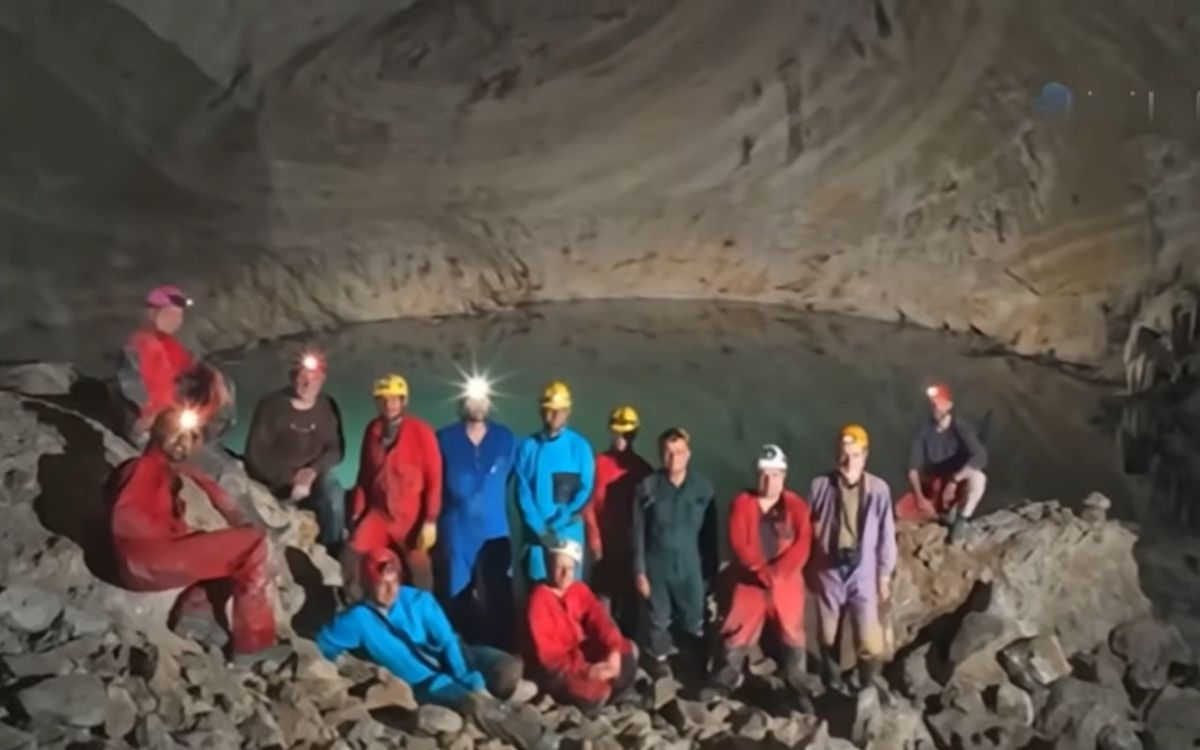
Imagine standing in a quiet mountain valley in the Balkans and watching steam rise from limestone rocks, like a kettle left on a turned-on stove. And now imagine what powers that steam. More than 100 meters below the surface, researchers have confirmed the existence of a massive thermal lake at the bottom of a deep cave system, believed to be the largest known underground thermal lake to date.
Lake Neuron, located near the border of Albania and Greece, is situated at a depth of 127 meters within the Atmos cave, in the Vromonera area. With the help of LiDAR scanning and sonar measurements, a team of researchers from the Czech Republic determined that the lake is 138.3 meters long and 42 meters wide, with a volume of about 8,335 cubic meters of warm, mineral-rich water. This is an impressive amount of water hidden from view, according to a study published in the International Journal of Speleology.
Discoveries like this change our understanding of the world beneath our feet. They help scientists better understand how groundwater moves, how geothermal systems function, and how sensitive certain underground ecosystems actually are.
This is not a cold puddle in a tourist cave. The system belongs to what researchers call sulfuric acid speleogenesis, a process in which water rich in hydrogen sulfide shapes and reshapes cave structures over time.
In the Vromonera area, warm water erupts through cracks in the rock. When hydrogen sulfide comes into contact with oxygen, sulfuric acid is formed, which erodes the limestone and contributes to the formation of large underground chambers.
Measurements in the Atmos cave and surrounding caves show that the system is still active. Hydrogen sulfide concentrations of about 2 to 22 parts per million have been recorded in more open zones, while the air temperature in hydrothermally active parts ranges between 15 and 29 degrees Celsius.
The lake itself has a stable temperature of 26 degrees Celsius, and the springs that feed the valley have a similar chemical composition and temperature. Researchers estimate that the total flow of springs in the Vromonera area is about 200 liters per second.
However, one discovery is particularly surprising. One might assume that deep thermal water rises slowly, almost lazily. However, dye tracing experiments have shown that the system behaves like a highly connected plumbing network.
A paper published in 2026 in the International Journal of Speleology describes tracing tests in this landscape of sulfuric acid caves and states that the flow rate in the Vromonera system can reach up to 30 kilometers per day.
The same study indicates that narrow supply channels, so-called feeders, which were previously believed to bring pristine deep water, may actually contain a mixture of deep groundwater and recycled water from higher cave lakes.
In practical terms, this means that what happens on the surface, including pollution and changes in land use, can travel through connected karst systems significantly faster than previously assumed.
Warm, sulfur-rich cave systems are not just geological laboratories. They can be habitats for unusual food chains that rely on chemical energy instead of sunlight and support dense populations of insects and spiders.
An open-access study published in the journal Diversity describes the Sulfur Cave in the same Vromonera canyon as a 520-meter-long hypogenic cave with a sulfide stream and a lake near the entrance.
It notes a water temperature of 27 degrees Celsius, and that the concentration of hydrogen sulfide in the air can reach up to 14 parts per million near strong emissions. The authors emphasize that their findings represent a basis for planning protection measures.
Experts exploring cave systems in the region also point to specific risks. A technical report on the cave system mentions cooperation with local authorities and an initiative to include hypogenic caves in the Vjosa National Park, with a warning that the construction of a dam on the Greek side of the Sarandaporo River could negatively affect the habitat of the Sulfur Cave.
And here we come to the essence. Even when a lake is hidden 127 meters underground, it is still part of the living, dynamic landscape that exists above it.
MORE TOPICS:
Source: N1; Photo: Printscreen YouTube
 Add Serbian Times as your Google source