




The United States this week increased pressure on Iran, setting a one-month deadline to reach an agreement and announcing the deployment of a second aircraft carrier to the Persian Gulf.
Iran and the United States held indirect talks in Oman on February 6 and announced a new round of talks next week in Geneva. Oman will once again act as mediator.
The talks in Oman were the first since the United States and Israel attacked Iran in June last year, and were held after Donald Trump decided in January that he would not attack Tehran after seriously considering military action due to the brutal suppression of mass protests in the country.
The talks were initially supposed to be held in Istanbul, but Iran requested that they be moved to Oman.
Protests in Iran erupted due to the severe economic crisis, but quickly escalated into a rebellion against the clerical regime. They spread across the entire country and were bloodily suppressed after three weeks. Thousands of people were killed and tens of thousands were arrested.
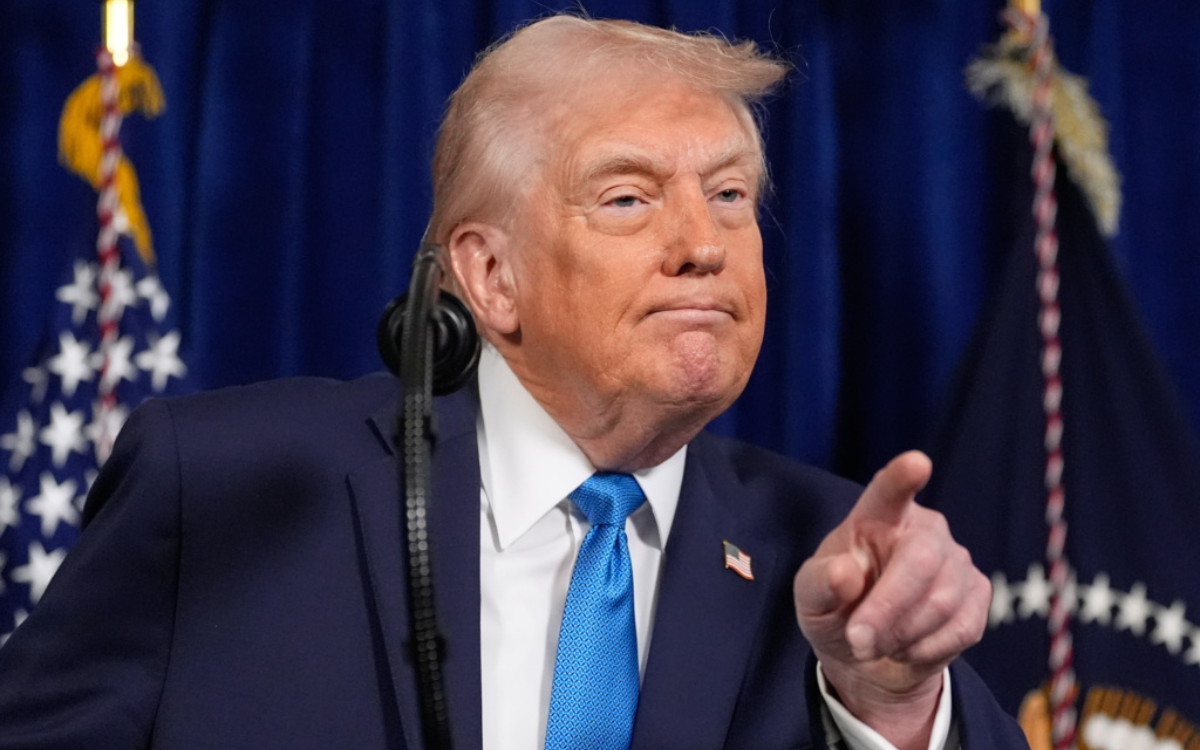
Trump said this week that he believes Iran wants a deal and expressed hope that the talks would be concluded “within a month.” Otherwise, he threatened “very traumatic” consequences.
“I will talk to them as long as they want,” he added, noting that in the absence of an agreement he would move to “the second phase,” which would be “very difficult” for the Iranians.
He once again recalled the American bombing of Iranian nuclear facilities during the twelve-day war launched by Israel in June last year. On Friday he supported a potential regime change in Iran, saying that “it seems like that would be the best thing that could happen.”
Netanyahu skeptical
Israeli Prime Minister Benjamin Netanyahu said on Thursday that he hopes U.S. President Donald Trump is creating the conditions to reach an agreement with Iran that would avoid military action.
“I expressed (to Donald Trump) a certain degree of skepticism regarding the quality of any agreement with Iran. I said that if an agreement is truly to be reached, it would have to contain elements that are very important (…) for Israel,” Netanyahu said, a day after a meeting at the White House.
“It is not only about the nuclear issue, but also ballistic missiles and Iranian proxy armed groups,” such as Lebanon’s Hezbollah, the Palestinian Hamas or the Yemeni Houthis, the Israeli prime minister emphasized.
Tehran, however, wants to talk only about its nuclear program, and in return demands the lifting of sanctions. It considers negotiations about its powerful missile program a red line.
“I think the conditions that Trump is creating, combined with the fact that they certainly understand how they made a mistake last time by not reaching an agreement, can create the circumstances for reaching a good deal,” Netanyahu said.
USS Gerald R. Ford arrives in the Middle East
Trump confirmed on Friday that he will soon send a second aircraft carrier to the Middle East, the USS Gerald R. Ford, along with accompanying ships, and very quickly.
The aircraft carrier USS Gerald R. Ford, the largest in the world, had been deployed in the Caribbean for several months as part of Trump’s operation in Venezuela, which included attacks on suspected drug-smuggling vessels and culminated in the capture of Venezuelan President Nicolás Maduro in Caracas.
The aircraft carrier will join the aircraft carrier USS Abraham Lincoln and several other American warships in the Middle East. The last time the United States had two aircraft carriers in the region was in June last year when it attacked Iranian nuclear facilities.
Preparations for a longer operation
The U.S. military is preparing for the possibility of a prolonged, multi-week operation against Iran if the White House orders an attack, two American officials who wished to remain anonymous told Reuters.
“President Trump has all options on the table regarding Iran. He listens to a range of perspectives on any issue, but makes the final decision based on what is best for our country and our national security,” White House spokeswoman Ana Kelly said.
The Pentagon declined to comment. In a longer operation, the U.S. military could target facilities of the Iranian government and security forces, not only nuclear infrastructure, an official said, without going into details. The United States expects Iran to retaliate and that it would last for some time.
The risks for American forces in that case would be far greater because Iran has a powerful missile arsenal. Iran has threatened that if America attacks it, it will retaliate with strikes on American bases in the region. Iranian retaliation would also increase the risk of a regional conflict.
The United States has bases across the Middle East, including in Jordan, Kuwait, Saudi Arabia, Qatar, Bahrain, the United Arab Emirates and Turkey.
MORE TOPICS:
THE GREATEST SERBIAN DIPLOMAT: Here’s Why Jovan Ristić Is Known as the Thomas Jefferson of Serbia!
Source: Mondo, Foto: AP
 Add Serbian Times as your Google source