




The Serbian flag is the main motif on the new front page of the prestigious French daily L’Équipe, which is not so unusual considering that the Australian Open has entered its second week and Novak Djokovic is set to play his quarterfinal match early Wednesday morning against Italy’s Lorenzo Musetti.
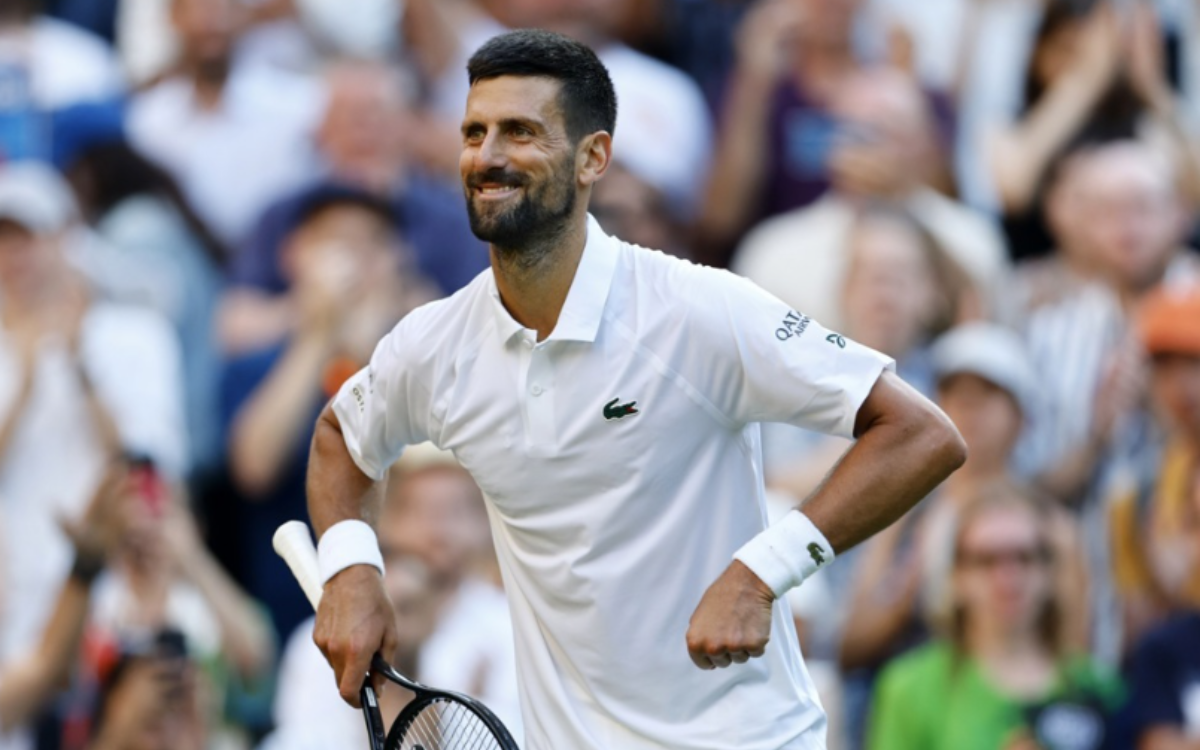
However, the motif behind it is intriguing – a montage of the 24-time Grand Slam champion “pumping” (a well-known image from Wimbledon) among participants in the student protests in Serbia. This segment occupies the next three full pages.
The headline on the first of them concerns Djokovic’s popularity and influence on public opinion, and even culture in Serbia, and reads “Serbian Symbol.”
“Novak supported our protests in several ways. But it was discreet, through likes or words. At Wimbledon he made the pumping gesture and everyone knew what it meant. That day I received a million messages in which people wrote to me, ‘Novak pumped!’ The very next day I painted this image on a wall and it soon became a trend for people to come and take photos next to it,” said Andrej Josifovski, known as Pianist, about the mural he painted in honor of the 38-year-old in Vračar.
🎾 NOVAK DJOKOVIC POPULAIRE ET GÊNANT
— Unes de presse (@unesdepresse) January 27, 2026
Voici la une de L’Équipe du mardi 27 janvier 2025. #tennis #Djokovic #Serbie #Serbia pic.twitter.com/6A4nSHB2BB
Despite this, Peščanik columnist Dejan Ilić, now speaking as an interlocutor of French journalist Romain Lefebvre, believes that Djokovic’s support for the students is not sufficient because, as he points out, “the political struggle in Serbia has no logic.”
“We are facing a regime that is not reasonable and whose only means of governing society is sheer force. Every time we oppose it, the solution is destruction. They tell us that we will be destroyed regardless of the nature of the movement if we are against them, and that they recognize only those stronger than themselves. Novak, despite his fame and enormous successes, is not strong enough to confront this regime,” the sociologist emphasized, assessing that Novak’s support has essentially changed nothing in the political situation in Serbia.
Ilić, who was arrested and against whom the Ministry of the Interior of the Republic of Serbia filed criminal charges for spreading panic after a guest appearance on TV Nova on March 29 last year, adds that Djokovic’s support for the students is neither strong nor explicit, but rather “modest, reasonable, and symbolic,” yet that young people experienced it as “disproportionately significant.”
“This shows how desperately the Serbian people need support in their actions, and yet we are still in the same place. I do not think his image has suffered because of this stance or that he has lost the support of the people, but this regime can contribute to that and has the power to shame him.”
Lefebvre insisted that Djokovic was perceived as a “close associate” of Aleksandar Vučić, and Ilić corrected the French journalist by explaining that the authorities in Serbia “used Novak as a symbol of greatness because of his successes.” Naturally, the topic of the relocation of the Serbia Open, Djokovic’s ATP 250 tournament, to Athens also came up.
“Novak tried to do things in this country and contribute to the development of tennis – through his academy or by organizing his tournament. Whatever you want to do here, you absolutely have to be with this regime. You cannot do anything independently. So if he went to them, if he talked to them, it was exclusively for business reasons, that’s simply how it is. All the people who are now celebrating Novak for being on the side of the students are the same ones who complained when he was photographed with Vučić, saying he had no integrity and didn’t know what he was doing.”
Ilić believes that the story of Djokovic is a rare example of an honest way to achieve great success in Serbia, and that he did so through hard work and effort while respecting the rules, rather than through immoral actions and cooperation with criminals.
“That is the story behind this regime. Novak is completely opposed to this way of operating. What we are now hearing about him from the regime is that he is old, that he is no longer competitive, that his time has passed. We knew this was how it would end.”
He also explained how the state apparatus reacts to even the smallest signals that a popular and influential person might enter politics.
“A few years ago, a rumor circulated that one day he would run for president, even though he himself never mentioned it. Immediately there was a media circus and vile stories about him, that he cheats on his wife and the like. The exact same thing happened to Ivana Španović because she dared to criticize the Athletics Federation. Immediately, although no one had mentioned it before, Vučić put out horrors about her alleged infidelity while pretending to defend her. That’s how he operates every time. Because he wants complete devotion and obedience.”
Unlike many who see Djokovic in politics in the future, Ilić believes that this is still at the level of speculation and that it is something journalists should ask Novak himself about, whether he even has ambitions in that field.
“As far as Novak is concerned, I do not think he currently has the courage to engage in politics. Of course, he has the intellectual capacity, but in Serbia that is not enough. If he has had enough of this regime and if this country finally becomes normal, then I can imagine him getting involved. However, until then, I do not see him jeopardizing everything he has achieved in order to engage in bitter political battles against this regime. The risk is not worth it,” Ilić concluded.
MORE TOPICS:
Source: Sport klub, Foto: EPA / TOLGA AKMEN