


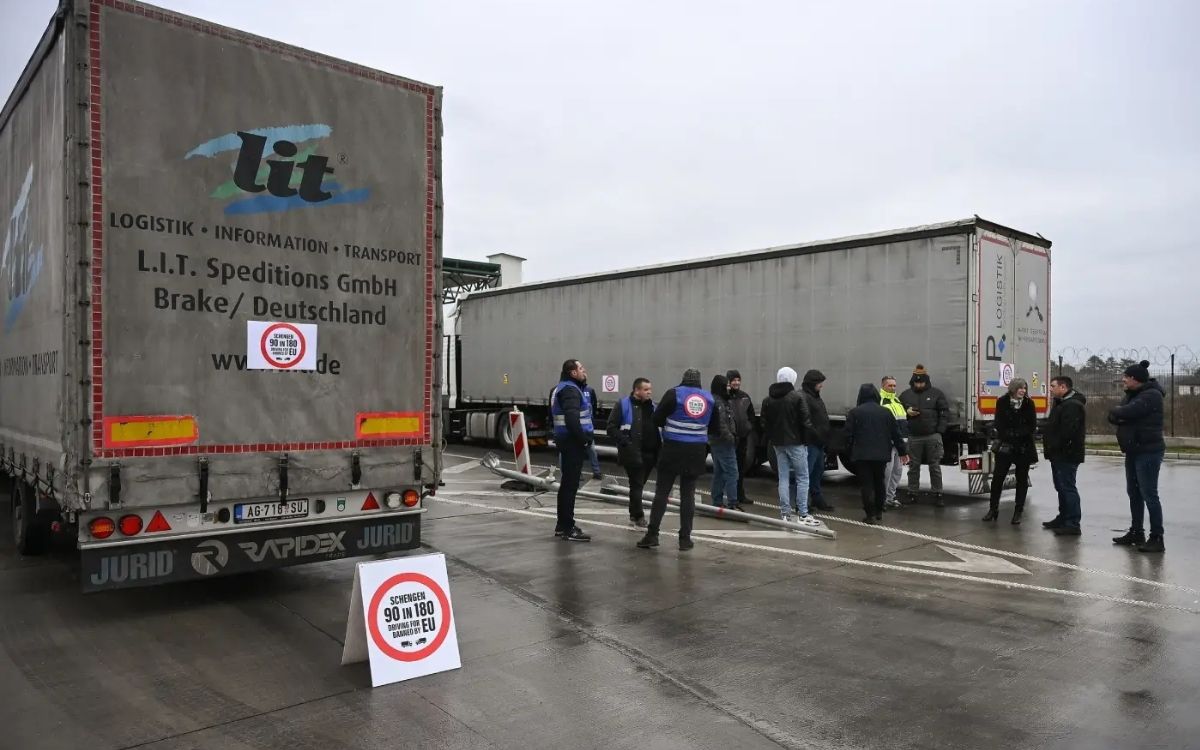
Carriers from Serbia, Montenegro, North Macedonia, and Bosnia and Herzegovina are blocking freight terminals due to the new EES system for entry into and exit from the EU, as well as the inadequate response of the European Commission and Schengen countries regarding the treatment of professional drivers and the limitation of their stay in the Schengen Area to 90 days within a 180-day period (the 90/180 rule).
The blockades are planned to last for one week.
President of the Serbian Chamber of Commerce Marko Čadež told RTS that each day of the blockade costs Serbia 55 million euros, and the region 100 million euros per day.
“Direct damage and penalties due to the EU’s inflexibility”
Milan Ilić, a representative of the International Transporters Association, says that there is understanding among colleagues.
“Simply put, this is in everyone’s interest. Maybe not a colleague from Bulgaria, but a colleague from Turkey certainly is, as well as those from the countries of the Western Balkans, all drivers who are subject to the 90/180 regime. This is a fight for all those drivers in the sense that their professional status is recognized and that they are exempted from those strict rules that apply to the territory of Schengen and the length of stay in the Schengen Area,” Ilić told the public broadcaster.
Marko Čadež, president of the Serbian Chamber of Commerce, told RTS that the damage to the economies of the Western Balkans amounts to 100 million euros every day – 55 million euros from exports alone and the inability to export from Serbia.
“Here we are talking only about direct damage to goods, and to that should be added the fact that every company that exports, if it fails to deliver something on time, pays certain penalties. They range per company between 10,000 and 50,000 euros, that is, in a single day. Take into account that 10,000 companies export from Serbia alone, and then we can calculate what kind of damage we are talking about,” Čadež stated.
It is paradoxical, he points out, that the supply chain crisis was caused primarily by the inflexibility of the institutions of the European Union themselves, which showed no understanding and led to a slowdown and a serious threat to their own economy.
Who is offering solutions?
Filip Simović, president of the German-Serbian Chamber of Commerce, told RTS that in recent years they have appealed and sent “non-papers,” in cooperation with German companies.
“So even the companies that have headquarters here, whose parent companies are in Germany, are appealing to their own state, but the state itself must also directly appeal to the European Commission. For now, we have no solutions here and no response from the European Union itself,” Simović said.
He hopes that the problem will be resolved as soon as possible and expects the European Commission to take a closer look at the situation, because not only Serbian companies are endangered, but also all European Union and German capital.
Čadež emphasized that the Serbian Chamber of Commerce, together with chambers of commerce from across the Western Balkans region, sent around 15 letters to the European Commission and member states in the past year alone, but that there was “no understanding,” and that drivers from the Western Balkans, who transport most of the goods to the European Union, are being treated as attempted migrants or criminals.
Reaction of the European Commission
Regarding the protest of transport associations from the Western Balkans over the entry and exit system to Schengen countries, the European Commission announced that it is “closely monitoring the situation and is in contact with partners from the Western Balkans.”
European Commission spokesperson Markus Lammert stated that the rules of stay within Schengen are “clear and have been known for a long time,” and that there is a certain degree of flexibility in their application.
He also emphasized that the decision on whether random border checks will be carried out or not is made by member states at the external borders, not by the Commission.
Prime Minister Đuro Macut spoke with the Head of the European Union Delegation to Serbia, Andreas von Beckerath, about the issue of limiting the stay of professional drivers in the Schengen Area.
Macut handed Beckerath a non-paper outlining specific solutions offered by Serbia that do not require amendments to the Schengen Borders Code, RTS reports.
MORE TOPICS:
Source: Nedeljnik; Foto: Edvard Molnar / MTI via AP