




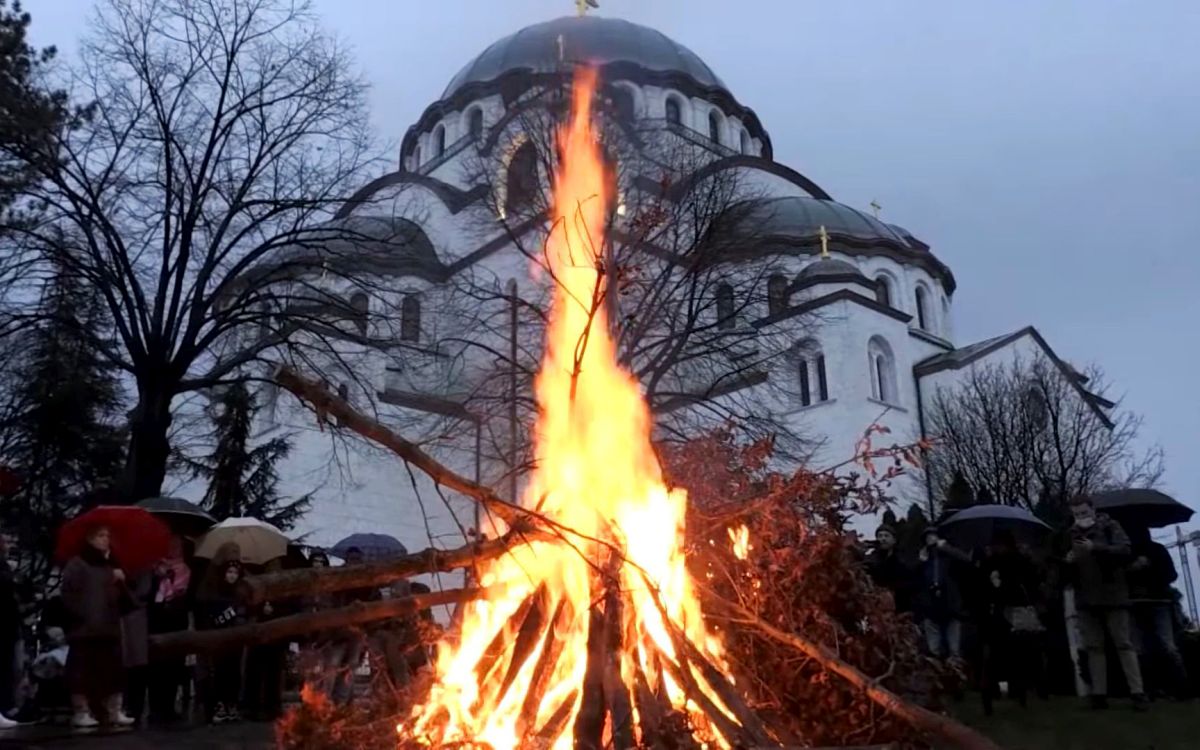
Christmas is the holiday celebrating the birth of Jesus Christ. It is celebrated for three days, during which the family gathers and visits closest friends. Christmas is preceded by Christmas Eve, when customs dictate that all borrowed items should be returned, and there is an odd number of Lenten dishes on the table, along with wine and mead.
The Yule Log (Badnjak)
Serbs have been marking Christmas for centuries, and with the Badnjak, or Christmas tree, they bring happiness, health, and progress into the home. Along with the wood, grain is also gifted so that the coming year may be fertile.
According to tradition, eternal fires were lit in sacred oak forests for protection against evil people. During Christianity, the oak took on a magical meaning. Oak branches were considered sacred, and leaves were brought to the sick so they would recover as soon as possible. According to tradition, the yule log was brought to the Bethlehem cave by shepherds. Joseph of Nazareth lit it to warm the cave where Jesus Christ was born. Countless sparks coming out of the cave marked the birth of Christ. Apart from the Orthodox Christian tradition, the lighting of the yule log is today also present in the old Hindu religion and culture, as well as among some pagan peoples. Customs dictate that, besides the Badnjak and grain, straw should also be brought into the house on Christmas Eve because in this way a sacrifice is offered to the spirit of Christ who was born on straw.
The Česnica
As tradition dictates, a česnica is prepared for Christmas, a white flatbread made of wheat flour without yeast. The česnica, as well as the Christmas roast (pečenica), originate from Old Testament stories, and one of the customs associated with breaking the česnica is putting a coin in the dough so that the one who finds it will be followed by luck all year long. In past times, the first piece of dough made for the česnica was set aside for making the zdravljak cake, which in some parts of Serbia was called “health and joy,” “small cake,” or “badnjak,” and which is eaten for Christmas Eve. Before baking, the housewife notches this cake into as many parts as there are household members and while doing so says: “Happiness, health, and progress.” The Christmas cake is circular in shape and made from two to three kilograms of flour. The upper surface was decorated with relief decorations made of dough, and along the middle of the cake, there were necessarily two relief strips of dough placed in the form of a cross. At the place where the strips intersect, a circle of twisted dough called a rose is placed, into which a sprig of basil or three stalks of wheat tied with red wool or red cotton thread is stuck.
A real feast is prepared for this holiday, and the main delicacy is mostly pork, which is the reward after the forty-day fast. Along with this, it is believed that the Christmas candle should not be extinguished by blowing, but should be calmed with bread soaked in wine.
The Položajnik
The položajnik is the first person who enters your home on Christmas. In olden times, it was always looked upon that it should be a man and someone who wishes your home well. However, as times change, customs change too, so it is completely normal today for the položajnik to be a female person as well. The first guest on Christmas, the položajnik, must necessarily be given a gift because they symbolize a divinity. The first duty of the položajnik is to wish happiness, health, and progress to the host’s home. When they enter the house (stepping over the threshold with the right foot), they approach the fire and with the end of the yule log poke the fire so that sparks fly out. The host and the položajnik exchange the greeting: “Christ is born”; “Truly He is born!” When leaving the home, the hosts give the položajnik a gift.
The coin from the česnica
Family and Christian tradition dictate that on the greatest holiday the family gathers and breaks the česnica together. They say that the lucky one is the one who pulls the coin out of the česnica.
One of the favorite Christmas customs for many is breaking the česnica and anticipating whether the coin symbolizing happiness, health, and wealth is in their piece. What is important is that every member of the family must eat their part of the česnica, whether the coin was in it or not, so that all members of the household may have strength and health.
According to customs, the money pulled from the česnica should be bought back with other money from the one who found it in the cake, and then it is placed on the icon or next to it and kept until the next Christmas because it is believed that the lucky one who pulled it out will be happy and wealthy all year long.
Superstitions
In addition to well-known customs, a lot of superstitions are associated with Christmas which people today mostly still respect.
There is a rooted belief that all debts and loans must necessarily be returned on Christmas Eve, and on Christmas itself, things should by no means be borrowed, because otherwise, things will only be going out of the house. On Christmas Eve and Christmas, people believe, one should do those things that caused us problems during the year so that we may master them more easily in the next. One of the oldest superstitions says that one should do something small on January 7 even though it is a holiday, because that means there will be work in the coming year as well.
One of the most unusual beliefs is rooted in the surroundings of Niš, where all household members take off their shoes at the same time before the meal, because it is believed that because of this, chicks will hatch at the same time, women will give birth with ease, cows will calve, and goats will lamb. For Christmas, it would be good to buy some new thing, specifically an item for the house that you will fill with coins, and thus, according to belief, ensure financial abundance for the family.
From Christmas all the way until the first Slava, which is Saint Stephen, the house should not be cleaned, and guests are strictly forbidden from knocking on the door, because otherwise, the household members will be arguing the whole year.
MORE TOPICS:
Source: Blic; Photo: Printscreen YouTube / NOVA S
 Add Serbian Times as your Google source