




The newspaper Danas has obtained an official memo in which the prosecutor of the First Basic Public Prosecutor’s Office, Gordana Nedić Isailović, describes how she was prevented from conducting an on-site investigation in the so-called Ćacilend, which the media previously reported on.
Danas obtained the official memo from a source in the Internal Control Sector of the Ministry of Internal Affairs (MUP), to whom the memo was delivered, along with a request for urgent action.
In the memo, the prosecutor described in detail how the entire event unfolded on November 5 and how police officers from the Stari Grad police station prevented her from conducting an on-site investigation in Ćacilend.
As she describes in the memo, she was the on-duty prosecutor that day when police officers from Stari Grad informed her that a person had reported that four or five masked men, with their faces covered by caps, had stolen her phone in Ćacilend.
The memo states that the police officers, describing the event, told her that it was necessary to undertake evidentiary actions to discover the identity of the perpetrators.
“I considered it necessary to immediately go to the scene and conduct an on-site investigation as an urgent and immediate evidentiary action, because three to five male persons stole and took a mobile phone, due to which the victim’s claims indicate that their actions could bear the hallmarks of the criminal offense of robbery from Article 206 of the Criminal Code of the Republic of Serbia,” the memo reads.
The memo further states that the prosecutor ordered the police officers to pick her up by car so that she could attend the on-site investigation, which the police officers did, but the head of criminal technique in Stari Grad immediately called the prosecutor to warn her that conducting an on-site investigation in that part of the city was not safe.
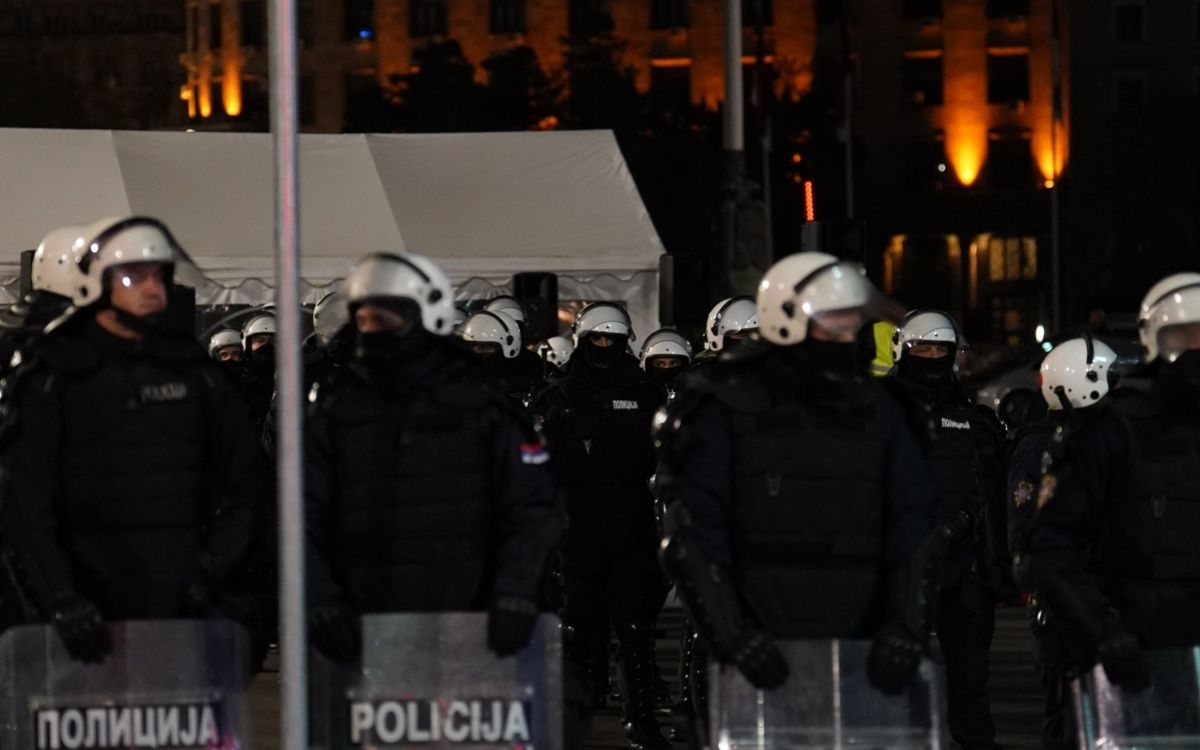
“Upon arrival at the police station, I went to the cabinet of the head of criminal technique, who informed me that we would not be able to conduct the investigation because the location was unsafe due to the protests that were taking place at that moment. After that, the chief, the head of the police station, also came and showed me videos on his mobile device – a broadcast of the protest – showing me that stones and pyrotechnics were flying in that area and that police workers from the scene warned about the impossibility of ensuring security for conducting the investigation,” the memo states.
Nevertheless, the prosecutor continued to insist that she be allowed to conduct the investigation, which the law itself mandates, as she believed there was a possibility of finding the perpetrators of the crime and locating the stolen phone there.
“The chiefs refused under the pretext that it was truly impossible to secure the scene, that the investigation team could not go with me as the on-duty prosecutor to the plateau in front of the Assembly. I asked them to bring members of the JZO (Special Police Unit), believing that in that case, they could escort us to the scene. The chiefs explained to me that this was also not possible because that unit is from, as they stated, another service. I insisted that it would be expedient to go to the scene in order to carry out this evidentiary action, which the CPC (Criminal Procedure Code) mandates for the prosecutor, and primarily for the police, and that there is no situation in which an on-site investigation cannot be carried out, but the chiefs remained firm in the position mentioned above,” the memo states.
The prosecutor further states that she did not understand the indifference of the police in this situation and their refusal to act as she instructed them, because she noted that in that area, according to her previous informal knowledge, they could also carry out the action of inspecting persons and objects, given that persons with a criminal past, individuals for whom searches, warrants, or a detention order have been issued might be staying there, which would facilitate the clarification of possible other criminal offenses by the police, and they might even discover new criminal offenses.
“Also, during the conversation with me, the chief informed the chief public prosecutor about my presence and my request for an on-site investigation to be carried out, and the chief prosecutor left it to me to independently go to the scene in cooperation with police workers. As time passed and as the chiefs maintained the position that they would not provide an investigation team with which I would go to the scene because it was not safe, and now, according to my personal assessment, they were not even allowed access to that place, I was forced to leave the police station,” the document seen by Danas reads.
The end of the memo states that it is being submitted to the chief prosecutor for its inclusion with the files of case KTR14565/25 or for the formation of a new case to assess whether the actions of the official persons meet the characteristics of any of the criminal offenses for which prosecution could be initiated ex officio.
Along with this memo, a note marked “URGENT” was also sent to the ISC.
The note explains how the prosecutor was prevented from carrying out the on-site investigation. It instructs the ISC that it is necessary to inform the prosecutor about all actions taken and notes that the on-site investigation, as an evidentiary action of such a nature, must be carried out urgently and without delay, by order of the prosecutor and, if necessary, in their presence, in order to secure the scene, find the objects of the criminal offense, find objects originating from the criminal offense, as well as find the perpetrators of the criminal offenses and all facts relevant to clarifying the criminal offense.
“This denial to the prosecutor of carrying out the evidentiary action in question means that you should carefully consider how you will proceed in similar situations in the future, for the reason that the prosecutor is the head of the pre-criminal procedure and police workers are obliged to act in accordance with the law,” the note to the ISC states.
The Danas editorial office contacted the prosecutor Gordana Nedić Isailović to comment on the memo. She did not deny the veracity of the memo but did not want to give a statement.
“I really would not like to give statements to the media until this procedure is completed,” the prosecutor said.
It should be recalled that the Minister of Justice, Nenad Vujić, stated that it would not be acceptable to him if a prosecutor could not carry out an on-site investigation in the tent settlement in front of the Serbian Parliament and asked who and when this was not allowed.
He said on RTV Vojvodina that he had heard such claims and that it was cited as one of the reasons for the protest of judges and prosecutors, but that the allegations that a prosecutor was not allowed to carry out an on-site investigation in “Ćacilend” were “never substantiated.”
MORE TOPICS:
DODIK: BiH will not become a member of NATO, because Republika Srpska opposes it!
TODAY WE CELEBRATE SAINT ALIMPIUS: He stopped the plague and leprosy, avoid eating this today!
Source: Danas; Photo: ATA Images
 Add Serbian Times as your Google source