




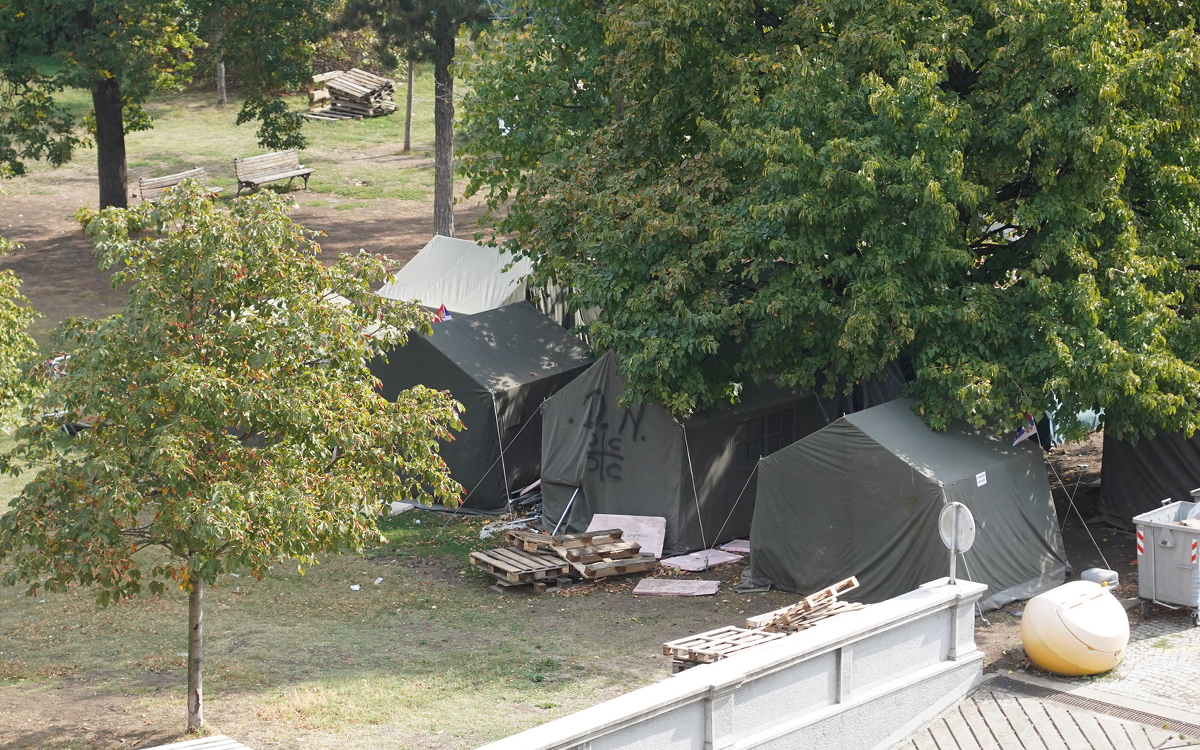
At the end of August, near Kosančićev Venac in Belgrade, Marija (real name known to the editorial team) was intercepted by a Škoda Octavia. A man stepped out of the gray car without license plates, put a hood over her face, and dragged her into the vehicle. Shortly afterward, she ended up in the tent settlement of sympathizers of the President of Serbia, known as Ćacilend, where, as she claims, masked men kicked, slapped, stomped on, and insulted her, Kompas reports.
In a conversation with Kompas, the young woman, who wished to remain anonymous for safety reasons and whom we call Marija, described the abuse and violence that occurred a few days after she had been detained by police following the August 18 protest in Belgrade.
That protest ended in riots in Cvijićeva Street in Belgrade, in front of the headquarters of the Serbian Progressive Party (SNS). Marija was among those arrested and was placed in detention. During her detention, she was held at police stations Stari Grad and Majke Jevrosime, and was taken to the Military Medical Academy (VMA) for toxicology testing. The police confiscated her phone, which was returned after some time. She was assigned a court-appointed lawyer who advised her to plead guilty — a plea that lawyers from non-governmental organizations later managed to change to not guilty for the charge of violent behavior at a public gathering. Marija is currently on probation.
The road to Ćacilend
After her release from detention, when she decided to go out and meet a friend, she was forced into an unknown car and taken to Ćacilend.
“Four or five days after spending the previous days not sleeping or eating, slowly trying to collect myself mentally, I went out with a friend. We talked, and I also posted on Instagram that I had no physical injuries but was mentally crippled. That same evening, around Leposava Bar, I was saying goodbye to my friend. I waited to make sure she left safely. I knew anyone seen with me could be in danger. I forgot to protect myself. That night, after she left, I suddenly heard a car and the sound of hard braking. I didn’t look back. I thought it was some fool, maybe even a taxi, until I heard footsteps — then I turned around. At that moment, a hood was pulled over my head, my head was forced down. The only thing I saw when they put the hood on me was a gray Škoda Octavia without plates. There was another man in the back seat. They threw me into the car and covered my face.
We drove. I counted the minutes in my head. We drove for about 10–15 minutes before the car stopped. I had no idea where I was. Only when they pulled me out of the car and threw me to the ground, like a sack of flour or cement, did I feel a sharp pain in my lower back and tailbone. I tried to get up, but someone had their foot on me. I tried again, but my arms flew upward, my legs felt cemented because someone was standing on them.
I started screaming, turning, thrashing, trying to wriggle free from them. That’s when I realized I was in Ćacilend. I saw a tent and a children’s climbing frame. Soon, a circle of masked people formed around me, and the three who held me down wore masks — but I remembered their eyes very clearly. The person standing on my legs told me I was lucky because they knew about my medical condition. I was in shock. That’s when I started fearing for my life. After those words, everyone who was there — and I know there were many — began kicking and slapping me and shouting disgusting words. Disgusting words,” she told Kompas.
Marija says the “party,” as she herself called it, ended when one of the attackers said, “We taught her well.”
Violence in Ćacilend
There have already been several incidents of physical violence in and around the tent settlement in front of the Serbian Parliament. Claims that unidentified men stationed in Ćacilend were allegedly harassing female students were also made publicly by Green–Left Front MP Biljana Đorđević.
“We know this has been happening for months — masked men taking girls to Ćacilend. No one has ever been held accountable. We are begging for someone to address the public, but not to tell us that an investigation was conducted and that citizens, male and female students, are lying — because that’s what you did after Nikolina Sinđelić,” MP Đorđević said from the parliamentary podium.
Also, a student from the Faculty of Computer Science was attacked on October 2 while passing by the Parliament. In the official report seen by N1, the student stated that “several men approached him without reason and demanded he stop recording with his phone.
‘I told them I wasn’t recording anything, but they surrounded me, and when I started calling the police, they began hitting me in the head and body with their hands,’” the student said in the report. Police stated that “the attackers were not caught because the incident is not clearly visible on camera footage due to darkness.”
The Serbian Ministry of Internal Affairs did not respond to Kompas’s questions about whether it had information that masked men were abducting and assaulting citizens in Ćacilend. The identities of the men seen in Ćacilend — as well as at numerous protests where they attacked citizens — were investigated by KRIK.
According to KRIK’s online database, these are “individuals convicted of murder, assault, drug trafficking, and people closely connected to the criminal underworld, who have provided support to the ruling party at rallies organized over the past year.”
People with criminal records, KRIK reports, have attacked students and citizens, kicked them, insulted them, and thrown chairs at them during various protests held across Serbia since the collapse of the shelter roof at the Novi Sad railway station.
In the case of Kompas’s interviewee, the violence followed her participation and arrest during a protest.
Marija’s case: How it began
On the day she was detained, Marija went to a protest near Vuk’s Monument with her friends. Uneasy but determined, she joined the crowd, though something felt different. Among the gathered citizens, she noticed an increasing number of masked individuals. Initially without a clear plan, led by the initiative of angry citizens, the demonstrators moved toward Cvijićeva Street, which at that moment seemed too empty to Marija. She sensed that something was about to happen — though she could not know she would become the center of it.
Around 10 p.m., the window of the SNS office in front of which the protesters stood was smashed by rocks — one, then several more. Through the shattered glass, peering inside, she saw nothing but a table and a few chairs. There was no expensive equipment. Fleeing the stun grenades, Marija and two others took shelter in a nearby alley. Only half an hour later, the president of Serbia, Aleksandar Vučić, personally appeared at the site where they had stood.
Seeking protection from tear gas, wind, and police, the three young people found refuge in an apartment building entrance, where an elderly woman let them in. They watched through the window to see whether the police would come for them. When it seemed safe, they decided to return to Vuk’s Monument to rejoin the group of citizens who had returned there from Cvijićeva. As they stepped back onto the street, they were met with a wave of fresh air — and fear. Just a hundred meters from their previous shelter, the police blocked their path. Marija, the girl beside her, and a young man with them were first searched. She vividly remembers the moment an officer frisked her.
She also remembers telling them, “Just don’t beat us.”
Five police officers stepped out of the van.
“Two of them grabbed me — one was disgustingly rough. The guy with us was beaten for both me and my friend. They searched me and my friend outside the van. I don’t know what right a male officer had to search me.”
After being taken to the police station, they waited in damp hallways. Scared and anxious, the three detainees waited to be questioned. They used their right to one phone call.
No one answered Marija’s call. In stale clothes, exhausted and hungry, she spent hours in the hallway of the Stari Grad police station. This was followed by 24 hours in detention, after which she was assigned a court-appointed lawyer. Having no one else to rely on, she was relieved to hear she was being sent to the VMA. Kompas’s interviewee thought doctors there would examine her. However, as she said, she received neither help nor reassurance — only drug and alcohol tests.
“At the VMA I relaxed, I thought I was safe. I thought I was there because of my health condition, but they tested me for narcotics.”
The experience at the VMA further deepened Marija’s distrust not only in the security services but also in the healthcare system. She interprets the drug testing as another form of intimidation. She could hardly wait to leave, even knowing she would be sent back to detention.
In detention, she told Kompas, she was kept in a dark cell. At times, she lost hope she would ever be released. However, after being assigned a lawyer, she was released with a suspended sentence. The following days she used to rest and recover her strength.
After the end of the proceedings and her probation sentence, Marija spent several weeks recovering from the consequences of detention and the treatment she received from some members of the Ministry of Internal Affairs. When she later went out for a drink near Kosančićev Venac with a friend, the attack in Ćacilend occurred.
Marija says she still feels pain in her shoulder from the injuries sustained from being slapped and kicked in Ćacilend.
She told us that, due to her experience at the VMA and her general distrust in institutions, including healthcare, she did not seek medical help after the assault in Ćacilend. Although many of the physical injuries have healed, she says she still cannot come to terms with the psychological abuse — the stalking, threats, and blackmail — all aimed at making her “stay quiet.”
She says that despite the traumatic experience, she is not afraid, but remains determined to change a system she could no longer trust.
MORE TOPICS:
“A MAN WHO TOUCHED HUMAN HEARTS”: Đoković revealed what he would like to be written on his monument!
BOJOVIĆ RELEASED ON BAIL: The policeman arrested in Chicago is awaiting a decision on deportation!
Source: Kompas, Foto: Antonio Ahel / ATAImages
 Add Serbian Times as your Google source