

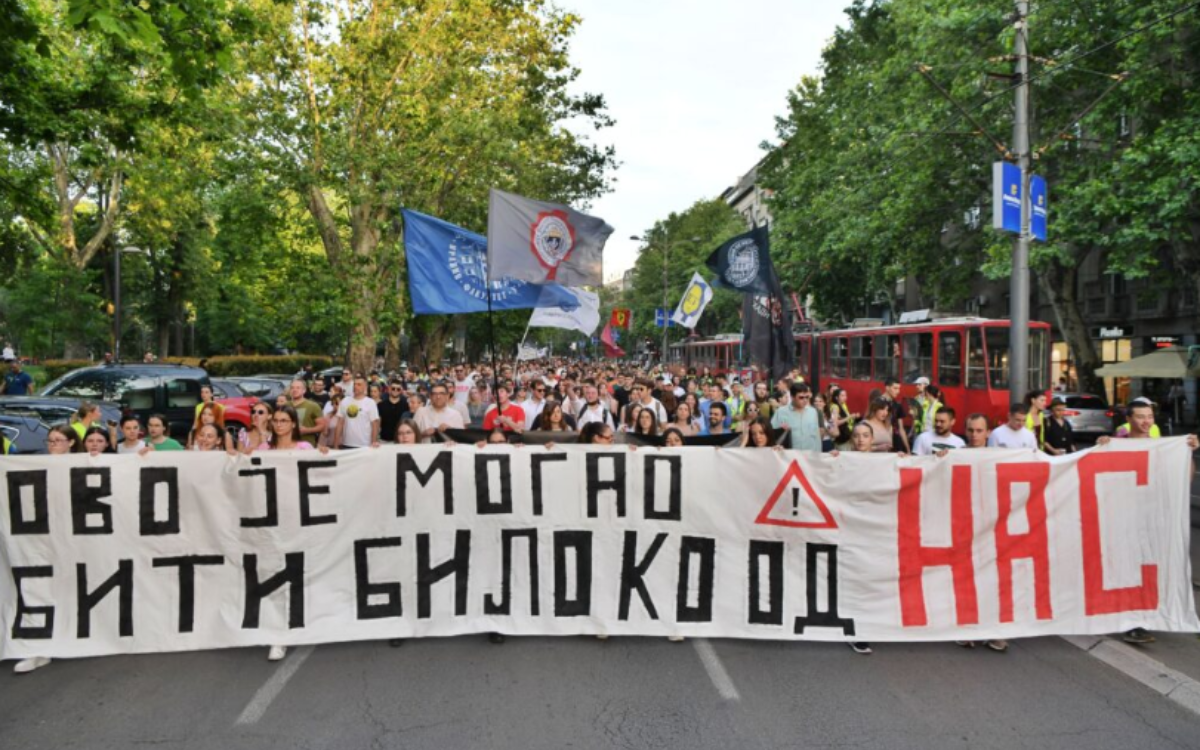
This is the chronology of all events following November 1 of last year — the day when the canopy at the Railway Station in Novi Sad collapsed, killing 16 people:
November 3
A protest gathering in Nemanjina Street in Belgrade over the tragedy in Novi Sad. Citizens left “bloody handprints” on the building of the Government of Serbia.
November 5
The “Your hands are bloody” protest in front of the City Hall in Novi Sad and the Railway Station. Demands made for the resignations of Prime Minister Vučević and Mayor Milan Đurić. Goran Ješić arrested. Aleksandar Vučić visited Novi Sad for the first time after the tragedy, attending a meeting at the SNS City Board. Goran Vesić resigns.
November 15
The first “14 minutes of silence for 14 victims” action in Novi Sad.
November 17
The fifteenth victim died at the Clinical Center of Vojvodina.
November 22
SNS supporters, including many party officials, attacked students and professors from the Faculty of Dramatic Arts (FDU) who were paying tribute to the victims of the Novi Sad tragedy.
November 26
Classes suspended at FDU. Students demanded that the Ministry of Internal Affairs file criminal charges against the known perpetrators and identify other members of the organized group that physically assaulted students and professors.
November 29
First blockade of the Rectorate. Initial plenums held. Students at several Belgrade faculties stopped classes. Four main demands began to take shape.
December 2
Blockade of the Rectorate and the Faculties of Philology, Philosophy, and Natural Sciences in Belgrade, demanding the publication of full documentation regarding the reconstruction of the Novi Sad railway station.
December 4
Students blocked the entrance to the Rectorate of the University of Niš.
December 6
Four members of the Belgrade Philharmonic and two others injured when a driver in Uzun Mirkova Street attempted to break through the blockade.
December 7
Over 1,100 members of the academic and scientific community signed a petition supporting the students’ demands.
December 11
Students gathered in front of the Presidency while Vučić was addressing the public. Loud noise could be heard live on all television networks broadcasting his speech.
December 13
All faculties in Belgrade and Novi Sad under blockade. Vučić declared that all student demands had been met and that documentation on the railway station reconstruction would begin to be released.
December 16
Blockade of Jovina Gymnasium in Novi Sad began.
December 20
The Government of Serbia admitted that the full documentation had still not been released.
December 22
A massive protest and hours-long blockade at Slavija, which the Archive of Public Gatherings described as one of the largest in Serbian history, attended by about 100,000 people.
December 30
The Higher Public Prosecutor’s Office in Novi Sad announced the beginning of the publication of the “complete documentation” on the canopy reconstruction.
January 10
“Come to Mostar if you dare” protest action — a 15-hour blockade.
January 16
A driver hit student Sonja Ponjavić on Roosevelt Street.
January 20
The principal of the Fifth Belgrade Gymnasium resigned after leaked messages showing she had threatened employees.
January 21
Ana Brnabić threatened students with the loss of state scholarships, dormitory spots, and student loans if they continued the blockades.
January 23
Graffiti reading “Ćaca to school” appeared on the gate of Jovina Gymnasium in Novi Sad.
January 24
A general strike: protests near the General Staff building, a lawyers’ protest near Andrić’s Wreath, and one of the largest demonstrations at Ušće. Protests held across Serbia, even at Kopaonik. A student of the Faculty of Agriculture was hit by a car; the driver was arrested.
A dog was killed in Novi Sad, run over by an ambulance.
January 26
Vučević announced that the government would publish new documents on the canopy.
January 27
A 24-hour blockade of Autokomanda in Belgrade under the slogan “Under our (Auto)command.”
January 28
Students attacked while placing stickers and writing on SNS premises. A female student seriously injured. Miloš Vučević and Milan Đurić resigned.
January 29
President Aleksandar Vučić issued 13 pardons: six students, one dean, one assistant professor, and four school principals.
January 30
Students from Belgrade began marching on foot to Novi Sad. Madonna expressed support for Serbian students.
February 1
A large protest in Novi Sad. Students who arrived on foot received enthusiastic welcomes. The protest lasted 15 hours.
February 4
The Rector’s Board of the University of Belgrade reviewed the president’s invitation to dialogue and decided to decline it under current circumstances.
February 6
FEST postponed.
February 8
Vučić said Serbia was “under attack from both outside and within” and announced a declaration on the protection of the state.
February 9
Gazela Bridge blocked for seven hours.
February 15
Large protest in Kragujevac. The Students’ Letter was read aloud.
March 1
Large protest in Niš.
March 4
Flares, tear gas, and eggs in the Serbian Parliament. The opposition demanded that MPs discuss only the students’ demands and the resignation of the prime minister.
March 6
Government supporters calling themselves “students who want to study” gathered in Pionirski Park, saying they would stay until their demands were met.
March 13
Twelve Novi Sad students and political activists arrested after the release of an audio recording that officials claimed was made during a meeting in the premises of the Movement of Free Citizens (PSG).
March 15 — The largest protest in Serbian history
Between 275,000 and 325,000 people gathered in Belgrade, according to the Archive of Public Gatherings, possibly more. That day, an alleged sound cannon was used. The Ministry of Internal Affairs denied it the next day, while on April 16, the Federal Security Service of the Russian Federation “confirmed” it.
March 24
Protest of students and citizens marking the anniversary of the NATO bombing and the revocation of the cultural heritage status of the General Staff complex.
March 30
Dean of the Faculty of Philosophy in Niš, Natalija Jovanović, stabbed in the hand.
April 3
Students began cycling to Strasbourg to draw attention from European institutions to their demands and the situation in Serbia.
April 14
Two-week blockade of RTS began, ending on April 28 after a public competition was announced for the REM Council.
May 1
Students in blockade and five national unions held a protest in front of the Government building to mark six months since the Novi Sad canopy collapse.
May 5
Students in blockade demanded early parliamentary elections.
May 14
Director of the Institute for the Protection of Cultural Monuments admitted to falsifying a document concerning the General Staff building.
June 4
Law student Petar Živković was assaulted during a night out between June 3 and 4, sustaining several head injuries and open threats. Petar is the son of a police general forced into early retirement due to his son’s participation in faculty blockades.
June 9
Members of the academic community under the “Rebel University” initiative began a blockade of the intersection in front of the Government of Serbia.
June 8
Local elections held in Zaječar and Kosjerić. The CRTA monitoring mission’s preliminary analysis stated that the elections were conducted in highly unfair and unfree conditions.
June 17
Professor of the Faculty of Civil Engineering in Belgrade, Milan Spremić, released from custody after 208 days.
June 28
The “Vidovdan Protest” gathered about 140,000 people. Clashes with police and tear gas followed. In front of the Serbian Parliament, a literary evening was held, attended by SNS supporters and members of the Government of Serbia. Leader of the “students who want to study,” Miloš Pavlović, declared: “We won.”
June 29
Following the arrest of Agricultural Faculty students, citizens of Zemun set up barricades. In the following days, citizens across Serbia followed suit, physically blocking streets with tires and dumpsters.
July 3
Vučić pardoned four SNS activists who, on the night of January 27–28, broke the jaw of a female student from Novi Sad.
July 6
For the first time, the police cordon was breached during a protest in Užice.
July 8
Video released showing a female law student being pulled by her hair by police officers while a third officer tried to unlock her phone.
July 29
Thugs and police violently expelled students from the State University building in Novi Pazar under a false alarm.
August 1
Commemorative gatherings across Serbia marked nine months since the canopy collapse. On the same day, the Organized Crime Prosecutor’s Office announced the arrest of 11 individuals as part of a financial corruption investigation tied to Serbia’s railway reconstruction project. Among those arrested was Tomislav Momirović, who was Minister of Construction, Transport, and Infrastructure at the time of the Novi Sad Railway Station reconstruction. Goran Vesić was not found at his residence.
August 4
Vučić pardoned Milica Stojanović, the woman who struck a student with her car during the January 24 protest.
August 12
At protests in Vrbas and Bačka Palanka, SNS supporters threw fireworks, stones, and bottles at citizens and students.
August 13
Protests held in several Serbian cities in solidarity with the citizens of Vrbas and Bačka Palanka.
August 15
Student Nikolina Sinđelić stated on N1 television that after being detained during a protest and taken to the Government garage, Commander of the Special Operations Unit Marko Kričak threatened her with rape.
August 20
In Požarevac, Leskovac, Bečej, and Vranje, the first gatherings against blockades were held, organized through social media by the Serbian Progressive Party (SNS).
August 22
President Aleksandar Vučić invited students in blockade to a debate. Students declined via social media.
August 27
Protest in front of the Fifth Belgrade Gymnasium — citizens, parents, and students supported teachers whose contracts were not renewed.
By late August and early September, a wave of mass firings of teachers who supported the protests began across Serbian high schools and elementary schools.
September 5
During a protest in Novi Sad, police used excessive force to push back citizens. Tear gas was deployed, and students of the Faculty of Sciences determined through analysis that illegal CN gas was used.
September 10
During the Serbia–England match at the “Rajko Mitić” stadium, thugs beat Serbian fans for chanting “Whoever doesn’t jump is Ćaca.” Among the fans were women and children.
September 16
Student Bogdan Jovičić began a hunger strike after his detention was extended.
September 20
A military parade held in Belgrade. Students and citizens gathered to support the army, but police prevented them from approaching.
October 3
Employees of the National Theatre held a protest against new regulations that prohibited them from expressing political opinions.
October 14
Students at the blocked Faculty of Agriculture announced that their colleague had suffered physical and psychological abuse by the police, providing photos of her injuries. The Ministry of Internal Affairs denied these claims, stating the student had not been in their custody.
October 22
A gunshot was fired in the tent camp in front of the Serbian Parliament, followed by a fire. President Aleksandar Vučić made a statement hours later, calling it a terrorist act.
October 23
On the road to Kosjerić, police stopped students from Novi Pazar who were marching toward Novi Sad.
MORE TOPICS:
“ROADS OF SERBIA” DENY THEMSELVES: The roads to Novi Sad will not be closed!
Source: Nedeljnik, Foto: Goran Srdanov / Nova.rs