




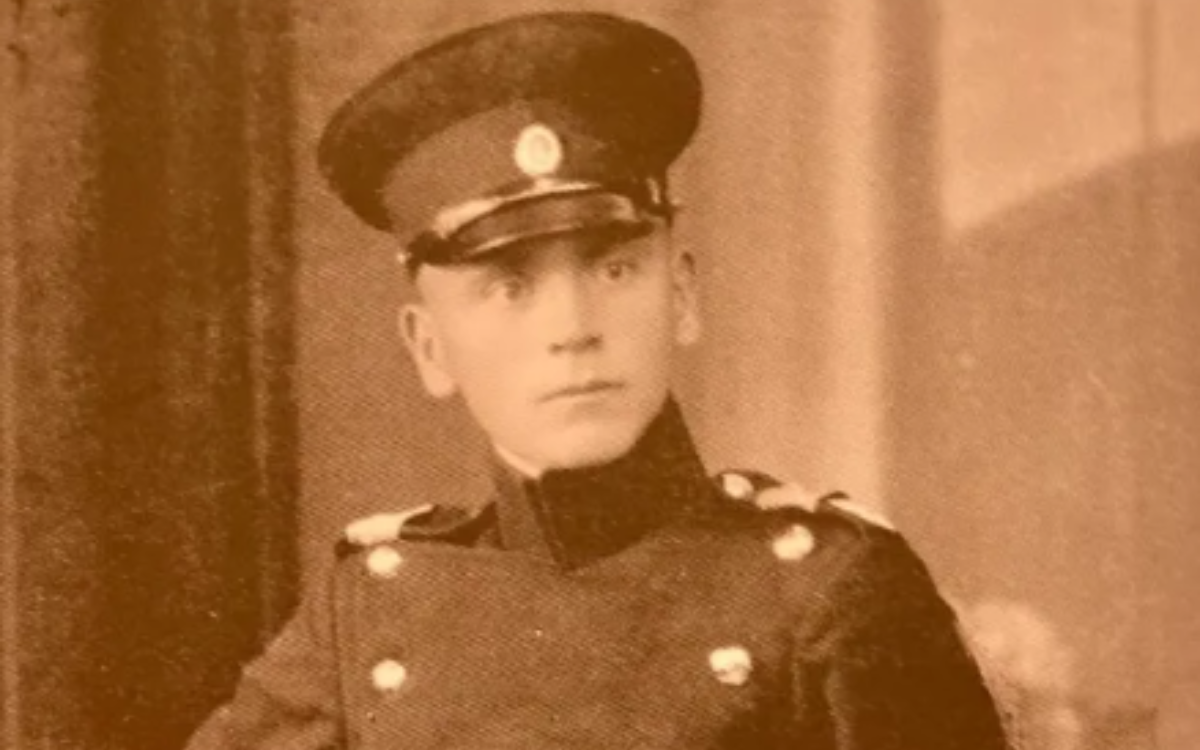
Dušica Kunaver and Darinka Bogdanović, daughter and granddaughter of Andrej Zlobec, an officer in the Kingdom of SHS who in his lifetime spoke with pride and deep respect about Serbs, his comrades-in-arms, revived memories for our portal of this honorable officer.
The recent very successful promotion of the book Un(justly) forgotten – dossier on General Majster and his Serbs, erased from history by Belgrade author Predrag Savić in Ljubljana, was an exceptional opportunity that, during the author’s stay in the Slovenian capital, he and the publisher realized several important meetings and encounters. The goal was to further acquaint themselves with historical facts from the period of the First World War and after, and to strengthen ties between the Serbian and Slovenian peoples in the field of shared history, through cooperation with historians, writers, chroniclers, editors, and other intellectuals from both sides.
Meeting with Dušica Kunaver
One of the most important and emotionally strongest encounters was with the doyenne of Slovenian literature, Mrs. Dušica Kunaver, author of more than 200 books and editor of over 800 books and publications, daughter of Andrej Zlobec, a soldier of the Serbian army in the First World War, in the units of General Rudolf Majster.
Thanks for this meeting, Savić and Jakšić, who were accompanied by historian Nikola Milovančev, owe to Mrs. Darinka Bogdanović, a diplomat from Ljubljana, niece of Mrs. Kunaver and granddaughter of Andrej Zlobec.

Dušica Kunaver is a great Slovenian writer, editor, translator, ethnologist, and publicist. For her work, she received numerous awards, among them the prestigious title Slovenian Woman of the Year. She is also the recipient of the state award for lifetime achievement in education (1995) and the Medal of Merit for the Preservation of Cultural Heritage (2024). She is the author of the monumental work 100 Most Distinguished Slovenians, which has found its place in numerous schools and libraries as a valuable reference on Slovenian cultural and national heritage. This renowned writer also read the text about Savić’s book on Serbian portals IN4S and Tamo daleko, and authorized her family to deliver to the author photographs of her father Andrej Zlobec and his memories of General Majster and his Serbian volunteers.
Dušica Kunaver spends her retirement days in the Šiška nursing home, tirelessly reading and arranging numerous texts for publication. In the green garden of the nursing home, smiling and dressed in bright colors, she welcomed the writers from Belgrade. In a cordial conversation, she clarified many details from the life of her father Andrej Zlobec and gave full support to the publication of the book about General Rudolf Majster in Serbia, also suggesting its translation into Slovenian, in which author Savić devotes an entire chapter to Andrej Zlobec. The guests from Belgrade presented Mrs. Kunaver with a copy of the book, to which she wished them luck in their further work and offered all support and assistance.
Mrs. Dušica Kunaver also sent a message to the participants and visitors of the promotion of the book Un(justly) forgotten – dossier on General Majster and his Serbs, erased from history in the diocesan hall of the Church of Saints Cyril and Methodius in Ljubljana, which reads:
“As the daughter of Andrej Zlobec, a fighter of Rudolf Majster, I cannot speak of this from my own experience, since I was not yet in this world. It has been 40 years since my father’s death… Nevertheless, the common desire of us all is that history, today’s history, be presented as much as possible exactly as it happened, and as it is written in this book. And forgive me that I can no longer think and speak as I once could.”
Who was Andrej Zlobec?
Andrej Zlobec left an invaluable mark in Slovenian military and memoir literature with his works illuminating key events at the end of the First World War and the struggles for the northern border, especially through his detailed testimony of General Rudolf Majster. He was born on November 8, 1899, in the village of Ponikve on the Karst, the eldest of nine children of farmer Andrej Zlobec (1872–1950) and housewife Ana Zlobec (1874–1961). He completed primary education in Avber and five grades of lower gymnasium in the local school. In the First World War, he was mobilized into the Austro-Hungarian army. After the war, in 1919, he joined Majster’s fighters in the battles for the northern border. Soon after, due to clashes with Italian fascists in Avber, he was forced to leave his homeland.
In the Kingdom of SHS, he attended infantry NCO school, then joined fighters on the southern border between 1921 and 1924, participating in battles in Albania and Greece. Afterwards, he served in the command of the city of Belgrade, studied at the Military Intendants’ Academy between 1925 and 1928, and worked as an active quartermaster officer in Zagreb and Maribor. In 1932 he participated in a military coup in Maribor, for which he was punished by being transferred to Prilep. Briefly, he took part in publishing the monthly Evropa, a specialist journal for teaching twelve languages, and in 1933 published the manual Priročnik intendanta (Postetnik) for the military academy in Belgrade. He also served in the powder mill in Kamnik in 1935, then in Ljubljana as a senior officer of the General Staff of the Triglav Division. At that time, he started a family with his wife Benica, née Žagar, with whom he had three children. Their daughter, Dušica Kunaver, became a prominent Slovenian writer.
After the April collapse of 1941, he was forcibly retired and joined the Liberation Front. In 1942, he was interned in the camps of Gonars, Monte Malle, Padua, and Treviso, where he helped other prisoners and was additionally punished for it. He returned to Ljubljana in 1943 and continued his work in the OF, including tasks in the Primorska region. In January 1945, he was arrested by the Home Guard, severely tortured, and left disabled. After the war, from September 1946 he worked as an accountant in various companies until retiring in 1965. At the end of his life, he prepared the memoir Za blagor očetnjave (Ljubljana, 1981), published posthumously. He died on September 23, 1981, in Ljubljana.
His life was marked by five wars. In the First World War, he was mobilized into the Austro-Hungarian army. Immediately after, in 1918–1919, he joined Majster’s fighters and participated in the takeover of Maribor and the battles toward Carinthia. Then between 1921 and 1924, he fought on the southern border of the Kingdom of SHS in Albania, and as a volunteer he also took part in the Greco–Turkish War of 1922–1923. Finally, in the Second World War he was an activist of the Liberation Front, later interned in Italian camps, and in 1945 brutally tortured after arrest.
According to the testimony of his granddaughter Darinka Bogdanović, as a young soldier of the royal army, Andrej Zlobec was a kind of courier and friend of General Rudolf Majster. Every month he brought him mail and pension to his house in Unec. Majster’s wife would prepare tea, and the two war comrades would talk late into the night about the battles for the northern border. Majster was especially glad that Zlobec had survived the war and advanced to the General Staff. He especially loved to speak of the Serbs who fought side by side with the Slovenians. He said that Serbian volunteers were “exceptionally brave, patriotic, and great patriots,” and that their presence gave confidence to Slovenian comrades. He also recorded their words that stayed with him for life: “Our life belongs to the homeland.” He repeated these words as proof of their unwavering devotion. Privately, too, he had deep respect for Serbs; his son-in-law, Darinka’s father, was a Serb from Leskovac, whom he always defended and loved.
In Za blagor očetnjave he left valuable testimonies. He recorded the atmosphere in Ljubljana at the end of 1918:
“Ljubljana in those days was a real military camp… National guards were deployed to secure access to the city… The Italians were already advancing… we carried rifles with us… in the barracks equipment and ammunition were distributed… we were helped by Serbian officers.”
He also wrote about the battles for Maribor and Carinthia:
“On November 1, 1918, General Majster took power… On November 23 we arrived in Maribor… the company secured the line toward Carinthia… fog and trenches, the Italians attacked but were repelled… the words of Majster: ‘Hold firm! This line must remain ours.’”
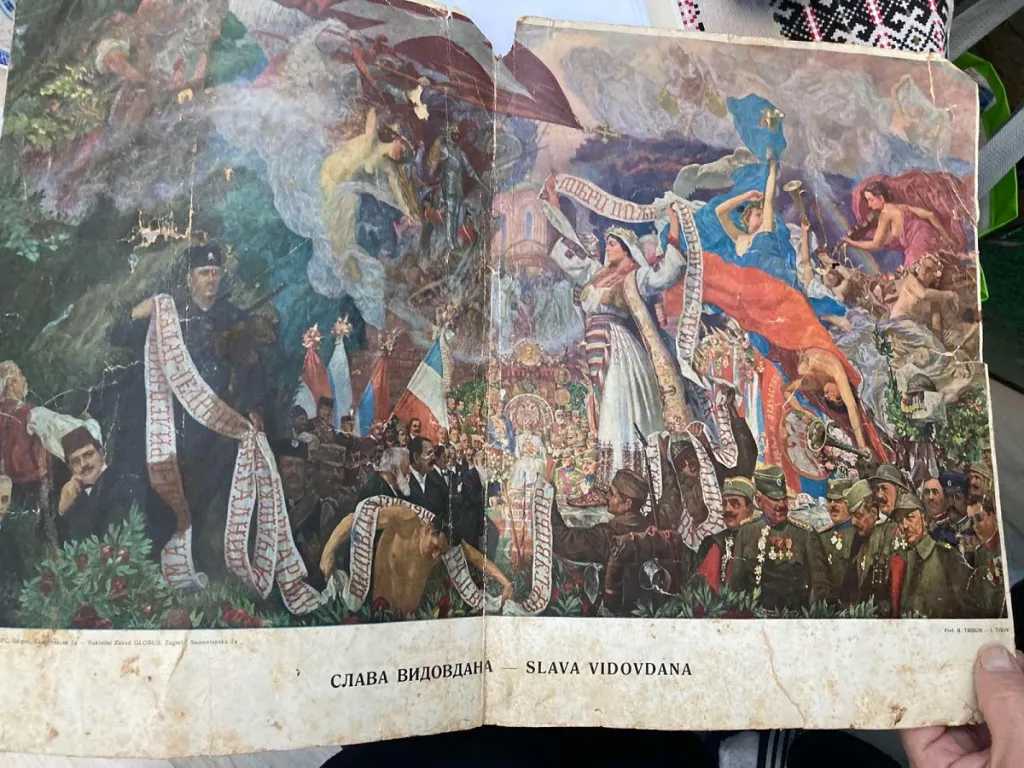
His publishing legacy was preserved thanks to the work of his daughter Dušica Kunaver and granddaughter Darinka Bogdanović. Four books were published: V bojih za severno in južno mejo, a military-historical overview of the battles for both borders of the Kingdom of SHS; Za blagor očetnjave, a memoir with personal and historical descriptions; a collection of wartime notes and letters of comrades; and a photo-monograph with original images and stories from all five wars. Two titles were published with institutional support, and two by the private initiative of the family. The family still keeps documents and photographs, including the poster Glory to Vidovdan. At the promotion of Savić’s book Un(justly) forgotten – dossier on General Rudolf Majster and his Serbs erased from history, Dušica Kunaver sent precisely this poster Vidovdan oath, emphasizing that her father Andrej Zlobec kept it in a visible place in his study as a symbol of personal commitment, connection to Serbian tradition, and memory of the battles he endured.
Andrej Zlobec was both witness and participant in crucial events, a man who in his heart remained a Karst native, but whom destiny led to many battlefields. His memories, manuscripts, and family testimony of his daughter and granddaughter today represent an essential source for the study of Rudolf Majster’s role, the courage of Slovenian and Serbian volunteers, and the trials of the Slovenian people in the first half of the 20th century.
Gratitude to Darinka Bogdanović
At the promotion of the book Un(justly) forgotten – dossier on General Majster and his Serbs erased from history by Predrag Savić in Ljubljana, alongside the author, historian Nikola Milovančev and publisher Miodrag Jakšić also spoke, and as a special guest speaker, Darinka Bogdanović, granddaughter of Andrej Zlobec, addressed the audience. Among the large audience was also a high delegation of the Rudolf Majster Societies’ Union, led by president Lučka Lazarev Šebec, representatives of the Union of Serbian Societies of Slovenia, as well as distinguished individuals of the Serbian and Slovenian communities, Nani Poljanec, head of the museum in Rogaška Slatina, General Milan Aksentijević, Dr. Dragan Mitić, Nikola Todorović, and many others.
At the very beginning of the literary promotion, Darinka Bogdanović presented the guests from Belgrade with a copy of a painting titled Kosovo oath, depicting Serbian fighters with their flags and the dates of battles they fought in the First World War. This relic, the poster Vidovdan oath, was proudly kept by officer Andrej Zlobec after the wars, framed and displayed in his home, and this tradition is continued today by his descendants.
Speaking emotionally and excitedly at the book promotion, Mrs. Bogdanović supported the event, where portraits of her grandfather Andrej Zlobec were also exhibited, and reminded those present that Zlobec was a participant in five wars and that his devotion to General Rudolf Majster was expressed not only in military operations and battles, but also in those small and ordinary human things, in his behavior and loyalty to his commander, but also to his friend, whom he regarded as the highest authority, bringing him pension money that arrived from Belgrade and mail to his apartment, and talking with him late into the night. Reading a few sentences from the writings of her grandfather Andrej Zlobec, in which he enthusiastically spoke about the founding of the state of Serbs, Croats, and Slovenes in 1918, Mrs. Darinka Bogdanović stressed the importance of remembering the great men of the past.
Commemoration for Majster’s fighters
It should be emphasized once again, in order to give even greater importance to the publication and promotion of the book Un(justly) forgotten – dossier on General Majster and his Serbs erased from history, that before this promotion, which aroused great interest and lasted more than two and a half hours, a commemoration was held in the Church of Saints Cyril and Methodius in Ljubljana for the Serbian fighters, heroes of Majster’s units, for the very first time, with the presence of more than five hundred faithful.
MORE TOPICS:
THEY TRIED TO BREAK HIS ARM: Group of young men brutally beat a student in front of the Assembly!
Source:Miodrag Jakšić / tamodaleko.co.rs, Foto: tamodaleko.co.rs
 Add Serbian Times as your Google source