




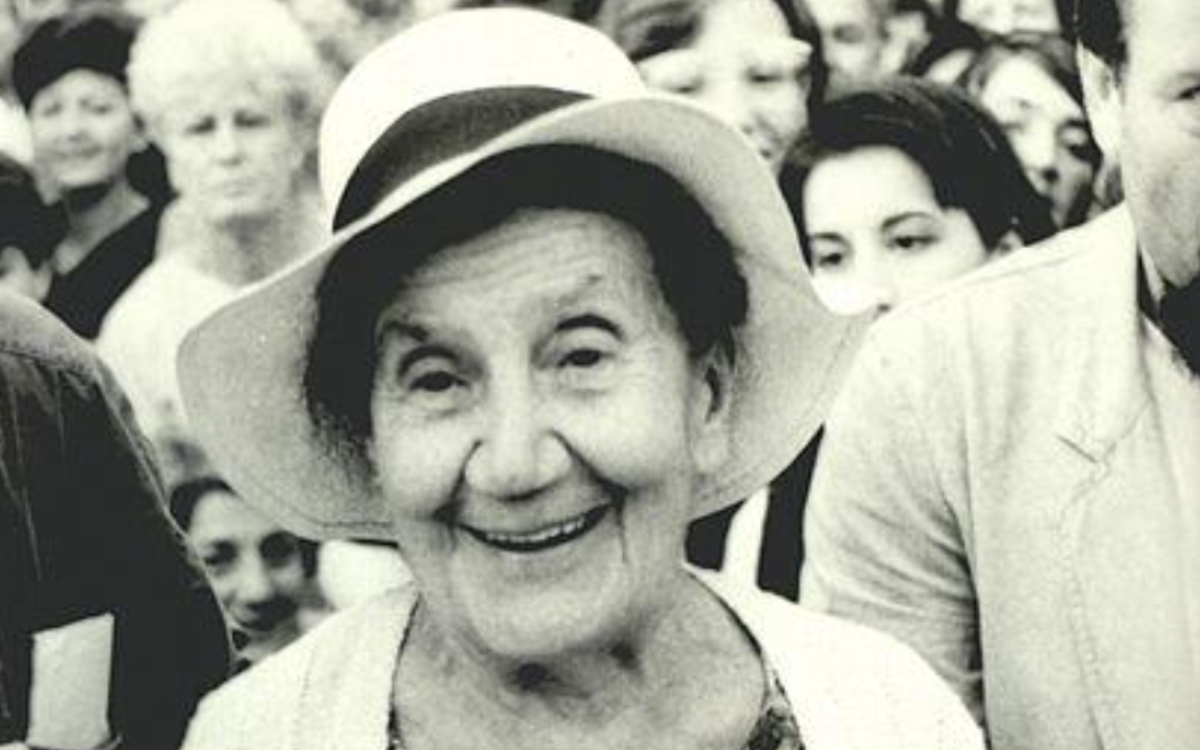
Desanka Maksimović was one of the most famous Serbian poets, a literature professor, and a member of the Serbian Academy of Sciences and Arts.
She was originally from Rabrovica near Valjevo, born in 1898 as the eldest of eight children to Mihailo, a teacher, and Draginja Maksimović, a priest’s daughter. Through her father, she was a descendant of Prince Jovan Simić Bobovac.
She spent her childhood in Brankovina, where her father was transferred for his service. She completed high school in Valjevo and studied world literature, general history, and art history at the Faculty of Philosophy in Belgrade. After graduating from the Faculty of Philosophy, she first worked at the Obrenovac Gymnasium, then at the Third Women’s Gymnasium in Belgrade, before receiving a scholarship from the French Government to continue her education in Paris. She then worked for a year in Dubrovnik, before returning to Belgrade, where she worked at the First Women’s Real Gymnasium, now known as the Fifth Belgrade Gymnasium.
From 1933, she lived in a harmonious marriage with the actor and poet Sergej Slastikov Kalužanin until his death in 1976.

A Beloved Teacher
Desanka Maksimović’s poems were youthful and full of enthusiasm, and she possessed a noble heart, illuminating everything with her kindness and pure soul. She was beloved by her students.
Once, when asked what kind of teacher she was to her students, she explained the essence.
“Well, how can I put it, I believed I was very strict, but the students said I was gentle. That means I was strict in terms of demanding that what I assigned be learned well, but when it came to punishment, when I had to give a failing grade, I didn’t rejoice and I didn’t give them. Instead, I let the student recite what I had assigned the next day or the day after,” Desanka Maksimović said and continued:
“Someone doesn’t have to know something today; they can know it three days later. I wasn’t so foolish as to demand it by that day. Knowledge is knowledge, even if acquired after five days, and I could, I liked to, and I wanted to wait for the child to learn. Someone’s mother is sick, someone’s father went for surgery, someone was beaten in the morning for not brushing their teeth, so how will they speak nicely to me… So I wait for all those troubles to pass. In that regard, I was not gentle, but normal,” the poet explained.
The famous Serbian writer always emphasized the importance of education and good manners, culture, and also patriotism, with which one ennobles everything around them.
“Every book brings a new field of knowledge. For goodness sake, this one walk through this churchyard brought me, who has been here five hundred times, some knowledge, let alone a child. Everything we touch and look at brings us knowledge, but I only warn young people. I tried to work that way; I don’t know if I succeeded, others will say,” are the words of Desanka Maksimović, which are perhaps more relevant today than ever before.
Desanka wrote many poems, and among the most famous are two completely different ones: “Anxiety” and “A Bloody Fairy Tale.”

The Love of Her Life
Everyone knows the verses of the poem “Anxiety” – “No, do not approach me! I wish from afar to love and desire your two eyes. For happiness is beautiful only while it is awaited, when it merely gives a hint of itself,” but it is little known that Desanka lived that way for a long time – waiting for love and true happiness within it.
FIND OUT MORE IN ENGLISH:
While working at the First Women’s Real Gymnasium, she met the man of her life.
“The Russians invited me one day to give a lecture at their club and read some of my poems. That’s where I met Sergej. Was it love at first sight? Probably! But certainly, my first love and the first man I kissed. I was already a mature girl. Later we grew closer,” the poet once recounted.
As she explained, due to her patriarchal upbringing and obligations to her family and younger siblings, as the eldest among them, she could not dedicate herself to this love immediately.
“I couldn’t get married right away because there were still children who hadn’t been put on the right path. I explained to Sergej that we had to wait, as I had to fulfill my inherited duties completely. He was a noble man and understood me. He patiently waited for the day when we finally got married and started our home,” Desanka said many years ago.

Sergej Slastikov Kalužanin was a Russian emigrant who, as a young cadet in World War I, was captured by the Turkish army. After much hardship and travel, he eventually settled in Belgrade. He patiently waited for Desanka to be ready for marriage. She finally said “yes” to him in 1933, and he then completed acting school. He was offered a job at the Skopje Theater, which he refused because Desanka was tied to Belgrade.
“He got a job at the ‘Prosveta’ publishing house as a Russian language translator. During his lifetime, he translated fourteen books. He also wrote poems for children, signing as ‘Kalužanin.’ He was originally from Kaluga, a forested area near Moscow,” Desanka recounted.
She also revealed that many believed she could have “married better” because Sergej wasn’t wealthy.
“I married the man my heart sought, regardless of his poverty. In him, I found what I desired,” the poet emphasized.
The couple, however, never had children, but Desanka stressed that her poems were her children because she gave herself completely to them.
“Later, in marriage, my creative work completely fulfilled me. When I wrote a poem, it was as if I had given birth to three children. I would be so exhausted. I gave my all,” the great poet explained.
Sergej passed away in 1976, and Desanka on February 11, 1993. They are buried side by side in Brankovina near Valjevo, in the churchyard of the Church of the Holy Archangels.
MORE TOPICS:
“THE DECEASED USUALLY HAVE NO RIGHT TO VOTE”: Students in blockade called for a voter list check!
Source: Kurir, Foto: Wikipedia