





It would be quite frivolous to accuse a small library of inciting assassination. It is modest, with only about twenty titles. The whole thing can fit in one backpack and be read in one summer. When they played billiards, the Young Bosnians discussed literature.
They were serious, analytical, and uncompromising in their views. Discussions most often ended with a showdown using billiard cues. In room 33 of the closed section of the Terezín hospital, Gavrilo Princip told Dr. Maurice Papenhajm that there was no joking in his relationship with books: “Always lonely, in libraries… Books mean life to me. That’s why it’s hard for me now without reading…”
Nedeljko Čabrinović wrote a list of literature for his colleagues, typographical apprentices, “which they must read to know how to distinguish truth from the lies that priests tell them.” The list, which contains 26 books, has been preserved to this day.
Due to the illegible handwriting, one title cannot be deciphered, the others are clear: The First of May 1907; Program and Organization of the Social Democratic Party in Croatia; The People’s Voice, Social Democratic Calendar 1907; The Progress of Social Democracy in Croatia and Slovenia from 1904 to 1906; Views on Clericalism in Croatia; Interpretation of the Socialist Program; The Communist Manifesto; The Proletariat and the Class Struggle; The Law on Trades and Social Democracy; Socialism and the People’s Struggle; The Law on Workers’ Insurance; Wherein Lies the Strength of the People; Workers’ Struggle; The Right to Life; The Earthly Paradise; How the Bourgeoisie Newly Plunders the Workers; The Confession of Pope Alexander II Borgia; Boycott; Wherein Lies the Strength of the Working People; The Socialist Commune; Speech of the Jesuit General; The Main Duty of a Social Democrat; Christmas Sermon; Do Not Betray Your Brother: What is Universal, Equal, Secret, and Proportional Suffrage. Danilo Ilić translated books, literally until the day of the assassination. On his last night, he was finishing Oscar Wilde’s book.
Among his translations are also works by Kierkegaard, Strindberg, Ibsen, Edgar Allan Poe… Every Young Bosnian wanted to be a poet. Princip didn’t have much talent, but he wrote persistently, hoping to become better. It is recorded that he showed his verses to friends twice. The first time, he read a poem to Dragutin Mras about roses blooming at the bottom of the sea for his beloved girl. Mras didn’t like the poem. The second time, he talked about his poems with Ivo Andrić. He promised to show them to him, but he didn’t. When Andrić asked him about them, he replied that he had destroyed them.
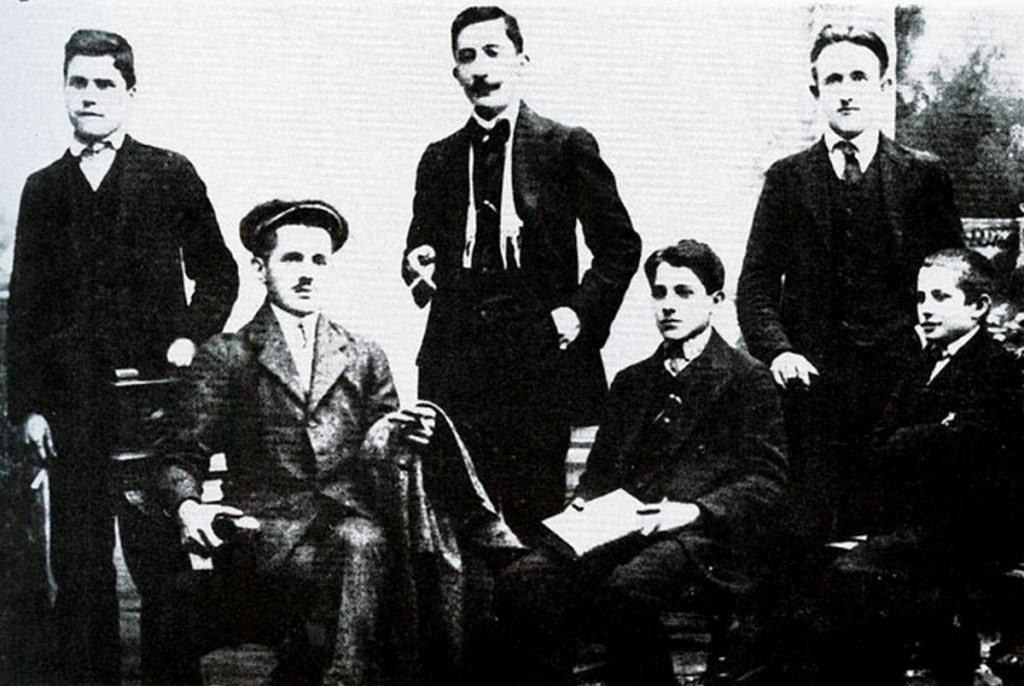
Princip’s only complete lyrical text from 1911 has been preserved in the guestbook of a mountain lodge on Bjelašnica.
“Silently, we walked with unsteady steps through the forest, lost in that mysterious, deep silence, we listened to the mute whisper of fragrant flowers and silent trees. Further and further into the dense forest – we looked at each other when the hellish darkness surrounded us, grinning with the laughter of grotesque monsters – a silent and light tremor and fear flowed through our half-tired limbs like electricity – silently we walked on, stumbling over various logs and scattered branches – woe is me, how many times the fatal thought flashed through my mind that I would not fly into some eternal abyss.”
Princip described that year, 1911, to Dr. Papenhajm as critical in his life. That’s when he began to acquire “ideals about life” and joined the Young Bosnians. He also fell in love that year.
He wrote his last verses on the wall, a few days before his death, about the shadows that frighten the lords in the court.
I found the books from the Pocket Assassination Library scattered in Vladimir Dedijer’s two-volume book “Sarajevo 1914” (“Prosveta”, Belgrade, 1978). As far as I know, they have never been collected in one place before, they were borrowed from various libraries, exchanged between the assassins, sold and then bought again, burned, read in Bosnia and Herzegovina, Croatia, Serbia, and France, in student rooms, komita huts, cheap hotels, taverns, restaurants, and Baščaršija sweet shops, carried in pockets, learned by heart.
Books inevitably share the fate of their owners, which does not make them powerless or innocent.
One book from this library participated in the very act of assassination. It’s not the first time, of course, I know of two, and I haven’t undertaken any research – those carried by Mark Chapman and retired prison guard Mile Matić.
Another book from the library, learned by heart for years, echoed in the mind of one assassin. It is always dangerous when one book echoes in the mind. Unfortunately, this is still a common occurrence today.

In the Pocket Assassination Library, I have compiled these books:
Conan Doyle, “The Adventures of Sherlock Holmes” Gavrilo Princip liked to read adventure novels, Alexandre Dumas, Walter Scott, and especially “The Adventures of Sherlock Holmes.”
He must have read this passage, in which Watson describes his friend: “His reserve had never relaxed so far as to allow me a glimpse of his past life. Beyond the vague knowledge which I had picked up in conversation it was a dark mystery to me. The latter was a subject upon which he had never spoken a word.
So far as I knew, he had neither kith nor kin in England. His temper was even, but somewhat cold and saturnine. In his moods he was reticent, and when he had his own purposes in view he was inexorable in his silence. His aversion to women, and his disinclination to form new friendships, were both typical of his unemotional character, and his dislike of any allusion to his own people was such that he never mentioned them.”
Nikolai Chernyshevsky, “What Is to Be Done?”
Nedeljko Čabrinović was 14 years old when he read the book “What Is to Be Done?”. His father Vaso found him with it, slapped him, and pulled the light bulb out of the socket.
Vaso was a strong man, weighing 120 kilograms, with hard fists and the stern character of a tired tavern keeper. Nedeljko was the oldest of nine children. His father beat them for the slightest violation of family or anyone else’s rules. Once, a worker in the printing shop slapped the apprentice Nedeljko. Vaso did not defend his son, he kicked him out of the house. Nedeljko went to Zagreb, wandered there for a month, and when he returned home dirty and hungry, his father called the police and persuaded them to arrest his son. The boy spent three days in prison for no reason.
Chernyshevsky wrote the novel in 1862 in prison while awaiting trial on charges of revolutionary activity. He wrote about creating a more just society through a family-run manufactory. When he finished the manuscript, he was sentenced to exile in Siberia.

Guy de Maupassant, “After Love”
When Major Vasić from the National Defense met Čabrinović in a Belgrade park and saw this book in his pocket, he was terribly disappointed.
“What Maupassant, what love, what love, what after it, no, no, no, please, such books completely blind a young man, no, no, no, please…” the officer must have said.
He gave him a collection of Serbian heroic folk songs, a hardcover edition, adapted to be kept in the pocket of a soldier’s blouse over the heart, where a bullet could slow down and save a life.
Trifko Grabež and Gavrilo Princip did not allow Čabrinović to visit the Black Hand operative Voja Tankosić with them because Nedeljko kept giggling (“It’s just my facial expression,” he vainly justified himself). The arrogant komita did not like frivolous people. He thought they were hiding something behind their smiles. He felt comfortable in the company of fanatics. He gave the Young Bosnians pistols, bombs, and pocket money for the trip.

Jules Payot, “The Education of the Will”
Čabrinović read “The Education of the Will” in 1912 in prison in Trebinje, where he spent three days, suspected of organizing strikes by printing workers, destroying machines, and attacking strikebreakers. Perhaps the book was part of the prison library, a form of correctional measure that the Austrians introduced in Bosnia and Herzegovina, experimenting with the Irish progressive system.
All in all, due to the education of the will or the strengthening of the body, his father never hit Čabrinović again from that year on.
Vaso complained about his son in a letter to his friend Vučina:
“…whom I bore, raised, and for whom we toiled and spent. About one of our greatest household demons, who behaved indecently towards his father everywhere, who was never obedient or submissive to his father in anything…”
Nedeljko became his own man, the master of his own life. And death, of course, as it usually goes.
At the trial, he said:
“I don’t want to accuse my father, but if there had been better pedagogy, I wouldn’t be sitting on this bench.”
FIND OUT MORE IN ENGLISH:
William Morris, “News from Nowhere”
One copy of the book with the signatures of Princip and Čabrinović has been preserved.
They read it in 1912 and underlined passages in the text that particularly impressed them.
Princip underlined: “Since we are eschewing centralization,” and Čabrinović: “…about the lack of the element of interestedness of the workers in a communist society.”
At the end of the book, Čabrinović neatly wrote:
“I read this book at a time when I was individually, as well as socially, in the greatest contrast to the optimism of this book.”
Svetozar Marković, “Serbian Illusions”
Svetozar Marković wrote that ideas in small countries are only as valuable as the people who represent them. The Young Bosnians believed in Marković’s view that society could be changed by the actions of morally strong and socially conscious individuals whose example would contribute to the creation of a new, better type of person.
Vladimir Gaćinović convinced Trotsky in Paris that all Young Bosnians strive for the morality of a simple life, that they are all revolutionary ascetics and puritans. He said that they do not drink and that they view declarations of love as a defilement of a girl’s dignity. He convinced Trotsky that the rule of mandatory abstinence from love prevailed in his organization.
As for Princip, he told the truth. He confided in Dr. Papenhajm in prison that he had never had sexual relations. He wore a rough prison shirt, without buttons. With his healthy hand, he tried to close it at his chest.
Oscar Wilde, “The Happy Prince”
Princip found Čabrinović’s sister Vukosava reading a pulp novel “The Secrets of the Constantinople Court”. He criticized her literary taste and brought her Wilde’s stories.
Years later, Vukosava described Princip as a withdrawn boy, sometimes witty, even sarcastic, with deep eyes, beautiful teeth, and a very high forehead.
Sarajevo judge Leo Pfefer saw him immediately after his arrest and described him as follows:
“The young man was of small stature, frail, with a long, pale yellow face, so it was hard to even imagine how he, so small, quiet, and modest, could have decided on such an assassination.”
Milutin Uskoković, “Immigrants”
Along with Wilde, Princip also lent Vukosava Uskoković’s novel “Immigrants”. Why would Uskoković appeal to a young girl? Perhaps a poetic notebook would have been more appropriate?
Nedeljko had a great influence on his younger sisters. Vukosava attended teachers’ college in Karlovac and said she was an anarchist, and her sister Jovanka was a “convinced socialist.”
Her brother wrote to her on July 14, 1912: “You ask if I am still a socialist. I am. Just a little smarter – different. You ask me if I’m hungry. Not yet. I’ve been many times. For your patron saint’s day, you ate roast meat, and I ate dry bread.”
Čabrinović sent a suitcase of anarchist literature from Belgrade to his sisters in Sarajevo. The books frightened his mother. In the dead of night, while the neighborhood slept, she burned them one by one in the kitchen stove 1 and crushed the ashes with a poker. So that not even a mention of them would remain.
Milutin Uskoković jumped into the Toplica River and drowned himself on October 15, 1915. His friends said he did it because of the “collapse of the fatherland.”
Oscar Wilde, “Thoughts on Art and Criticism”
Danilo Ilić translated this book in 1913, at a time when he was most preoccupied with preparations for the assassination. Towards the end of the book, he abandoned his intention.
Until his last day, he persuaded Princip and Grabež to also give up the assassination. Unsuccessfully, as we know.
Yet it is well; he has never trod
That last black mile of pain.
(The Ballad of Reading Gaol)
Sima Pandurović, “Days and Nights”
Princip most valued pessimism in Pandurović’s poetry. Jovan Skerlić wrote that pessimism at that time “flooded” the entire Serbian literature:
“And never have cemeteries been so sung about, and never has nirvana seemed such an ideal as in those gloomy and sorrowful times.”
In the book of poems “Days and Nights”, Princip underlined the verses of the poem “Today”:
And if we create nothing by ourselves,
We will at least end the misery of these days:
We will, after all, be the foundation with our grave.
For a new life without today’s flaws,
A better life that leads to something at least,
If not honorable peace, then war,
If not happiness, then freedom.
Henrik Ibsen, “Catiline”
Henrik Ibsen believed that permanent rebellion was the main law of life:
And is not life itself just an eternal struggle
Of hostile forces within our soul
And is not that struggle the only life of that very soul of ours.
Ibsen’s letters to Georg Brandes were translated in the Zora magazine, in which he writes:
“The only thing that matters is the rebellion of the human spirit. The concept of freedom contains the fact that it must constantly be increased.”
Friedrich Schiller, “William Tell”
William Tell is a character from Swiss folk tales who killed Gessler, the Habsburg governor, after which a peasant uprising broke out. Schiller wrote a drama based on this story.
Bogdan Žerajić obsessively read the book while preparing for the assassination of General Marijan Varešanin. After firing five shots at the provincial head, he killed himself with the last one. In his pocket, the police found a notebook full of quotes from “William Tell.”
In prison, Princip claimed that as early as 1912, he swore at Žerajić’s grave that he would avenge him. The night before the assassination, he stole flowers from other graves and laid them on Žerajić’s burial mound.
Pyotr Kropotkin, “The History of the French Revolution”
In addition to the notebook, the Sarajevo police also found a badge on Žerajić, which the inspector described in his report as follows:
“…which consists of a red cardboard circle about 10 cm wide, bordered by a red edge, showing a portrait of a beardless man wearing hair; and with a passionately distorted face, open mouth, and disheveled hair.”
The badge was reproduced and sent for expertise to the police commands of European capitals. In Budapest, they recognized the motif and replied that the badge was “identical to the cover of the book ‘The History of the French Revolution’, written by Pyotr Kropotkin and published by Theodor Thomas, a publisher from Leipzig.”
The police buried the body of Bogdan Žerajić in the part of the Sarajevo cemetery where suicides and vagrants lay, and his head was exhibited in the Criminal Museum. At that time, the criminologist Lombroso’s popular theory was that every criminal had a specific skull defect, so the police believed that Žerajić’s head could be useful to science and interesting to the public.
After the fall of the Habsburg Monarchy, the head was reunited with the body.
Sergey Stepnyak, “Underground Russia”
Critics usually single out the warmth and care with which Stepnyak speaks of his friends and comrades from the book “Underground Russia.”
Grabež and Princip believed until the last day that Čabrinović was incapable of carrying out the assassination. Grabež thought he was gullible and saw “a friend in every man.” Princip described him to Dr. Papenhajm as a “typesetter” without great intelligence.
Danilo Ilić once said that Čabrinović threw the bomb only to regain the trust of his friends.
The night before the assassination, Nedeljko Čabrinović read “Underground Russia” for perhaps the umpteenth time. In the morning, he packed the book in his pocket, along with the bombs, and headed to the agreed place near the Miljacka River.
Jasiya Torunda, “When Countrymen Meet and Other Stories”
Princip wrote in the margins of this book:
“What your enemy should not know, do not tell your friend. If I keep a secret, then it is my slave. If I tell it, I am its slave.”
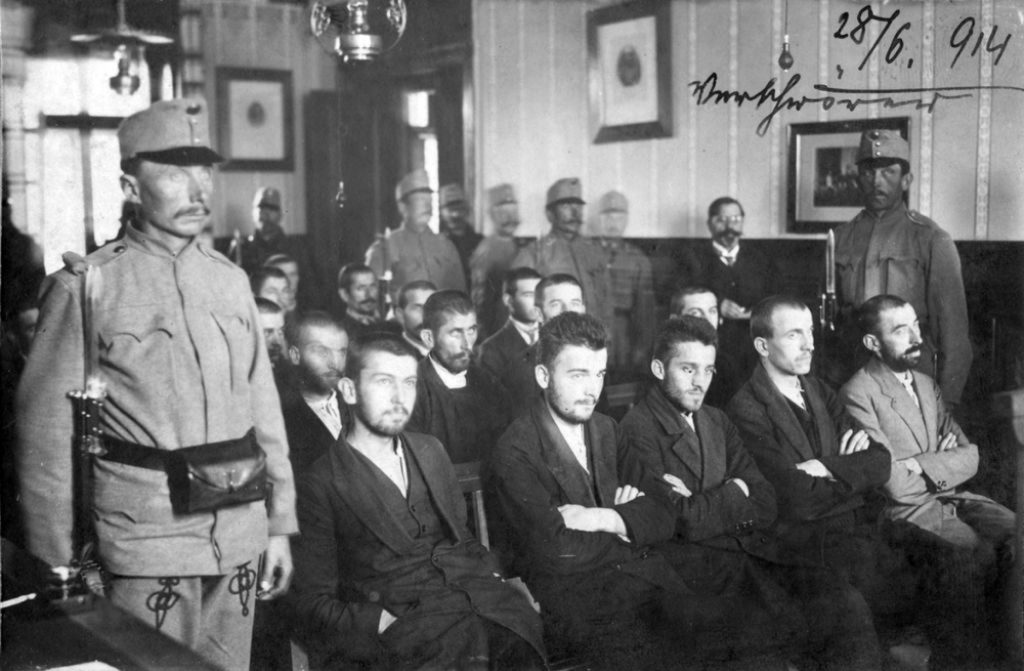
During the trial, in critical moments of testimony, Čabrinović asked to consult with Princip. When they were confronted in front of the judge, Gavrilo calmly replied that he should speak according to his conscience.
In his closing statement, Čabrinović said he was sorry he killed Ferdinand and that his last words greatly moved him: “Sophie, stay, live for our children.”
Princip spoke after him and said that he regretted that the children had lost their father and mother, that he was sorry he killed the Duchess, but he did not regret the Crown Prince, he wanted to kill him. Čabrinović quickly rose from the bench and stated that he did not regret Ferdinand either.
Leonid Andreyev, “The Seven Who Were Hanged”
In “The Seven Who Were Hanged,” Andreyev writes about the execution of two criminals and five political prisoners, how they accept death
MORE TOPICS:
TRUMP’S BIGGEST RAID SO FAR: Over 100 illegal immigrants arrested in Colorado Springs underground nightclub!
COLUMN, KOVAČEVIĆ: Not My Patriarch! Because my Patriarch would never slander his people in Moscow…
MILAN CELEBRATED SERBIAN FOLKLORE IN AMERICA: Came to Chicago for love, became a cultural ambassador
Source: Selvedin Avdić (Žurnal, Sarajevo); Foto: Wikimedia Creative Commons