




By Slav Dedović for Deutsche Welle.
In Belgrade, you sometimes drive down a street that changes its name without changing direction. Dušanova. George Washington Street. March 27 Street.
And yes, Queen Maria Street, where in the 1980s I used to go to Mašinac for concerts.
On the corner of Dobračina and Dušanova, I worked for years in the first decade of this millennium, so I know that area well. Dorćol (or more precisely, Dorčol) is divided into two parts—the bourgeois area above Dušanova and the hardcore Dorćol below it, which some claim, perhaps exaggeratedly, is the only true Dorćol.
When you cross from 14th-century Dušanova into 18th-century Washington Street near Skadarlija, nothing much changes—until Takovska marks the transition into March 27 Street, a sudden leap into the 20th century.

Our Coup, Your Coup, Their Coup?
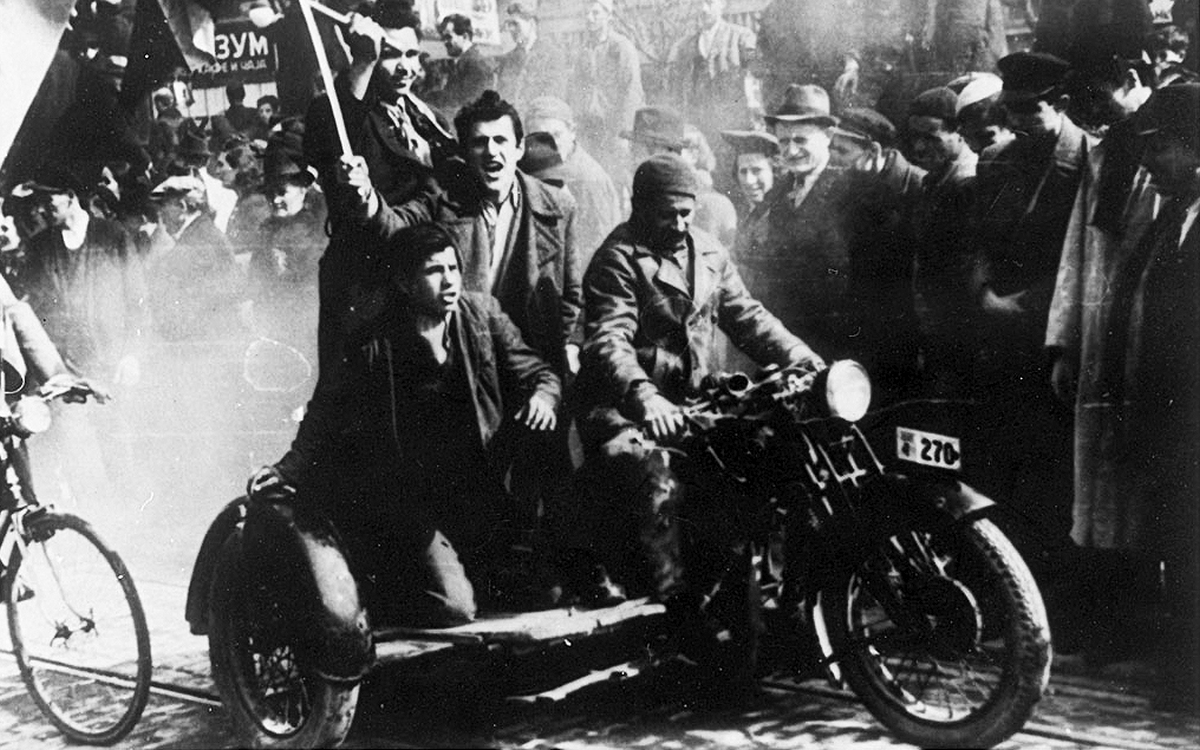
March 27, 1941: A group of pro-Western officers staged a coup, overthrew the Regency led by Prince Pavle Karađorđević, declared Crown Prince Peter Karađorđević of age, and rendered the recently signed Tripartite Pact meaningless.
Anniversaries force people to ask difficult questions in line with their historical memory: What does March 27, 1941, mean to us today?
During socialist Yugoslavia, the communist and patriotic resistance against the Tripartite Pact were equated. The truth is, those pro-Western officers were supported by both Stalinists and those loyal to Patriarch Gavrilo Dožić. After the war, a myth was added: that Yugoslavia’s coup delayed Hitler’s attack on the Soviet Union, pushing the Wehrmacht into the Russian winter, where its blitzkrieg stalled.
Later, the officers behind the coup were both celebrated and criticized. The British intelligence influence became more apparent. And then came the pragmatists, asking: Wouldn’t it have been smarter for the fragile Kingdom of Yugoslavia not to provoke Hitler?
These narratives stand side by side in Serbia’s historical collage. Some call this pluralism, others chaos. But what can you do? We prefer grand myths over sober historical analysis.

When London Finds You a Soul
For the rest of the world, what did March 27, 1941, mean? The British popped champagne after the coup. Winston Churchill famously declared that Yugoslavia had “found its soul” again.
But I think of British cynicism—no military aid to Belgrade, no diplomatic solutions either. Yugoslavia was allowed to “find its soul” just days before being crushed under Nazi boots—all to buy time for London and Moscow against Hitler.
The British knew Hitler wanted to invade Greece, after Mussolini’s humiliating failure. And Britain couldn’t let the Third Reich dominate the Mediterranean—that would cut off oil and colonies. So, 58,000 British troops were sent to Greece.
A neutral Yugoslavia was unacceptable to London. But the Tripartite Pact signing on March 25 in Vienna was seen as a direct threat to British interests in the Balkans and Greece. So, British intelligence activated all its contacts in Belgrade—agents of the Special Operations Executive (SOE), who had studied Harold Temperley’s 1917 “History of Serbia.”
The British playbook? “Just anger the Serbs and push them toward patriotism.”

“Serbian Conspiratorial Mob”
While the British toasted with champagne, Hitler fumed. He hadn’t anticipated the coup. Already frustrated with Mussolini’s failures in Greece, the Belgrade coup was the last straw.
Germany couldn’t invade the Soviet Union with an unstable southern front. And with British forces in Greece, the Romanian oil fields—vital to Hitler’s war machine—would be within enemy bombing range.
Contrary to the stereotype of Hitler as an irrational Yugoslav-hater, historical records show he wanted to win over Yugoslavia without war. He even said that no price was too high for “friendly relations” with Yugoslavia.
But the coup revived his Austro-Hungarian trauma. He called the plotters “a Serbian conspiratorial mob” and vowed to “burn that Balkan ulcer to the ground.”
That led to Directive No. 25:
“The coup in Yugoslavia has changed the political situation in the Balkans. Even if Yugoslavia guarantees loyalty, it must be considered an enemy and destroyed as quickly as possible.“
After March 27, events spiraled into war.

One Man Tried to Stop It
On March 27, demonstrators burned German flags in Belgrade, smashed German offices, and the next day, in the Orthodox Cathedral, German envoy Viktor von Heeren was insulted and spat on.
Ironically, von Heeren was the one German official trying to prevent war.
Despite Ribbentrop’s orders, von Heeren maintained intense contact with the new Yugoslav government. He even warned them of the upcoming bombing six days before the April 6 attack. He protested the invasion in Berlin—and for that, he was removed from duty. His career was over, and he died in Bavaria in 1949.
He couldn’t stop Directive No. 25, nor the April 6 air raid on Belgrade. But he tried, sacrificing his career in the process.
FIND OUT MORE IN ENGLISH:
Forgotten in the Shadows
The Air Force General Borivoje Mirković led the coup. Today, he has a street in Paracani, a town of 600 people, 30 km south of Belgrade.
After Yugoslavia’s defeat in April 1941, he evacuated the royal entourage from Nikšić airfield—with eight crates of gold in his plane. Shot down by Greek anti-aircraft fire, he broke both legs. After the war, he served in the British Air Force and died in London in 1969.
General Dušan Simović fared slightly better—his name appears on dead-end streets in Ugrinovci and Borča. He testified at Draža Mihailović’s trial and supported the Partisan resistance. He died in Belgrade in 1962. His friend, Charles de Gaulle, occasionally sent French diplomats to check on him.
The coup plotters believed they were saving national honor, correcting Prince Pavle’s doomed attempts to pick the “lesser evil.” But as soon as they seized power, they tried to reassure Berlin—too late.
Soon, monarchists, communists, and civilians alike realized that the British intelligence slogan “Better grave than slave” wasn’t a metaphor—it was a one-way ticket to a mass grave.
MORE TOPICS:
SERBIAN EXPERT TEAM: Data indicates that NATO deliberately committed genocide in Yugoslavia in 1999!
Source: Deutsche Welle, Foto: Wikimedia Creative Commons
 Add Serbian Times as your Google source