




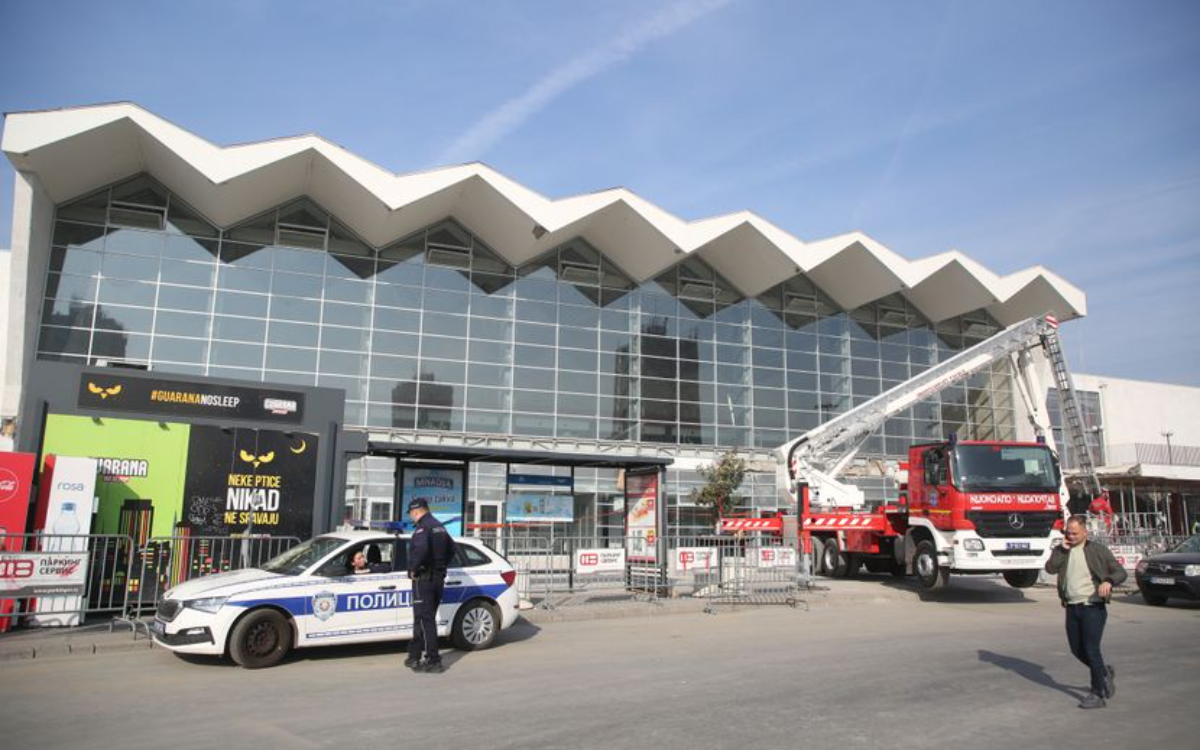
Experts from the Faculty of Technical Sciences in Novi Sad testified at the end of last year before the senior public prosecutor and the defense attorneys (now defendants) of 13 people, that the canopy at the railway station would collapse very quickly and that no work had been carried out on it, shows Forbes Serbia’s insight into their statements.
They first explained that the collapse would not have occurred without any adaptation because the tie rods were designed with a safety coefficient of 2.25. This means that they would withstand an additional load of 40 to 50 kilograms per square meter. This would increase the total load of the canopy by up to 10%.
However, the problem was corrosion on the tie rods. The deterioration of the wires, according to them, is the primary cause of the collapse.
Therefore, in the continuation of the examination, one of the experts stated that “the collapse would have occurred in a shorter period of time when the corrosion progressed by a very small degree.”
Another added that “probably the canopy would have collapsed very quickly in a situation where no work was carried out on the canopy, taking into account corrosion.” Within that conclusion, he took into account the load that wind and snow would represent.
Despite the lengthy examination by lawyers and expert associates, the experts stood by their finding.
It is not known how the corrosion occurred
They also said that it cannot be determined how the corrosion occurred. They assume that it occurred in the same way. And it appeared about 25 to 35 centimeters from the anchors embedded in the roof. It is especially impossible to determine by years how the corrosion “developed.”
When asked whether damage to the tie rods was visible at the time of the Conceptual Design, they answered that from the ground under normal circumstances it is not possible to see that there is a gap between the tie rod pipes and the place where they enter the roof, but that there was damage. They explained this by the fact that in the pictures (highlighting those from 2014) stains are visible around the tie rod protection, at the junction with the roof.
They added that they determined on-site that there was a gap of several centimeters.
They are also of the opinion that the place of rust appearance could not be determined by visual inspection alone. They claim that checking the condition does not only imply a visual inspection but “all necessary inspections.” They explained that there are regular and detailed inspections. And that the condition of the tie rods always had to be of particular importance. They said that their condition had to be precisely determined after the expiration of their exploitation life. They added that the service life of the structure was not prescribed.
How to determine
The experts were asked several times how the problem could have been determined. In one part of the testimony, they referred to photographs from different periods. And that around each of the tie rods at the point of entry into the roof, the plaster and concrete had fallen off. However, the cause of the falling off cannot be determined with 100% certainty, i.e. there can be several reasons, the experts stated.
One of the reasons can be earthquakes that move both the building and the canopy. This could have separated the concrete from the tie rod. Another reason could have been the temperature effect on the tie rod protection and concrete, i.e. the contraction and expansion of the tie rod protection. The third reason is that some of the previous damages cause damage to the wires, and then additional damage leads to corrosion.
When asked by the lawyer, they answered that the photographs are not of such quality that the corrosion of the pipes could be seen. But also that the falling off of concrete and plaster is visible on them, which according to them is an indication that there is a problem.
Camera?
The experts were asked how the designers should have tested the wires. Bearing in mind that the connection of the wires and anchors was not visible. They answered that this requires the engagement of experts. They would determine the method of checking and would do it “until they were sure that they knew the situation, i.e. the condition of the structure.”
One of the experts said that the condition in the tie rods could be checked by a less invasive method. He explained that the plaster around the tie rod could be broken off and that an endoscopic camera could be “entered.” Another confirmed that such a method exists, but that a destructive method should also be done if the inspection requires it. If the camera showed that there was corrosion in one place, the check would be repeated in other places. And that would last several days, according to the experts. They defended their claims by the fact that it is a 60-year-old building. As well as that it is known in construction practice that this type of element has failed on several occasions. They added that it is “unacceptable” to leave the tie rods without adequate inspection.
FIND OUT MORE IN SERBIAN:
Two tie rods had not been carrying the canopy for a long time
The experts described in their expertise that two tie rods out of a total of 18 were not in function. It is a professional description and use of the term that they are inactive and do not transmit load.
In the testimony, they explained that it is quite certain that two tie rods were not in function. That is, that they had not been carrying the canopy for decades. This was determined based on corrosion, but it is not possible to determine what exactly caused “such corrosion” on those two tie rods.
And for the assessment that 40% of the wires in the other tie rods were inactive, which is mentioned in several places in the indictment, they said that it is an optimistic estimate. According to IMS (Institute for Materials Testing) measurements, more than 45% of the wire cross-section was damaged.
It was also explained that they determined frame by frame from the video recording from which anchors the tie rod failure started.
14 anchors from the roof (out of 18) were analyzed and four more were extracted from the remains of the canopy. According to them, it was concluded that the remaining anchors in the canopy were in good condition. One of the experts could not answer whether the 40% result would have been worse if all the anchors had been analyzed. It was assessed that it would have been worse if they had determined that the anchors from the canopy were also affected by corrosion.
They measured the reduction in load-bearing capacity by comparing the cross-sections of healthy wires and those corroded.
Who should have determined the condition of the tie rods
One of the experts said that it was the obligation of the investor (Infrastructure of Serbian Railways) to control the condition of the building. He adds that there is no statement about the structural condition of the station building in the handover record.
They did not determine by reviewing the archival project that there are instructions for maintaining the building.
However, they are of the opinion that the structural designer should have prepared a report on the condition of the structure. They believe that the measurements made by the architect are not sufficient for the preparation of the structural design. They said that the assessment of the condition from the architectural design that the building is in good condition represents an assessment of the condition of the structure. But they also repeated that this is not enough for any structural design.
War of lawyers and builders?
From the experts’ statements, it can be guessed that the defense lawyers will “attack” the findings of the expertise at the trial. They have already done so in the examination. They did not agree that the experts precisely determined the level of load to which the canopy was exposed during construction itself. They also disputed that it was precisely determined how much old material was removed from the canopy during the last works, and therefore they could not precisely determine the last load.
What can be expected to be a point of contention is the difference in the fact that the experts had the archival project when preparing the findings, while the designers did not receive that document from the investor.
Several civil engineers, as well as lawyers, in an interview for Forbes Serbia, explained several other points where it is not possible to confirm with 100% certainty whether the experts are right or not. That is, whether the defendants’ lawyers will succeed in “overturning” the expertise in some parts.
Interpretation of regulations
Perhaps more important than the construction part is the interpretation of regulations, i.e. the legal part. The first and biggest objection of lawyers to the expertise is that the experts ventured into the interpretation of regulations, i.e. they did not stick only to the construction causes of the canopy collapse. Also, one of the “wars” that will be fought in the courtroom is which regulations, i.e. rules, were valid at the time of the start of work on the project. This is important because it also affects the assessment of whether the designers had an obligation and how to determine the condition of the building structure.
Likewise, from the very beginning, an important question is whether a reconstruction was done on the canopy. Although the project bears such a name, the profession is of the opinion that it was still an adaptation because the structural elements of the canopy were not touched. One of the experts said in the testimony that no structural works were carried out, but he added that glass with a substructure was added, which is an additional load that implied the obligation to calculate the load-bearing capacity of the existing structure.
Also, it can be expected that the defense lawyers will “attack” the photographs as proof that there was a problem. What is also important is the issue of the need to prepare a report on the assessment of the condition of the structure
, as well as the issue of engineering practice. As the engineers we spoke with explain, a report under that name does not exist in the regulations. One of the experts confirmed this in the examination, i.e. that it is not written in the regulations that a notebook bearing that name is needed. But he referred to the fact that there should be a record of the condition in the structural design and that the designer, together with the main designer, can decide whether to call it a report or put the assessment of the condition in the structural design.
Another term that the experts refer to is engineering practice. As our interlocutors tell us, although such a practice may exist on the ground, it does not exist in the regulations, so the question is whether it can be maintained in court as an argument.
However, what will be key for the defense of the majority of the defendants (especially engineers) is the interpretation of the Law on Planning and Construction and the regulations on construction and control of technical documentation. And whether they made omissions in that part or worked in accordance with the law and bylaws, i.e. the project task which, they claim, did not require them to assess the condition of the structure.
MORE TOPICS:
NEW INCIDENT IN THE SERBIAN ASSEMBLY: Opposition MP activated a fire extinguisher! (VIDEO)
Source: Forbes, Photo: Nikola Tomić