




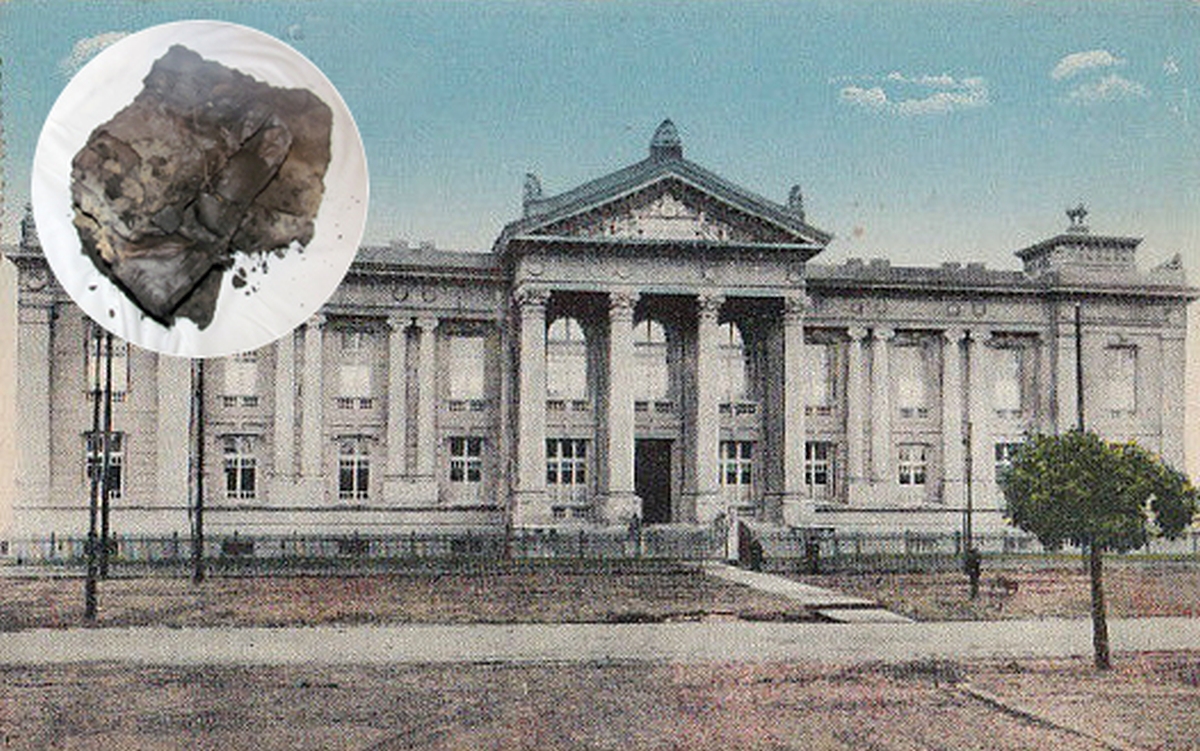
The National Library of Serbia was founded in Kragujevac on July 12, 1838, within the Ministry of Education, and was relocated to Belgrade at the beginning of the following year.
In the second half of the 19th and early 20th centuries, some of the most significant figures in culture and science, such as Đura Daničić, Janko Šafarik, Stojan Novaković, Jovan Bošković, Nićifor (Dučić), Milan Đ. Milićević, Stojan Protić, and Ljubomir Jovanović, were at its helm.
In 1903, historian and academician Jovan N. Tomić was appointed as director, holding the position longer than anyone before or after him—a total of 24 years.
HISTORY IN WOODEN CRATES
After Austro-Hungarian envoy Baron von Giesl delivered the ultimatum from the Austro-Hungarian government, Minister of Education Ljubomir Jovanović ordered Jovan N. Tomić the next day to set aside the most valuable manuscripts and old printed books and hand them over at the capital’s railway station to representatives of the Ministry of Foreign Affairs.
The most precious materials were packed into two wooden crates and loaded the same day into wagon No. 6639 as part of a special railway convoy. It is believed that the final destination was Kruševac.
During the summer of the same year, the National Library of Serbia’s collection suffered partial destruction as enemy artillery repeatedly struck the Captain Miša’s Mansion, where it was housed. The Ministry ordered an urgent evacuation of collections to multiple locations. By late 1914 and early 1915, parts of the collections were transferred to Niš, Skopje, Kosovska Mitrovica, and Peć.
The first postwar years found the national library in a dire state. The primary task was to recover looted collections. Some books and magazines stolen from the Serbian National Library were found in the National Library of Bulgaria in Sofia.
Director Tomić made efforts to secure adequate space, as the pre-war premises of the National Library of Serbia in Captain Miša’s Mansion were so damaged that they could no longer be used. It was not until 1921 that the National Library received its first home on Kosančićev Venac in Belgrade.
April 6 is of fateful significance for the Serbian national library and culture as a whole.
On April 6, 1921, the director of the National Library of Serbia submitted an initiative to Minister of Education Svetozar Pribićević to purchase the building at Kosančićev Venac No. 12 for its accommodation, which was approved.
After years of adapting the building to specific library needs, relocating, and organizing the collections, the National Library of Serbia opened to the public in 1925.
The issue of preserving the most valuable collections gained importance. It was not until 1938 that 120 metal crates were provided to at least partially safeguard the most valuable materials in the absence of a proper vault. The consequences of insufficient efforts to establish a vault with security features or a remote deposit at a (secret) location became fully apparent on April 6 and 7, 1941, when the National Library building was completely destroyed.
Despite all difficulties, the institution continued to receive donations. The National Library of Serbia also lent parts or entire collections to other institutions. This practice proved invaluable given its destruction on April 6, 1941.
For decades, it was believed that the entire national collection, except for one medieval manuscript, was completely destroyed during the tragic April days of 1941. However, a small part of the national collection survived.
In 1939, the leadership of the Music Academy in Belgrade requested musical materials from the National Library of Serbia. Director Dragoslav Ilić informed the academy’s administration that it had been decided to permanently lend “all musical works available in the library with a request for their careful use.”
With this act, the entire Music Collection of the National Library of Serbia was saved from later destruction.

OUR FATAL MISTAKE
The agony began in 1939 when it became clear that Yugoslavia was the next target of Nazi Germany and its allies.
Following a series of meetings at the relevant ministry, it was decided to prioritize the evacuation of the National Library of Serbia’s treasures. The secret location designated was the Blagoveštenje Monastery in the Ovčarsko-Kablarska Gorge.
However, the evacuation was later abandoned in favor of securing a shelter for cultural treasures in Belgrade’s central cultural institutions. In February 1941, it was decided to establish a shelter in the tunnels beneath Tašmajdan, structured as a network of branches so each institution would have a separate section.
Unfortunately, it was too late.
After the coup on March 26-27, 1941, Director Ilić was informed that the institution’s evacuation should occur as soon as instructions were received from the Council of Ministers.
That same day, Adolf Hitler held a series of meetings with his closest political associates and military commanders. He was informed of the coup early that morning. Enraged, he declared that he had been “betrayed by the Serbs in the most perfidious way” and decided to “crush Yugoslavia.” Speed was of the essence. The attack needed to be carried out “with ruthless severity in a lightning operation.”
The operation was scheduled to begin early in the morning on Sunday, April 6. Military maps marked the National Library of Serbia as one of the targets to be destroyed.

THE ATTACK WITH MUSIC
Sunday, April 6…
Complete uncertainty prevailed. Those present were overcome with a sense of helplessness.
The enemy military operation was set to begin at 5:20 a.m. on Sunday, April 6. A total of 2,144 enemy warplanes participated.
At 5:20 a.m., the attack on the Kingdom of Yugoslavia began.
The day of tragedy dawned clear and chilly.
Around 6:20 a.m., the director and some staff were in the National Library of Serbia. Two trucks and soldiers were expected to arrive around 10 a.m. to transport the treasures to the railway station.
Instead of soldiers and trucks, the sounds of hundreds of enemy fighter planes and bombers filled the sky over the capital.
The days-long bombing of Belgrade had begun.
It was the beginning of the ruthless destruction of the old European capital and the entire Yugoslav kingdom.

War had begun
During the third wave of bombings, between 3:30 p.m. and 6:00 p.m., Kosančićev Venac was bombed. Enemy planes approached from the direction of Veliko Ratno Ostrvo, showering the entire quarter with incendiary projectiles.
At around 3:30 p.m., an incendiary shell struck the National Library of Serbia building.
The rest was ashes.
MORE TOPICS:
“THIS IS ABSOLUTELY INSANE”: Donald Trump under fire for swearing in a post threatening Iran!
Author: Dejan Ristić (Text was primarilly pubished in Serbian Newsweek)
Photo: Wikimedia Creative Commons, Narodna biblioteka Srbije