




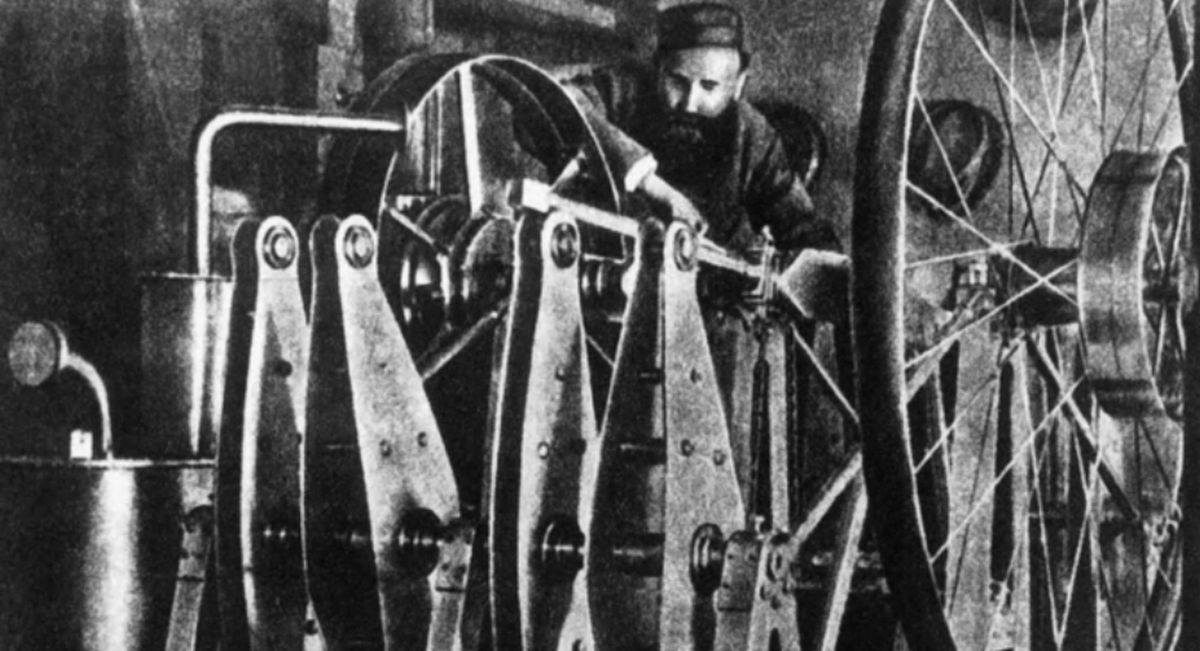
One of the boldest pioneers of Russian and global aeronautics and the creator of the gasoline internal combustion engine was the Serbian Ognjeslav (Ignatiy) Kostović (1851–1916). Although he did not live to see his plans fully realized, Kostović’s ideas were kept as a top secret in the USSR for many decades after his death…
Today, Russia’s global achievements in aircraft and helicopter design are widely recognized. The foundations of this field were laid in the late 19th and early 20th centuries by renowned scientists such as Igor Sikorsky, Alexander Mozhaysky, and Nikolai Zhukovsky. However, few people know that among the early Russian aircraft designers was a Serbian, Ignatiy Stepanovich Kostović (formerly Ognjeslav Kostović, before acquiring Russian citizenship), who significantly influenced the development of Russian—and consequently global—aviation.
Kostović was born in 1851 in the Austrian town of Wiesenburg. He lived and worked in Pest, where he received a technical education. For some time, he served as the captain of a steam tugboat on the Danube. When the Russo-Turkish War broke out in 1877, the Hungarian authorities ordered him to transport the steamboat Ada along the Danube to Russian army positions and then return to Pest. Kostović nearly completed his mission—except he never returned to Pest.
Under his command, the Ada transported Russian troops across the Danube, and Kostović was awarded the rank of captain in the Russian fleet. He is attributed with the words: “I am a Slav, and for the mother of all Slavs, Russia, I am ready to lay down my life!”—his response when a Russian military representative asked him to remain as the captain of the Ada.
During the war, he was wounded but continued working on his first project even while in the hospital. He designed a “fish-boat” for eight people, capable of staying submerged for about 20 hours. In October 1878, he appealed to Russian Emperor Alexander II to become a Russian citizen, and soon after, he moved to Russia.
His fish-boat project (essentially a submarine prototype) was reviewed by the Naval Technical Committee’s scientific department in November 1878 but was criticized primarily due to its lack of a sufficiently powerful engine to propel the boat at the necessary speed.
This critique motivated Kostović to study the existing engines of the time seriously. He happened to attend a lecture by the great Russian chemist Dmitry Mendeleev on designing a stratospheric balloon with a hermetically sealed cabin and an airship with balloons filled with compressed air.
From that moment, Kostović became passionately devoted to the idea of flight. By 1879, at a meeting of the First Russian Society of Aeronauts, he presented his airship project. The most striking feature of this original design was the gasoline internal combustion engine with electric ignition. At that time, such engines did not yet exist.
In his design, Kostović was the first to apply not only the idea of electric ignition but also a configuration with opposed piston movement in oppositely placed cylinders. It is worth noting that gasoline was primarily used at the time as a household cleaning agent for removing grease stains from clothes. Kostović’s idea was supported by the Society of Aeronauts, which founded the Association for the Construction of the Airship ‘Russia’. Private investments of 200,000 rubles were collected, and the Ministry of War allocated an additional 35,000 rubles for the airship’s construction (for comparison, the average annual wage of a worker in Russia in 1879 was 189 rubles).
Construction of the airship began in 1882 in St. Petersburg. The engine built for it, completed two years later, had a power output of 80 horsepower. The plan was for the airship’s structural components to be made of “arborite” (plywood soaked in a special type of resin), a material Kostović himself developed. It is notable that 30 years later, Igor Sikorsky used a similar material in the construction of his famous Ilya Muromets aircraft.

By 1888, the airship was nearly completed, but final assembly was hindered by a lack of funds. Kostović again appealed to the Ministry of War for assistance, offering to sell the unfinished airship to the military. However, his proposal was rejected due to additional costs. In his report, the chairman of the Aviation Commission, Lieutenant General Mikhail Boreskov, warned Engineer General Konstantin Zverev that “merely testing this unfinished construction would cost over half a million rubles.” More importantly, the effectiveness of such airships for military purposes was called into question.
Thus, Kostović’s project ended in failure. However, just ten years later, the world’s first airship with an internal combustion engine took flight in Germany. During the Soviet era, rumors circulated that the Germans had somehow learned details of Kostović’s engine, though no concrete evidence has ever been provided.
PROČITAJTE VIŠE:
Nevertheless, it is worth noting that at that time, many Germans were involved in state and scientific circles in Russia, and the main components for Kostović’s engine were manufactured in Germany.
Despite the setback with the Russia airship, Kostović did not lose heart and remained in Russia. As early as the 1880s, he opened the Arborite factory near St. Petersburg, producing his multilayer plywood. He married in St. Petersburg and had three daughters. Even in Russia, he did not forget Serbian traditions and celebrated slava (the feast of Saint Nicholas) every year. Among his guests was Dmitry Mendeleev.
Ognjeslav continued to pursue his ideas. Among other projects, he worked on the designs of several airplanes, and in 1911, he received an exclusive privilege (patent) for two aircraft projects: a land-based triplane (three-winged aircraft) and an aero-hydroplane.
His final project was the Aviata Russiyu, a two-seater monoplane. However, this aircraft also remained unfinished, as Ognjeslav passed away that same year in St. Petersburg, where he was buried.
Although it might appear otherwise at first glance, Kostović’s failures do not mean that the military leadership of Imperial Russia was indifferent to his ideas. Significant financial resources were allocated to his projects, and the discontinuation of work on them was due to various factors—war, unforeseen cost increases, possible loss of confidence in Kostović by the military authorities, and many other unknown reasons.

Regardless, none of Ognjeslav Kostović’s inventions were completed and put into practical use during his lifetime. However, he was the creator of one of the first high-powered gasoline engines, specifically designed for airships. And despite his failure to realize his aircraft project in Imperial Russia, Kostović’s engine was considered a valuable invention and remained classified as a secret from 1880 onwards. Its confidential status was not lifted even after the establishment of Soviet rule, and the motor’s design only became publicly available in 1947!
This fact alone highlights the significance attributed to Kostović’s inventions in both Russia and the USSR. Many of his ideas were realized in the following decades. In any case, it can be said that Ognjeslav Kostović made an invaluable contribution to aircraft design, both in Russia and on a global scale.
MORE TOPICS:
TRUMP ISSUED ULTIMATUM TO EUROPE: Three weeks to agree on the terms of Ukraine’s surrender!
“THIS IS A SIGN THAT I AM ON THE RIGHT TRACK”: Tamara won 2 gold and one bronze medal in Singapore!
Source: Russia Beyond Foto: Wikimedia Commons
 Add Serbian Times as your Google source