




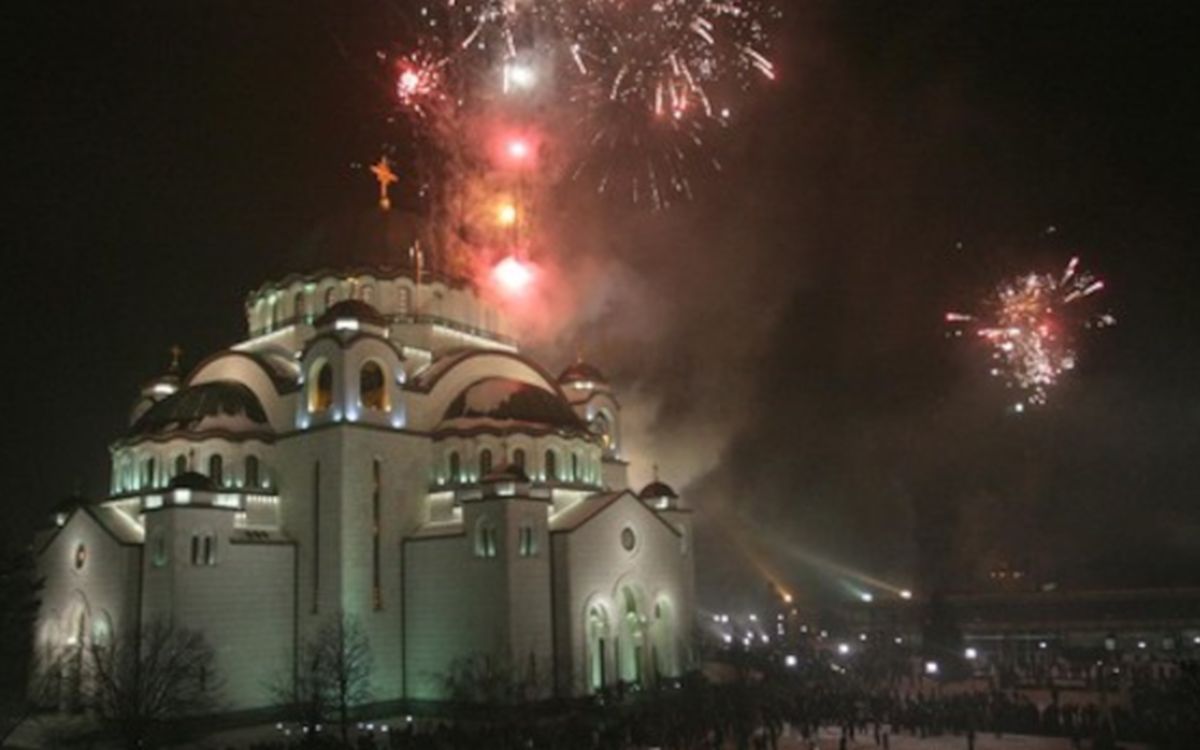
The New Year according to the Julian calendar is being celebrated solemnly tonight throughout Serbia – in squares, restaurants, and many citizens will celebrate in their homes, surrounded by family. The city of Belgrade is organizing a festive New Year’s Eve celebration on Republic Square, as part of the “Belgrade Winter” event.
The Julian New Year is a holiday celebrated on January 13/14 according to the Gregorian calendar every year. On that date, it is January 1st according to the Julian calendar.
Although the established name in Serbia is Serbian New Year, in different parts of Europe it is known as Julian, Old, or Orthodox New Year.
Although it is not the official New Year, it is celebrated in Serbia, Bosnia and Herzegovina, Republic of Srpska, Montenegro, North Macedonia, and Orthodox parts of Croatia.
It is also celebrated by the Orthodox population in Russia, Belarus, Ukraine, Armenia, Georgia, and Moldova.
The tradition of celebrating the Julian New Year also exists in some German cantons in Switzerland, as well as in some parts of the Gaelic community in Scotland.
When did Serbs start celebrating the New Year?
The exact date when Serbs started celebrating the Julian New Year cannot be determined, but this holiday gained significance after the First, and especially after the Second World War.
Although it was not officially banned, during the communist regime, there were no organized public celebrations, nor celebrations in restaurants and cafes.
The discrepancy between the two New Years occurred due to the reform of the Julian calendar and the creation of the Gregorian calendar in 1582.
Despite the long-standing resistance of predominantly Orthodox countries, the Kingdom of Serbs, Croats, and Slovenes equated the two calendars in 1919, but the Serbian Orthodox Church did not.
Although it is now happily celebrated in city squares and catering establishments, the Serbian New Year, unlike the other one, is not a state holiday or a non-working day.
Customs observed on this holiday
The Orthodox New Year is also called Little Christmas, and it coincides with the church holidays of the Circumcision of the Lord Jesus Christ and the patron saint day of St. Basil the Great.
On that day, the head of the Christmas roast is eaten, which is most often the head of a lamb or pig, and the hostesses bake a New Year’s loaf, “vasilica”.
The church sees out the old and welcomes the new year in a spiritual way, with prayers and services, but also blesses all decent celebrations, reminding us that this significant holiday is marked in many church homes.
On that day, in some parts of Serbia, the remains of the Yule log are burned, and in addition to “vasilica”, they also bake doughnuts, in which, like for Christmas, a coin is placed.
It is also believed that, in addition to a rich table, a new thing should be brought into the house on this day, bought that day, so that the house and its inhabitants have progress throughout the year.
MORE TOPICS:
Source: RTS, Photo: RTS