




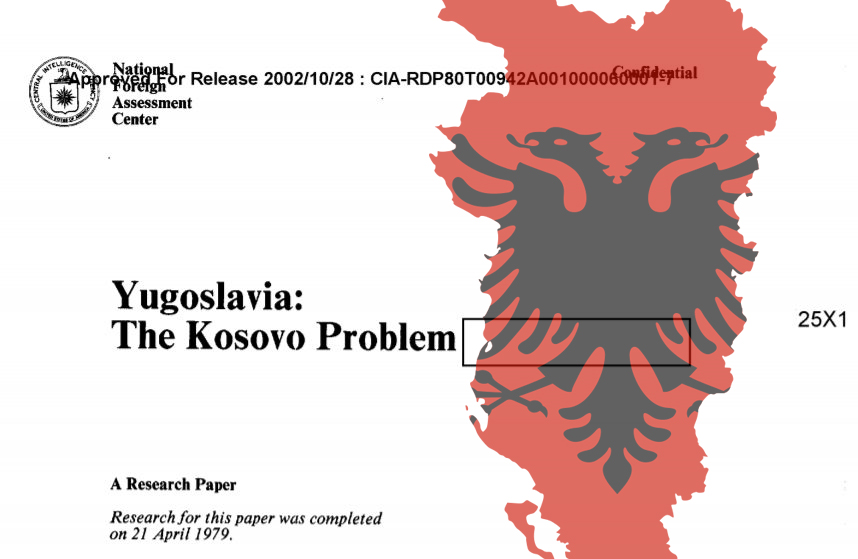
In documents recently declassified for the public, the United States Central Intelligence Agency (CIA) analyzed as early as the late 1970s the established Albanian policy of Kosovo’s secession, the brutal methods of Aleksandar Leka Ranković, and the idea of an Albanian republic within Yugoslavia, which evolved into a “natural and lasting goal” of uniting into “Greater Albania”.
In April 1979, the CIA analyzed Yugoslavia’s “Kosovo question”. In the document “RDP80T00942A001000060001-7“, published on the agency’s official website and titled “Yugoslavia: The Kosovo Problem,” the American agency identified the roots of the Serbian-Albanian problem and its implications for the future of Kosovo in post-Tito Yugoslavia.
The CIA analysis begins with the thesis that although Serbian-Croatian rivalry is the main one in Yugoslavia, the Serbian-Albanian rivalry is developing in the background, and it will have “an equally important impact on how Belgrade will cope with the problem of national minorities.”
The report states that, despite Serbian efforts to sway the Albanians with concessions such as increased autonomy and economic aid, Albanian nationalism is strengthening due to the increasingly weak Kosovo economy.
“The regime of Enver Hoxha in neighboring Albania views Kosovo as an entity under temporary Yugoslav control… Although there is no evidence of foreign subversive activities in Kosovo, the situation is already prepared for foreign interference. This is especially true, as the problem of the Albanian minority in Yugoslav Macedonia can destabilize the region to which Bulgaria has territorial claims,” the report states.
The CIA points out that one million Yugoslav Albanians constitute the poorest group in the country. At the same time, this group has the highest birth rate and illiteracy rate, which makes Albanians particularly attached to the land.
“A hard line of Albanian nationalism has developed among them, aimed at overcoming the effects of former Serbian rule, and is based on unrealistic expectations of economic benefits… The presence of an independent Albanian homeland within the borders of Kosovo adds a foreign dimension to the problem,” the analysis states.
HISTORICAL ENMITY
The CIA analysis also examines the problem’s historical roots. It mentions Serbs’ deep cultural, historical, and spiritual connection with Kosovo, which is the foundation of “Old Serbia” and the home of the first Patriarchate of Peć. The importance of the Battle of Kosovo in 1389 is emphasized.
On the other hand, CIA agents were aware of the Albanians’ claim to be direct descendants of the ancient Illyrians, making them autochthonous to the Balkans. At the same time, the Slavs would be an invasive element.
The report also notes that Josip Broz Tito had severe problems with the Albanians in southern Serbia.

BELGRADE’S RESPONSE
“For example, in 1944, Tito’s partisans fought against a native Albanian army that wanted to establish control over the region. Albanian hostility, always just below the surface, erupted again in the 1960s when Aleksandar Ranković, a Serbian nationalist, Tito’s confidant, and overseer of the Secret Police, lost power. Ranković played a key role in often brutal repressive measures against Albanians, and his departure created hope that the door would open to political and social change.”
The 1968 protest by Albanians is mentioned, in which they clearly demanded the fulfillment of seven conditions: the end of the “Serbian colonization of Kosovo; autonomy; the right to self-determination; the right to a special constitution for Kosovo; the creation of an Albanian republic within the Yugoslav federative structure; the creation of an Albanian university not dominated by Serbs; and the right to fly the Albanian flag.
After the 1968 demonstrations, the Albanians once again raised the issue of the republican status of Kosovo.
“In December 1974, unrest broke out again, concentrated around the University of Priština. Hundreds were arrested, and many ended up in prison on charges ranging from distributing Albanian nationalist pamphlets to writing nationalist slogans at the university, some of which called for the creation of “Greater Albania”.
THE MUSLIM FACTOR
The American intelligence agency’s analysis also highlights the problem of the religious factor, which, given the “repression of 3.8 million Muslims living in Yugoslavia and the global awakening of Islam,” could create a severe problem for Belgrade.
According to official data, in 1979, around 1.3 million Albanian and Turkish Kosovars lived in Kosovo, which constituted about 85% of the province’s total population. Another 350,000 Albanians lived in Macedonia, and an additional 1.7 million Slavic Muslims lived in Bosnia and Herzegovina. The report states that these Muslim groups are separated by “geography, race, and (in the case of Bosnia and Herzegovina) adherence to a feudal Muslim culture that is not present among the Albanian and Turkish elements.”
“For example, blood feuds and the sale of brides are common in Kosovo, while they have long disappeared among Slavic Muslims,” the document states.
The CIA predicts that, in the event of an Albanian uprising in Kosovo, there would be a division into two streams – a religious one, which would turn to Libya, Iraq, and Kuwait, where religious preachers are educated, and a nationalist one, which would be inclined towards Tirana.

POVERTY AND IMPATIENCE
The CIA advocated that Belgrade must launch an effective economic program to reduce poverty in Kosovo and thereby calm nationalist spirits.
The demographic boom of Albanians in Kosovo also created problems in integrating Kosovo into the Yugoslav economy. The report estimates that Kosovo will never become part of the Yugoslav economic “mainstream” and that the situation is, therefore, ideal for foreign interference, implicating the moves of the government in Tirana and its winning over of Albanian nationalists for its own goals.
Despite assurances that he does not plan to intervene in Yugoslavia’s internal affairs, the Albanian leader Enver Hoxhahas always viewed Kosovo as territory under temporary Yugoslav control and has simultaneously openly positioned himself as the “protector of the Albanian minority in Yugoslavia”, the CIA report emphasizes.
However, the report implies that Albania, which is economically more backward than Kosovo, is trying to gain the respect of Kosovars through nationalism.
“In an unusual conversation with a Western diplomat, Albanian Foreign Minister Nesti Nase suggested that the ‘natural and lasting’ goal was the unification of all Albanians into one state,” the document states.
“Nashe’s comments may indicate that Tirana plans to exploit the post-Tito era – if Yugoslavia disintegrates – to achieve the goal of forming Greater Albania. Such an idea appeals to Kosovars, not only because of their nationality, but also because no matter how backward they are in Yugoslavia, in Greater Albania they would be advanced,” the CIA report concludes.
FIND OUT MORE:
AMERICANS THANK SERBS FOR HURRICANE RELIEF: ‘You’re doing what our government can’t!’”
Author: Novak Lukovac
Photo: CIA